While practically 90% of the Canadian disco out there seemed to come out of Montreal, this (along with Denise McCann and Bryan Adams' first single) seem to be among the few that I've found to come out of Vancouver..
Produced by Brian Griffiths for Griffiths Gibson Productions, a company which was (and still remains today, as Griffiths Gibson & Ramsay Productions/GGRP) one of the top commercial music production (read: commerical jingles) services in Vancouver, the album was also recorded at their facilities, Vancouver's Little Mountain Studios. Having hosted acts like Bon Jovi, Aerosmith, AC/DC, Mötley Crüe and The Cult among others, it was reportedly one of the pinnacle recording destinations in Western Canada in it's day. Perhaps as a result of the connections, the album's credits end up reading like a veritable laundry-list of notable Vancouver musicans of the time. Among them are drummer Jim Vallance, Peter Bjerring, Howie Vickers, Guitarist David Sinclair, Bob Buckley on Keyboards, along with mixdown engineers Bob Rock and Vancouver punk scene veteran Ron Obvious to name most of them.
Out of all of them, Vallance and Rock are perhaps the most eminent. Vallance, who along with Peter Bjerring had been involved with Canadian arena rock band Prism and it's predecessor Sunshyne, would become one of Bryan Adams' major collaborators, co-writing many of his hits as well as writing for acts like Aerosmith, Ozzy Osbourne, Joan Jett among others.
Bob Rock, then a staffer at Little Mountain would later have a sizeable hit in Canada with his own group, The Payola$ and their single "Eyes Of A Stranger." Rock has gone on to become a superproducer of sorts, having produced for acts ranging from Metallica and Aerosmith to Cher and Michael Bublé..
Of the other names, Howie Vickers, who has writing credits on three of the album's six tracks, was the lead singer for a group called The Collectors, and essentially served as the pre-cursor to Canadian rock mainstays, Chilliwack.. While aside from being well-travelled session players in their own right, guitarist David Sinclair (Sarah McLachlan, k.d. lang) and keyboardist Bob Buckley (Our Lady Peace, Celine Dion) would form a duo in the 80's called Straight Lines and would go on to be part of the group Body Electric.
That's of course not to disregard the singers, Nancy Nash, Mary Saxton and Rosalind Keene, who end up cutting a flawless, radiant (albeit anonymous) harmony on the record. Perhaps as a way of diminishing some of the project's anonymity, all three are actually credited as being Touché, themselves. While all three seemed to be regular session singers, at least two of them have some notabilty attached to their names.. Mary Saxton has at least a couple of albums and some singles to her name, some of which have become rather highly regardedin the NorthernSoul scene. One of her albums, entitled "Sad Eyes" (1969, Birchmount) has become particularly sought after, having fetched some fairly high prices online recently. Given it's apparent rarity, someone had recently taken the liberty of putting the audio of her entire "Sad Eyes" LP up on Google Video, for anyone whose curious.
Nancy Nash, aside from having some of the highest profile session work of the three, had also released a couple of albums, including a little known AOR-type album in the early 80's entitled "Letting Go" (1982, Avalon/Polygram). Later, having adopted the Aboriginal name Sazacha Red Sky, Nash had continued to record, with one of her songs garnering a (slightly controversial, it seems) Juno Award nomination in 1994.
Although there's less information about Rosalind Keene and her credits, she, like Nash and Saxton, is apparently stillactive today, performing regularly in and around the Vancouver area..
Although Nash, Saxton and Keene are credited as being the group itself, after looking them up, they're obviously not the same ladies on the album's cover (which the credit on the back seemed to imply), that being said, the intensity of the album's black and blood-red artwork & photography is one of the record's most obvious distinguishing features. Designed by graphic artist Hugh Syme (best known for being the artist behind Rush's distinctive album covers) and photographed by Michael Gray (who recently left some commments, below), whose work had been seen on a number of album covers at the time, including at least several other disco projects, most prominently: L.A.X.'s "Under Cover Lover" (1979, Attic), the first Lime album, Alan Hawkshaw's Rendezvous (1979, Attic) LP and CBS Canada's "legs" disco sleeve. In his comments below, Gray re-confirmed that the cover girls weren't the actual singers themselves, but in fact three anonymous Toronto area strippers.
Can-Con trivia aside, despite the strong rock connections, the album itself ends up being a pleasantly slick, sexy sublime disco production. With the light rock-ish guitars, sax solos and gliding strings that underscore most of the tracks, the album is perhaps more of an atmospheric combination of soft-rock and disco than a high tempo, bass and percussion driven disco groove..
The best illustration of that would likely be the opening track "Warm Storm Of Love." Arranged by Jim Vallance and written by producer Brian Griffiths and Howie Vickers; anchored by a heavy guitar refrain in the intro, elevated by the singers' airy harmonies and surrounded by a gusty string section, "Storm.." makes for a dramatic first impression. A perfectly appropriate opening, the almost gentle intensity of the vocals mixed with the stark backing ends up making it the perfect compiment to the album's artwork.
The second track, and only non-original on the album, "Dancing In The Dark," a cover of the Schwartz/Dietz standard arranged by keyboard player Bob Buckley, ends up bringing a little more levity to the proceedings. Anchored by a sexy, nocturnal sax solo and some genteel string and vocal arrangements, they manage to turn out an excellent cover, at the very least convincingly turning an old standard into a misty nighttime disco fantasy..
That said however, I'd consider the next three tracks to be the ultimate highlights of the album. Starting with the Side A closer, "Nightrider," arranged by Bob Buckley and written by Buckley and Vickers, this track ends up taking the tempo up a little bit from the previous selections. Opening with a driving guitar, leading into a more spacious mix putting extra emphasis on the beat and the percussion, it's perhaps the closest thing on the album to a bona-fide disco stomper.
The album's second major highlight would have to be the Side B opener (and the album's single), "Take A Look (But Don't Touch)" arranged by Peter Bjerring and written by Brian Gibson. A smouldering disco teaser with Mary Saxton apparently on lead, it's got to be the sexiest track on the album, not just because of the vocals or the swelling strings that underscore them, but mostly because of the lyrics. With it's soft, subdued vocals and the words painting a sensual lyrical ode to dancefloor surrender, it's probably the best song on the record, lyrically speaking. Musically, I'd single out the string refrain after the chorus, interspersed with the little guitar fill-in as a moment of brilliance in itself..
The third of the three major highlights would have to be "Love Eyes." A sublime, guitar driven disco track, written by Vickers and arranged by guitarist David Sinclair; with it's tempo and sweet string arrangement augmented by the great, albeit brief break in the middle, this song ultimately marks the album's breezy, uplifting culmination.
After that, the album concludes with an instrumental track, "One Day," written and arranged by Bob Buckley. Naturally featuring Buckley's synth work, he manages to get into some pretty great spacey synths solos at a couple of points in the track. Given album producer Brian Griffiths and his company's background in commercial jingles and themes, it's probably no accident that this track ends up reminding me of something that could have been used in a late 70's TV commercial..
Looking at Griffiths Gibson & Ramsay Productions/GGRP's website, the only mention of this album is a rather dismissive reference in their 'History' page, which makes it sounds like a cash-in that they would much rather forget about. And while perhaps the cash-in part of it might have been true, for a bunch of rock guys whom I'd imagine would have sooner divorced themselves from an album like this if given the chance; they actually managed to come up with a pretty solid, albeit slick (they are a commercial production company, after all) set of disco tracks. While the rock-influenced disco sound seemed to have been gaining some steam around this time, the rock influence on this album is less about energy and tempo and spashing loud guitars everywhere, as much it is about mood. Complimenting rather than overpowering the disco elements, personally, I think this is too good of a record to be left as some rock musicians' dirty little disco secret..
As far as Space Disco goes, this one has to be one of my best and most recent acquisitions in the genre. A couple of instrumentals written by the same guys behind Ottawan's "D.I.S.C.O." of all things, Jean Kluger and Daniel Vangarde (whose probably more well-known these days for being the father of Daft Punk's Thomas Bangalter) and with production credited to Ralph Benatar, and Mike Butcher; despite it's apparent obscurity, this Starbow single had some rather notable, prolific names attached.. Benatar, along with Kluger had been behind notable projects/acts like Black Blood (which also invoved Vangarde), L.A.X. and the one-off disco classic "Do You Speak French?" by Nite School, while co-producer Mike Butcher was not only a frequently credited engineer on a good number of Jean Kluger productions, but at one point had evidently produced Black Sabbath, of all things (just in case anyone out there's searching for an Ozzy Osbourne disco connection).
With it's heavy bass drums and guitars, the kaleidoscopic layers of deep, eerie synths (especially that jagged, hypnotic intro); of the two tracks, the A-side "Intersidereal Message" (special disco edit by Patrick Jenkins) probably hits the hardest. That being said, the B-side, "Voyager II" would have to be my pick. With the guitars and drums given a slightly more prominent place, that along with the sublime synth work, it ends up cutting a slightly easier groove than the heavier A-side.. These days, "Voyager II" is perhaps the slightly better known of the two, as a result of being included on Dirty Sound System's "Dirty Space Disco" (2007, Tigersushi) compilation..
Not completely sure if this Starbow project was simply another one-off, but it certainly looks that way. Given how excellent these tracks are, it's too bad they don't seem to have been expanded on further in LP form.. As they are though, the two sides on this single, both of them with their darkly ethereal grooves would have to be prime examples of the Space Disco subgenre.
Having nearly upstaged Obama at his own inauguration not so much with her performance, but with her rather spectacular church lady crown, I was suddenly inspired to take a listen to Her Soulful Highness's much maligned 1979 'disco' album, "La Diva." After signing with Atlantic and subsequently going from strength to strength in the late 60's and early 70's; not unlike some of her contemporaries, the mid/late 70's and the onslaught of disco found Aretha in a commercial slump of sorts (the Sparkle soundtrack with Curtis Mayfield being a notable exception). Having the dubious distinction of being one of her most, if not the most ill-received album she's ever released, "La Diva" was the first of her Atlantic studio albums to miss the Billboard top 100 altogether, and to this day, with barely any critics out there having anything good to say about it, it has ultimately gone down as one of the undisputed low-points in her career.
During this time, her classic hits behind her and with her mentor, the late Jerry Wexler gone from the label, none of the changes in direction that she embarked on seemed to stick. While "Sparkle" (1976, Atlantic) was a bright spot, its follow-up with Mayfield, "Almighty Fire" (1978, Atlantic) failed to sustain any of it's momentum. In her autobiography with David Ritz, "From These Roots," Aretha briefly touched on this period, saying: "my records were falling short of the mark for gold. I began to feel that the label's promotion and marketing were not creative enough and wondered whether a change was in order." Not too surprisingly, "La Diva" would be the last album she would do for them before jumping ship to Arista.
While her career context wasn't exactly rosy, the run-up to this album's recording sessions and eventual release seemed to be fairly turbulent in itself. A quick glance at the album's thank-yous, with Ahmet Ertegun's assistant and executive vice president Noreen Woods credited for "being a swellegant mediator in getting the LP out" along with a special thanks to "all musicians and singers, Marvin Gaye and George Benson, and numerous other artists whose LP's I enjoyed through numerous delays while waiting to finish mine" seemed to reveal as much. Biographer Mark Bego in his book "Aretha Franklin: The Queen of Soul" suggests a disco album from the Queen of Soul was apparently highly anticipated at the time, calling it "a logical move..an assured bet that Aretha could go into the studio to create the hottest disco record of the year." Given that, I'd imagine that it was Atlantic's suggestion to usher in this change of direction by pairing her with a couple of the label's hottest producers at the time, Chic's Nile Rodgers & Bernard Edwards.
Aretha claimed in her autobiography that the proposed Chic collaboration had gone into the actual pre-production stage, claiming that she'd originally been given the two tracks which would later helm Diana Ross' "Diana" (1980, Motown) album. Although as far as Nile and Bernard go, The Queen, it appears, was not impressed.
"I liked some disco and thought that certain singers - Donna Summer, Gloria Gaynor - were well suited to the style. Later during the disco era, I met with Nile Rodgers and Bernard Edwards, whose group, Chic, was burning up the charts. They presented me with material that I liked. Good songs, in-the-pocket grooves, and cute lyrics. But when preproduction started, things cooled off in a hurry. Their idea for me was 'just come in and sing impromptu and we'll take it from there.' Well, I hadn't worked that way. I'm an interpreter, and I need to be involved with the total musical environment. I was game, but my relationship with Rodgers and Edwards ended before it even began. There were unmentionables concerning their attitudes, which just didn't fly with me. They took those songs - "Upside Down" and "I'm Coming Out" - to Diana Ross. I had no regrets." (pgs 160-1)
To supplement Aretha's recollections, Nile Rodgers related his own in Daryl Easlea's book "Chic & The Politics of Disco," which at least on the surface, seem to counter Aretha's recollections somewhat.
"'We never wrote anything for her,' Rodgers remembered. 'We had one meeting with her and we were so turned off, we couldn't believe Aretha wanted to do disco.'..... 'We were not going to go down in history as the producers of Aretha Franklin's disco record! In the end she went with Van McCoy - we were shocked he would do it - but then, he did write "Do The Hustle" which IS a disco record. I thought of her history and we certainly weren't going to produce her. That was the only time that we ever met her.' " (pgs 190-1)
Van and Charles in the studio
with Aretha and her Kools
(picture from vanmccoymusic.com)
Whatever the case, we obviously didn't get a Chic produced Aretha album (and perhaps for good reason, looking at their comments). The album we did end up with however, produced largely by the late Van McCoy (whose songs Aretha had recorded in the past) and his right-hand man Charles Kipps, with the exception of two tracks (one produced by Aretha and one by Skip Scarborough) was largely a collection of lightly treaded disco fluff and drippy ballads, broken by the occasional soul-funk throw-down as 'Ree herself might put it. Putting it frankly, it probably wouldn't be anyone's idea of a classic, especially in the shadow of her earlier and truly classical, enduring Atlantic albums. Whether it be because of my own disco attachments, being somewhat removed from the time and not nearly as steeped in her 'Queen of Soul' mythology to have taken this seriously enough, or me just being my usual contrary self, I've honestly never found this album to be anywhere near as horrendous and awful as it's been made out to be. While I can understand critics not rating this favourably, I've always been surprised at just how many make it seem like "La Diva" was the absolute worst record of her entire career. However, having heard the albums she did in the late 80's and early 90's for Arista, I'd honestly be hard-pressed to put any of her Atlantic LPs (even less well recieved albums like this one) in that category..
The disco portion of the album was helmed by two of Aretha's own self-penned efforts, "Ladies Only" and "Only Star," (which began Side One and Two, respectively) - a couple of slick, pleasantly produced and orchestrated disco-lite numbers. Both produced by McCoy and Kipps, I'd venture a guess to say it was probably these songs which led Rolling Stone to deride the album as "over orchestrated pap." Given that they were the most obvious disco tracks on the record, in the end they probably ended up missing the mark somewhat. Despite their redeeming qualities - the rich melodic orchestration and the enthusiasm in Aretha's performances, they were perhaps lacking in the sort of groove or energy to have seriously competed with the sort of disco that was lighting up the dancefloors at that period in time. In fact, out of the two of them, "Ladies Only" (an attempt, it seems, at a "Last Dance" knockoff) was released as a single (peaking at #33 Billboard R&B) and yet as far as I know, had no 12'' remix or release for that matter, which is probably saying something in itself.
YouTube has a live performance of "Ladies Only," from an appearance on the Mike Douglas Show (which is now available in full), backed with a rather Vegasy arrangement, which only serves to emphasize the overorchestrated pappiness of the whole thing. Though, still, delivered with an impressive vocal from the lady herself, whose wearing the full outfit from the album cover, no less (note the flower fall at 1.45).
While they are pleasant enough melodically speaking, lyrically however, I'd have to admit that they sound like precisely the sort of thing one would expect from a disco amateur scraping for ideas. Which is to say, overly self-conscious, formulaic and entirely lacking in any clever lyrical subtlety; as if a disco song had to use the words 'party' and 'disco' at least half a dozen times, mention both "The Rock," and "The Freak," and at some point in the song declare one's self a 'disco queen' to even qualify.
Boogie down with Ree!
"Only Star" on Side Two would probably be considered the worst offender. A slightly narcissistic lyric, with the verse "I'm gonna be the only star tonight at the disco" heading up the chorus; the background singers (which in the general credits included notables like sister Carolyn Franklin, Zulema Cusseaux and her former group Faith, Hope & Charity along with future one-shot disco singer, Sharon Brown) had the dubious honour of reciting the song's unforgettable spoken section: "We're disco queens, you know what that means? We're disco queens!.. Sophisticated, magnifique, we get down with the rock and you've got to see us freak!" which is complimented by a bit of clumsy Spanish that's even a bit more embarrassing than the French in "Ladies Only." To top it all off, Aretha follows that by bellowing out her own intentions: 'I'm gon' BOOGIE DOWN! BOOOOGIE DOWN!.." which in itself was probably enough to make legions of unsuspecting rock critics cringe in the sheer abject horror of it all.
Nile Rodgers has a particularly hilarious anecdote about this song in his recollection of his and Bernard's meeting with 'The Queen,' also from "Chic & The Politics of Disco," which I thought was well worth citing here:
"Bernard and I were sitting in the Queen of Soul's house, this beautiful mansion in Los Angeles and she was singing 'I'm going to be the only star tonight down at the disco.' And Bernard and I were looking at each other in disbelief, thinking 'holy shit! We're with Aretha Franklin and she's telling us she's going to be the only star in the disco tonight...Is she nuts?' We were stunned and dumbfounded. We were sitting at the piano with her and we couldn't say anything. If we told her that was great, she would say 'are you kidding me, you want me to sing some shit like this?' We didn't know if it [was] a joke." (pgs. 190-1)
As is sometimes the case with ill-reputed albums like these, I'm usually able to come away enjoying something, in spite of everything. This one is no different (so much for good taste, I suppose). All criticisms aside (because really, it's just way too easy), I must admit that I actually enjoy these tracks to bits, in spite (or perhaps because) of their faults. There's something about Aretha talking about getting herself another fashion faux-pas, or in her words: "a dress with the fringes flyin' high" (referring to that low-cut yellow leather get-up she's wearing on the cover, I'd imagine), threatening to show everyone up at the disco and "do it up right tonight..and then some," or Aretha in her inimitable French, asking her ladies to "party down, s'il vous plait"in "Ladies Only," that while perhaps awkward and slightly delusional, is to me, much more unpretentiously endearing than anything else. While I suspect these songs might have cleared a dancefloor in record time in 1979; given some of these songs' limitations; Van McCoy's and Charles Kipps' production values, trendy or not, really did seem to make the most of these two tracks, at least to my ears. The slow-building intro to "Ladies Only" ends up showing off her voice in its full splendour while Arthur Jenkins' arrangements on "Ladies Only" create a backing that is as warm and inviting as her infectious performance. And really, being Aretha's own compositions, while in this case lacking in the lyrical department, they never really fail as far as their chords and melodies are concerned.
One track however, that needs no criticism or defense is the album's second track, "It's Gonna Get A Bit Better," one of the songs which has been unjustly buried beneath this album's reputation. Written by the late Lalomie Washburn, who had worked with Rufus & Chaka Khan (and had done a stellar album of her own for Casablanca's Parachute imprint), and arranged by Richard Gibbs, the orchestration ends up taking a backseat to the groove on this one. With it's simple, uplifting "try dancin'" refrain, lyrically it manages to pay tribute to disco with much more grace and verve than either of Aretha's disco contributions. Musically, with the Queen's vocals on fire and the track's scratchy guitars and in-the-pocket basslines, it's one of the funkiest tunes on the record and one of the album's ultimate highlights. Aretha wouldn't rock a groove this tight until hooking up with Luther Vandross for "Jump To It" some three years later.
While her disco tracks weren't the best showcase for her songwriting, Aretha's finest contribution here as a songwriter is without a doubt, the rousing, gospel-tinged "Honey I Need Your Love." A brief return to classic Aretha territory, not only written, but also produced by Aretha herself; the song showcases the lady at her finest - at the piano, singing - or rather, sangin' her butt off.. Musically, with its piano driven intro and build-up, it also ends up sounding like her reply to Natalie Cole's rather Aretha-esque breakout hit, "This Will Be." Perhaps a reply not only to that but to certain segments of the press who had reportedly taken to calling Natalie "the next Aretha," which given some of her recent declarations, must have had Queen Ree in a righteous regal huff. While Aretha has since dismissed their legendary feud as a bit of press manufactured publicity (partly encouraged by Natalie, according to Aretha of course), one still can't help but think of this song as perhaps the Queen Of Soul's way of exercising some of her property rights, so to speak.
Luckily, there's some live TV footage of this song, from an 1979 appearance on The Jack Jones TV Special archived (for now) on YouTube. One of four songs she performs, the lady herself on piano with a full band behind her, she delivers a practically flawless performace.
Another one of the album's high points is the only other track not produced by McCoy & Kipps, the second track on Side Two, "Reasons Why." Produced by the late Skip Scarborough (Patti LaBelle, The Emotions, Phyllis Hyman) and written by Scarborough, Wanda Hutchinson of the Emotions and Wayne Vaughn (who had also produced The Emotions and Earth, Wind & Fire), it's a pity there weren't more like this on the album. With a groove held down by a heavy bassline and a killer horn section topped off with some of Aretha's most spirited vocals on the album; it's one of the most assured performances on the record. A standout simply because it's one of the songs on the record that managed to both boldly step her out in a new direction, yet still managed to bring out the best in Aretha.
As far as the album's ballads go, it's there where the drippy, overwrought orchestration really starts to weigh things down. While songs like "I Was Made For You," penned by son Clarence (and performed as a duet with Van McCoy), McCoy's own "You Brought Me Back To Life" and co-producer Charles Kipps' "What If I Should Ever Need You" (recorded not long before by Gladys Knight & The Pips) are decent enough; unfortunately Aretha ends up sounding far too constrained by the maudlin production to really give them the sort of intimacy and feeling that the ballads on her earlier albums had. That said, the best of the bunch would have to be Zulema Cusseaux's contribution as songwriter and arranger, "Half A Love," which allowed her a brief respite from the flowery arrangements into something displaying a bit more attitude and range.
The main flaw with the ballads is highlighted and contrasted perfectly by another awesome live performance (also from Mike Douglas Show) archived on YouTube. A performance of Charles Kipps' "What If I Should Ever Need You," the live arrangement allows Aretha to take it to church as it were, and put her stamp on the song much more effectively than the studio recording on the LP.
Coming full circle, closing the album is another one of the album's straight-to-the-disco tracks, Van McCoy's "The Feeling." The most energetic of the disco tracks on the album, albeit still in the realm of run-of-the-mill disco dross, it's nothing that's exactly mind-blowing or potentially chart-topping. Vocally driven, light on the groove, but heavy on the orchestration, and without being marred by any of Aretha's cliched disco lyrics, they actually do manage to turn out a decent piece of safe, quintessential 'diva disco' on this track.
White not a total write-off; admittedly Aretha's 'disco' album does come off as an ultimately flawed and imperfect release in the end. Despite that however, it does have it's guilty pleasures and shining moments. And it's those bright moments in particular which really show what probably could have been, had circumstances been just a little bit better planned and guided. While no disrespect to McCoy and Kipps intended, perhaps instead of getting them to do practically the entire album, Aretha and co. could have gotten a few other outside producers to contribute and give some balance and perhaps a wider variety of updated musical settings. I'd venture to guess that the album ended up coming off as too far and too desperate of a 'disco' effort for an artist of her stature to really appeal to the general public or a good chunk of her fanbase. By the same token, the record probably sounded too watered down and not seriously disco enough (especially this late in the game) to make an impact on the disco audience either, for that matter. It's honestly one of those records which makes me understand the place of the oft-credited (though noticeably absent from this record) 'disco consultant' on some of the albums of the time.
However, the album as it is, is what it is, after all. And while it's not exactly "Young, Gifted and Black" (1971, Atlantic), thankfully with the calibre of its musicianship and with Aretha's voice in top form, sounding as golden as it ever was; dare I say, it's not nearly as awful and ill-advised as some of the dreck she would later release under the auspices of Clive Davis at Arista, either. Not to tarnish her entire tenure at that label, but for all the negative press on this album, and all the mythology about Davis' golden touch, I'd question whether "La Diva" is seriously any worse than, say 1991's questionably titled "What You See Is What You Sweat," for example (anyone remember that one?). Personally, I think not.
I'd imagine the growing backlash towards disco in the US, and the sheer horror of their beloved Queen Of Soul giving into 'disco fever' at that period in time likely also played a part in this album's reception and the almost fervent disdain that it still seems to inspire. While not exactly a record deserving of a complete re-evaluation and certainly far from the most graceful bid for disco credibility; it's certainly not without its salvageable points, either.
Some Trivia: Notably, "La Diva" along with four of the other records she did in the late 70's for Atlantic are, to date, are some of the only Aretha albums that haven't yet made it to CD. It was revealed in a 2003 interview with David Nathan for Billboard (PDF file link) that upon her departure from the label, Atlantic had actually given her the rights to some those later albums - which included "La Diva," along with "You" (1975), "With Everything I Feel In Me" (1974), "Sweet Passion" (1977) and "Almighty Fire" (1978). Essentially all of her lesser regarded albums for the label and likely the most plausible reason for their continued unavailability.
A little something today that I'd come across on one of my recent record hunting adventures. Written by a one Jean Fortin and Produced by Jerry Cucuzzella (who I'm assuming is a brother or other relation of one time Montreal DJ and Unidisc founder George Cucuzzella) and released on his label, JC Records; without even looking at the credits, this would still be an immediately identifiable Montreal disco track.
Starting right at the beginning with the sort of melodious, somewhat jaunty, galloping synth patterns and sounds typical of a lot of the electronic disco that came out of Montreal at the time; the production on the single is impeccable. The lyrics and vocals however are another story. The Discogs entry for this single has a review by Murderbot describing the vocal as 'appalling'. Although I personally wouldn't go that far, the vocalist herself (who I'm naively assuming is this Kendra girl) actually sounds fairly decent, especially compared to others I've heard before. That being said however, the vocals don't exactly add much to the track itself. Being fair though, that might be in part because the lyrics don't exactly give much to work with either...
Vocals and lyrics aside though, the instrumental on the flip side more than made up for it's limitations. Less of a straight, clean instrumental track, they (wisely) kept the French/English vocodered backing track in the mix, singlehandedly taking this one out of the scrapheap.. Unlike the female vocals on the A side, the bilingual robotic space alien voice on the vocodered instrumental track made the perfect highlight for the synthesized, space disco elements of the track.
With that little revelation, I wanted to see how far I could take things, so I decided to pitch down the instrumental as far as my old Technics would go (which really isn't that far). Keeping the space, but toning down some of the jauntiness, I actually think this turned out a little bit better at a slightly slower tempo.
Curiously, "Helping Myself" also appears as the B-side of the Suzy Q cover of Suzi Lane's "Harmony." Although credited to Suzy Q, I'm not sure if that version is simply an edit of this one, or of it was an actual re-recording. Given that the producer of this track, Jerry Cucuzzella had produced much, if not all of the Suzy Q records, that along with the interchangable and anonymous nature of some of these studio acts, I wouldn't be surprised if it was the former.
A classic case of a track salvaged by it's instrumental, I'd put this as one of my more notable finds lately. Certainly well-representative of the sort of Montreal electro-disco that I've come to appreciate more and more these days.
Released on Philadelphia's ill-fatedWMOT label in the brief period when they were Fantasy's Philly outpost; looking at the credits, Slick, at least on this, their first album, was essentially a studio meeting between members of both Ingram and Fat Larry's Band.
Largely produced by Butch Ingram (AKA Norman 'Butch' Ingram) who had also produced the likes of Philly Cream, Ronnie Dyson, Blue Magic and not to mention Barbara Mason's "Another Man" among other things, this album was something of a family affair with pretty much all of the Ingram brothers in the credits. Aside from Butch as producer and bass player, brothers Jimmy (keys/synths) and Billy (guitars) got the bulk of arrangement credits, along with Timmy Ingram on percussion, John Ingram on drums, as well as sister Barbara and her ubiquitous trio, often known as The Sweethearts of Sigma on background vocals. Along with Fat Larry's Band musicians Anthony Middleton (guitars) and Larry LaBes (bass), 'Fat' Larry James himself along with his wife Doris James also had prominent credits on the album along with one time blue-eyed soul singer Len Barry, best known for his 1965 Motown-esque hit "1-2-3" who was still in the business, albeit mostly behind the scenes by this time.
Personally speaking, I must have been around fifteen the first time I had heard of Slick, back in the days of the original Napster. In the program's search field I would sometimes type in something vague and innocuous like 'disco' or some variant of it, just to see if anything interesting would come up. One of the best tracks I had discovered that way was the second single off of this album, "Sexy Cream." Immediately piquing my curiosity when it came up; with a title like that, I just had to hear it. And I definitely wasn't disappointed when I did. Musically, it had everything I loved - a propulsive beat, deep popping, pounding synthesized bass, augmented by a coloring of strings and hefty horns in particular; it was one of those late disco, high-energy tracks which like nothing else, seamlessly combined traditional instrumentation with tempo and technology.
On top of that of course, were the vocals and lyrics, which made this possibly the naughtiest, borderline x-rated disco track I had heard up until then. Featuring 'Fat' Larry James' wife Doris James on vocals, free of the sort of simulation displayed on tracks like "Love To Love You Baby," the Tee Cees' "Disco Love Bite" or Musique's "Good And Plenty Lover," her breathy, willowy vocals still had an undeniable sexiness to them. If one didn't know better, one might think Andrea True, Marilyn Chambers or some other moonlighting porn actress was behind the vocals, which for a track like this, is the highest compliment I could possibly pay.. With lyrics like "gimme, gimme some of that sexy cream, you know what I mean.." and other lines like "..that sweet sexy stuff, it always blows my mind.. it makes me feel so real.." delivered with a wink and touch of 'give it to me' desperation, the track came across (no pun intended) less like the massage theme they may have originally intended, and more like some kind of debaucherous disco ode to the joys of bukkake instead.
That said, it's perhaps no wonder why "Sexy Cream" was banned in the UK by BBC Radio 1. It was perhaps that which led to it being subtitled 'The Massage Song' on the LP (the subtitle printed only on the label, not on the back cover tracklist curiously enough) in an attempt to perhaps extinguish some of the controversy. While, at least for me, the massage themes in the song became somewhat clearer after getting the LP, it seems more of a not-quite multiplied single entendre than a genuine case of misunderstood intentions. Even if it were, I highly doubt that there are body lotions or massage oils around with the sort of intense mind blowing qualities that Doris James' vocals constantly allude to.. Between the suggestion of the album's cover shot and the sequencing on the album, with "Sexy Cream" followed by "Put Your Pants On" - a brief, sassy lousy lover lament that Vanity 6 could have easily pulled off had they been around, it's context doesn't exactly serve to diminish anyone's first impressions either.
Interestingly, "Sexy Cream" is another one of those cases where the LP version is actually slightly longer than the 12'' version, however, the 12'' mix is much harder-hitting and streamlined. The piano and guitar fill-ins ever present on the LP version, are turned way down on the 12'' making things a little deeper and darker, the sexual intensity of the track coming across much more forcefully, with the synths, drums, strings and horns getting more space in the mix. In a notable west coast connection, both the LP and 12'' versions were mixed by John Hedges and Marty Blecman, both of whom were doing quite a bit of production and mixing for the likes of Sylvester and others on the Fantasy label(s) at the time. Blecman and Hedges would of course would go on to be quite influential with the San Francisco Hi-NRG sound, and the Megatone label in particular.
That aside however, the best known track on the album would have to be the opener, "Space Bass." Written by Doris and Larry James with Len Barry, it's seems obvious that this was the track which helmed the whole Slick project, given that it was not only the first single, but the only track on the album whose credits noticeably differed from the others. While Butch Ingram had produced the rest of the album, the producton on "Space Bass" was credited to a consortium of sorts - Len Barry, Larry James along with WMOT principals Alan Rubens and Steve Bernstein also taking credit.
Musically, it's perhaps one of the most stunning, forward-looking tracks to come out of Philly at this time. A stunning, 7 minute space-age disco odyssey, filled with trumpets and laser beams, backed by a cavalcade of wondrous, swelling strings, and an allmost jazzy bassline that just doesn't quit, I'd imagine it would have been enough to send a number of drug induced disco dancers into a frenzy in it's day. With The Sweethearts on lead vocals (which might make this one of the most futuristic records they ever took part in), Space Bass is, in my opinion, quite possibly one of the best non-library 'space disco' tracks around, having combined an epic, cinematic quality with just the right amount of rhythm, tempo and bass to make it translate on a dancefloor. Surprisingly, despite not charting in the US (at least according to the Billboard Disco Charts book), "Space Bass" was not only a club hit in the UK, but had even become a top 40 pop hit, peaking at #16 in July '79.
As far as the rest of the album goes, nothing else on it quite tops or approaches the excellence of "Space Bass" or "Sexy Cream." The only one which comes close would probably be "Feelin' Good." Opening with an epic intro which gives one the impression that "Space Bass, Pt. 2" was on the horizon, it doesn't quite follow through with the intro quickly giving way to what is, barring Barbara Ingram's great vocal and the break two thirds of the way in, a fairly insubstantial, albeit pleasant disco track.
A saccharine shock after the heavy romp that was Sexy Cream/Put Your Pants On, what doesn't come close in any way whatsoever is the album's closer "The Whole World's Dancin'." A piece of mandolin-laced 'disco is taking over the world' filler fromage, it's the one track on here that's perhaps best forgotten.
There was one more Slick LP which followed this one, entitled "Go For It" (1980, WMOT/Fantasy), where they evidently tried to re-engineer the project as a more conventional female R&B group (which included the late Brandi Wells as a member). Although yielding something of a mellow soul classic in a track called "Sunrise," nothing on there quite had the same impact as the singles off this LP. Filler tracks on this album notwithstanding, the two singles which helmed this record, with their flawless combination of musicianship, rhythmic intensity and technology, rank, at least in my mind, as some of the best examples of the heavier, energetic disco of this time..
Just a note to begin: Halfway through this, I realized that: 1. This album will (finally!) be reissued on CD on the 21st of this month, so I'm only putting up a few of the songs and 2. I had accidentally saved my mp3s in 128 kbps, and didn't back them up (due to #1, since I'd ordinarily burn them to CD), so my apologies to those who care about bit rates and all. Anyway due to all that, this'll be a somewhat limited disco delivery installment, as far as songs go..
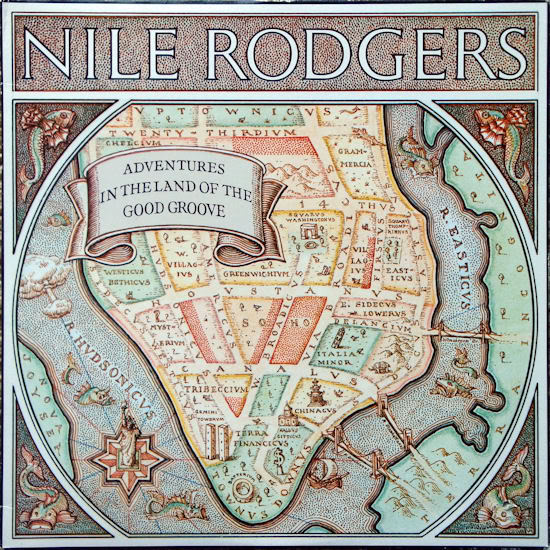
Released between Chic albums in 1983, on former Atlantic Records President Jerry Greenberg's Mirage label, a company which released many a post-disco dance classic in the early 80's; out of all the solo albums that Nile & Bernard did, I'd have to say this one is my absolute favourite. Perhaps because out of all of them, this one's the closest to the Chic sound of the time; after all, aside from Nile of course and notable outside guests like Sarah Dash and Rachel Sweet, Chic colleagues Bernard Edwards and Tony Thompson both appear on the album along with other Chic regulars like Rob Sabino, Raymond Jones and Fonzi Thornton.
That being said however, "..Land Of The Good Groove" is definitely more than just a Chic album under a different name. Aside from the fact that Nile himself took sole writing credit on all of the songs and takes on the bulk of the musical credits, there's a looseness to the groove on here, a playful eclecticism and sense of humour that not only echoes elements of the Chic sound, but drops hints at New Wave, Rock and straight-ahead pop in a way that none of the Chic albums of the time really did.
For one thing, It's probably highly unlikely that Nile himself, or any of them would have been able to get away with such odes to pussy as "Yum-Yum" and "Get Her Crazy" on a Chic album, particularly the former which contains what has to be some of Nile's most infamous lyrics: "poontang, poontang, where you want it..slept all night with my hands on it.. gimme some of that yum-yum before I sleep tonight..." I suppose it was lines like those which led The Trouser Press to remark that "Nile proves he can make a fair-to-middling one-man Chic (no mean feat), but a visionary he's not - unless you define vision as smug sexism" going on to describe "Yum-Yum" as "the album's most offensive meditation on the desirability of 'poontang'."
While on paper, it may seem to veer into the edge of Rick James territory, both tracks have an almost juvenile, cutesy, playful quality to them that makes up the difference. I suppose recording the intro in a schoolyard and getting Rachel Sweet to chime in (check the end of "Get Her Crazy") probably didn't hurt, since no matter how many times he says 'poontang,' "Yum-Yum," in all it's jingliness still ends up sounding less "Super Freak" and more nursery rhyme than anything else.
While I'm not sure if Bernard's even in the song (he was probably replaced by a synth), between a lyric like that and Nile's inimitable choppy guitar stylings as the centrepiece, the groove actually ends up sitting alongside even some of Chic's better efforts at the time.. The 12'' version is unfortunately not centered so much around Nile's guitar, being only slightly longer and a bit more synth-heavy than the album version, but still entirely worth it just for the solo after the four minute mark.
Continuing with the playful theme, "Beet," appropriately anchored by Tony Thompson's rhythmic precision, is another favourite of mine on here. Described in Rolling Stone's album review as "a sparse dance-and-roll" number, it can probably be divided in two parts; the first being a perky call-and-response ditty extolling the virtues of 'the beat' with some rather amusing lyrics "..the beat can make policemen dance (no ticket! no ticket! no..) and boy they're wicked when they dance (no ticket! no ticket! no..).." with the second half, barring the occasional filler vocal, being an instrumental which Nile and Tony largely get to themselves.
On Side Two, the second track, "Rock Bottom," would probably be my candidate for the best song on the album, or at least the one which the best guitar work. Opening with and never letting go of one of the more devastating, infectious guitar licks Nile must have had at the time (imagine the possiblities, had it been saved for a Chic record), it's probably the catchiest song to ever have a refrain with the lyrics "I've hit rock bottom." Best of all, of all the songs on the album, Bernard's buoyant basslines get an ample spotlight on this track, rising to the top of the mix by the second half of the song, right alongside Nile's rock guitar tangents.
Much less treacly than the title makes it seem, the lone ballad on the album "My Love Song For You" is another highlight on the album. Sarah Dash duets with Nile on this one, and her angelic voice (along with the airy production on the background harmonies) pretty much makes this song, in what must be one of her finest post-Labelle moments. While Chic's approach in the studio, their stressing of spontenaity may have left some of their ballads sounding like lagging afterthoughts at times, they definitely did get better with time, in my opinion. This one, capturing a sweetness and sincerity that ranks up there with the finest of Chic's balladry (see "You Can't Do It Alone"), makes this song in particular, feel like the best ballad Chic never recorded.
Music aside, the pig-latinized map of Manhattan on the album cover by illustrator Robert Van Nutt (whose evidently become a fairly prolific illustrator of children's books) is one of my favourite things about the album. One of those things best admired in it's full 12'' glory; some of the placements on the map, namely New Jersey (Nova Joysea) and Brooklyn (Terra Incognita) are good for a little chuckle..
Although overshadowed by Chic and David Bowie's "Let's Dance" which Nile had produced, evidently Bowie himself thought quite highly of the album. In his book, "Everybody Dance: Chic & The Politics of Disco", Daryl Easlea relates a quote from Nile on how this album basically led to Nile's Bowie collaboration.
...what cinched the deal for Bowie was Rodgers' own recorded work, especially his first newly-finished solo album; "I think that must have come from him meeting me that first night. Him feeling my spirit and energy - and then I played my solo record for him, which is what sealed the deal. I played him 'Adventures In The Land Of The Good Groove.' I'll never forget it, he was in my apartment and he said to me after it had finished playing 'if you do for me a record half as good as that, I will be very happy."
In reading the comments from Rob Sabino and Tony Thompson in Daryl Easlea's book, the clash between Nile's thirst for the cutting edge (ie. the use of drum machines) and Bernard Edwards' more traditionalist approach was apparently one of the main irritants within Chic at the time. It's probably why on this album, free of some of the tensions within the fold, that the marriage between the well-honed Chic rhythm section and the additional synthesized elements sounds and feels much more comfortable on here (the title track on here being a prime example) than it did on even Chic's "Believer" (1983, Atlantic) LP, which followed in the same year. Out of all the records he was involved with at the time, this album is perhaps the one record which manages to occupy the perfect middle-ground between Nile Rodgers of Chic and Nile Rodgers the 1980's super-producer, capturing the best of both - the essential simplicity of the Chic sound, at the same time highlighting his own individual style in a way that was eclectic without being excessive.
Although even the high points of Chic's 1980's output continue to be relatively underrated, this album is perhaps one of the most. Evidently not one of the more well-known (or at least well-acknowledged) Chic-associated efforts, in fact it's the only one out of the Chic solo albums that hasn't (at least until now) seen a CD release, "Adventures.." still remains one of the hidden jewels in Chic's associated output.
A note about the reissue: The small reissue label Funky Town Grooves is set to reissue this album on CD January 21st, with the 12'' versions of "The Land Of The Good Groove" (which I didn't even know existed) and "Yum-Yum" to be added as bonus tracks. Aside from some of the other Mirage Records releases that Funky Town Grooves has reissued on CD lately, in other Chic-related news, Funky Town Grooves is also set to release (also on January 21st) a Mirage Records compilation, entitled the "Mirage Records Soul & Funk Collection, Vol. 1" which is set to include the highly sought-after 12" version of Carly Simon's Chic-produced single "Why." According to a posting on the discomusic.com forums by one of their representatives, noted remixer John Morales will be mastering both the Nile Rodgers reissue and the Mirage compilation.
Which is what? Twenty or so in blog years? Anyway, I admit 2008 was a bit of a slow year on here, but it's still hard to believe this thing has been going now for three (!) years (well, three years and six days to be exact). With that in mind, I thought I might as well take this time to put up some re-uploads that people have requested recently.
First up is the Grand Tour - On Such A Winter's Day (1977, Butterfly) LP (Disco Delivery #49) that I've probably had the most requests for (I wonder if it's the weather..). If it weren't for my preoccupations and procrastinations, it's probably one that I would have done up at around Christmas time. It's still very much winter around here though, so now seems as good a time as any for this one.
Next up is the Cut Glass post from April 2007. Brought to you by the same producers behind the awesome Hott City project, the two tracks on that single - "Without Your Love" and "Alive With Love" have to be among some of the most sublime, soulful electronic late disco tracks out there. And that's not even counting the Hot Tracks Remix of the former, which was so amazing that when I first heard it, I thought my head would explode. (It's that good, people).. Not too hard to believe, looking back at the entry. In retrospect, I think I went just a teeny little bit overboard with that write-up. Depending on whether I have the time or the willingness, it's one that's due for a little editing.
Third and last (for now) is an upload for one of the more obscure 12'' singles I've posted on here; "Mutual Physical Attraction" by the little-known Quebecois disco diva, Eve John. It turns out that when I had bought the original 12'', I had inadvertently been cheated out of the original cover (not that I was complaining about the coked up disco lady on the generic sleeve that I did get). I had only realized this recently, when I had stumbled across a copy of the original sleeve (with the wrong record inside, no less) while diving through the records at my favourite local record haunt. I guess someone must have done some shuffling at the record store..
Also, just in time for DD's third birthday - my first actual blog award (yay!). Major thanks to Mike of the divine, often irreverent but always witty and hilarious Pop Trash Addicts, which is undoubtedly one of my regular blog pleasures (no guilt here!). Where else can one indulge in the latest in Aussie and UK pop divas along with the latest from Carol Jiani, Amanda Lear, LaToya Jackson and middle aged Spanish girl group Las Supremes de Mostoles and take pleasure in some unparalleled Photoshop artistry all in one place? Let me just say that I'm honoured to be in the presence of such blog fabulosity! I'm truly flattered. Thanks again, Mike! xo
To conclude things, a humble plea from yours truly.. At the end of this past November, my long suffering, overloaded computer finally got it's revenge and crashed on me. I kind of saw it coming, though not soon enough to back up all the stuff I really wanted to save. Regardless, it's done now, the new PC has ample space for more disco and other things.. However, I lost a couple of things that were, as far as audio files go, quite dear to me, namely the Nile Rodgers' BBC Record Producers episode that I had posted January 2007 and the I Feel Love - Classic Singles interview with Giorgio Moroder posted December 30, 2007. If anyone out there who had downloaded either of them still has the audio and is able or willing to send me a copy of either file, I would be eternally grateful!