Showing posts with label Munich Machine. Show all posts

Saturday, April 14, 2012

Disco Delivery #64:
Melba Moore - Burn (1979, Epic)


Melba Moore - Burn
Melba Moore - Hot and Tasty
Melba Moore - If You Believe In Love
Melba Moore - Night People
Melba Moore - Can't Give It Up
Melba Moore - I Don't Wanna Lose Your Love
Melba Moore - Miss Thing
Melba Moore - Need Love

Melba Moore - Night People (12'' Version)


While Melba Moore's success in music and stage made her one of the most versatile acts working in music, (the lady possesses a Tony award and a four-octave vocal range) the peaks and valleys of her career are almost as legendary as her voice.

Following a notoriously bitter divorce from ex-husband/manager Charles Huggins in 1991 which practically derailed her career, and which she claims left her destitute; she has nonetheless remained active, albeit largely under the radar for the past two decades. More recently Moore was the subject of a 2009 episode of "Unsung," TV One's Behind The Music style mini-documentary series dedicated to veteran R&B acts. However, while there have been some excellent installments in the Unsung series, the Melba Moore episode was not one of them. Highlighting the limitations of the format, it looked as if the program's producers had scrambled to cover as many bases as possible, while not going deep enough into some of the key, contentious chapters of her story (particularly regarding the details and fallout of her divorce). One couldn't help but come away from the whole thing with more questions than answers. Although whatever the program's faults, the coverage seemed to be a harbinger of the renewed interest her catalogue would see in the coming years.

While Moore may not have occupied the same position in the public consciousness as peers like Chaka, Whitney or even Donna Summer may have, (in reality she seems to lie somewhere alongside or between Jennifer Holliday, Stephanie Mills and Phyllis Hyman in terms of popular recognition), Moore nonetheless has a rich catalogue to draw from. In spite of the recognition gap, having worked with producers as diverse as Gene McDaniels, Van McCoy, McFadden & Whitehead, not to mention the architects of her 80's hits Kashif & Paul Lawrence, it was a catalogue which had remained largely untapped over the years. Though given the resurgent interest in disco, boogie and all things related from the time period, the past two years has seen much of her material from the 1980s on Capitol/EMI and two of her three Epic albums re-released on CD across three different specialist labels (Big Break Records, Funkytowngrooves and PTG/Vinyl Masterpiece), after being out-of-print for decades. So far though, this is the only one of her three Epic albums which, as of this writing, has yet to be reissued.

Given earlier disco success on the Buddah label with "This Is It," co-written and produced by Van McCoy and mixed by disco mix master Tom Moulton, and the singles off her first Epic label album: the Philly-styled cover of the Bee Gees' "You Stepped Into My Life" (produced by McFadden & Whitehead) and "Pick Me Up, I'll Dance," it was perhaps no surprise that Melba and company chose to focus their efforts more squarely on disco for their follow-up.

Having worked largely with American producers before (and since) in a decidedly R&B vein, Moore and company broke from that with this album, opting for British (via Munich) producer Pete Bellotte. With Belotte being something of a disco specialist by this time after co-producing Donna Summer (and others) alongside Giorgio Moroder, "Burn" is clearly and obviously the most disco-centred LP of her career. Bellotte not only brought disco credentials, but a different sensibility to her work altogether.

In some of the press surrounding this album, much was made of the harder disco sound and sexier image she chose to portray for this record. A significant break from the rather generally cute, tamer image she had presented in the past, which probably outlived its usefulness on her previous album "Melba" (1978, Epic). With Moore awkwardly cast in the cover photos as a giddy painter splattering her name in coloured paint everywhere, it probably deserves a place among some of the more ridiculous album covers of the time. The image not only didn't jive properly with the music and feeling on the record, the results ended up looking more loopy and delirious than the 'funny/cute' image they seemed to aim for.

With legendary photographer Richard Avedon's sleeve photos showing off a new, kinetic glamour this time around; steering things away from ballads - aiming squarely for disco action on the musical side, there would be no such dissonance on this record. Despite disco's (often deserved) rep for championing producer control over artistic collaboration, curiously enough the more assertive image seemed to be matched in the credits, with "Burn" being the first album in which Moore herself received writing credits on all cuts, a fact which was highlighted extensively in an article by Irv Lichtman in the October 20, 1979 issue of Billboard:

With an accomplished background in the musical theatre, concerts, tv and films, she's collaborated with Pete Bellotte in a new Epic album, "Burn," for which she has played an authorship role for the first time in her disk career.

Some would argue that the disco formula is one in which performers can easily lose their identity. Not so, says the artist.

"All kinds of music have their guidelines and parameters," she explains, "but you can't lose your identity by listening to your inner personality...."

.....Whether it's recordings or concert appearances, her approach has one common denominator: to be honest with one's feeling and to perform for the audience, not one's self.

Moore's first songwriting venture on disks is the result of the rough demos she played for Bellotte and Epic executives Don Dempsey and Lenny Pietze. "They liked about four of the 10 songs I had on the demos. Bellotte had some melodic ideas, so I did the lyrics for these.
"

The four tracks she demoed appear to be the ones she co-wrote entirely with Bruce Hawes and Mikki Farrow - "Hot and Tasty," "Night People," "Miss Thing," and "Need Love." Both Hawes and Farrow were both prominent writers out of the Philly Soul scene, with Bruce Hawes having been one of Thom Bell's writers having penned songs for The Stylistics and The Spinners and Mikki Farrow working with producer Norman Harris having written songs for Salsoul acts like First Choice, Loleatta Holloway and Double Exposure. Mikki Farrow would later release an album of her own, which included the minor hit "Itching For Love," (produced by Norman Harris) in 1982. The other four tracks on the album ("Burn," "If You Believe In Love," "I Don't Wanna Lose Your Love," and "Need Love") were written by Moore (and occasionally Farrow and Hawes) with Bellotte and a smattering of his and Moroder's regular Munich Machine players/writers like Jerry Rix, Sylvester Levay, Michael Hofmann, Gunter Moll, Stefan Wisnet and the well-travelled Thor Baldursson (the album's arranger and keyboardist).

One look at the cast of credits, with its mix of European and American players and writers gives a small hint at the sound and sensibility of the record. With the involvement of Bellotte and the album's eurodisco/rock/funk hybrid, traces of Donna Summer's "Bad Girls" (released earlier in the year) and the prevailing stringless rock disco sound of the time are all over the place. For Moore, it would be probably the closest she would ever come to doing anything approaching Eurodisco, and alongside 1985's "Read My Lips" (Capitol) as far as she'd ever gone in incorporating rock elements in her music. Additionally, with players like the renowned bassist Marcus Miller on board, this album probably ranks as one of Pete Bellotte's funkiest solo productions.

The title track and album opener is, quite appropriately, the ultimate summary of the record's sound. Starting up with a popping bassline giving way to some blazing fretwork from John Gatchell (who doubles elsewhere on the record and on most of his credits as part of the horn section) sliding and wailing all over the mix, they wasted no time in making a bold first impression (who'd ever have thought you'd hear those guitars on a Melba Moore record?). With the whole thing speeding along at some 125 BPM, "Burn" ends up sounding like the wild child of Donna Summer's "Hot Stuff" and Blondie's "One Way Or Another" ("gonna gitcha, gitcha, gitcha!"). With Moore attacking the song like an unhinged disco temptress scorching her way through the music (see Wardell Piper's album or Ann-Margret's disco record for some comparisons), it's probably as far as she's ever gone from the sweet-voiced innocence of "This Is It."

Moore continues in disco temptress mode (along with some more heat and fire references) on the second track "Hot and Tasty" which is probably as suggestive as she's ever gotten, boasting about her tasty love and her need for "AK-SHUN." Fed by more of Gatchell's sharp, smoking guitars and a blaring horn section, with her vocals yelping and whirling like a dancefloor possessed pyro/nympho-maniac, threatening to "set someone on fire," it's probably no wonder this was one of the songs which seemed to garner the most press attention at the time of the album's release.

That aside, the album's lead single, "Miss Thing" is undoubtedly one of the record's most memorable tracks, if not the major standout on the album. With Marcus Miller bringing some major swagger on the bass (a foreshadowing of the sound he would bring to Luther Vandross' records, hear the break at the 3.10 mark) and the cool, sly touch of Gatchell's guitarwork, Moore and company pack more funk and attitude into this 5 minute gem than on practically anything she's done before or since.

With lyrics written by Melba herself, per her own words, as a homage to her gay fans ("all my people are so happy and so gay") and the flamboyant, raucus cheers they would often give her; she obviously knew her audience well. Peppered with sassy shout-outs, seemingly straight from the mouths of back-in-the-day club queens: "go 'head, miss thing!" "work it out, miss thing!" "oh, don't hurt nobody, miss thing!," Ms. Melba drops each and every one with some serious ferocity on here. The lady either had to have been witness to at least a few drag balls, or just simply knew and appreciated her gay audience that well to have written and pulled this one off the way she does. Pre-dating Paris Is Burning and "Vogue" by nearly a decade, I'd imagine that the gay cultural subtext would have likely escaped a good many listeners (or would-be listeners) altogether at the time.

For some added gay cred (not that it needed any) and visuals, YouTube has footage of Melba performing along to the single version on the late Bea Arthur's über-gay 1979 TV bomb, The Beatrice Arthur Special (also featuring Rock Hudson and Madame, more Bea Arthur Special here and here). According to an October 1979 article in Jet Magazine, the producer of the special gifted Melba with the dress she wore in this performance (which was also seen on the cover of that particular issue, see photo above). Said to have cost $5,000 at the time, it was apparently designed especially for this song, based on its lyrics.


Melba Moore - Miss Thing
Uploaded by jeffmiguel


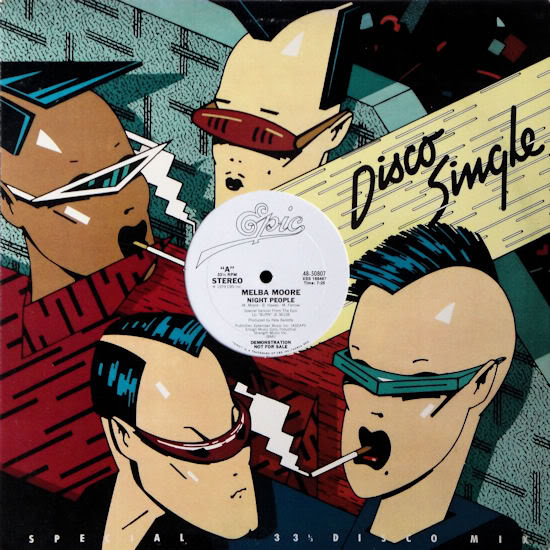
While "Miss Thing" didn't receive a special extended remix (a missed opportunity, if you ask me), the second US single "Night People" did. Another one of the album's best bids for dancefloor action, with it's disco scene and scenester lyrics: "Night People with their glowing eyes, looking like they're superstars.. night people with their studio smile, looking like they're hypnotized" it's just about as deep as things get on here on the lyrical front, which probably isn't saying a whole lot, but was probably their closest attempt at a Donna Summer-esque Bad Girls-style single. The 12" version extends things by around three minutes, giving more space for Marcus Miller's bass in the intro and using some alternate vocal takes on the verses, not heard on the LP version.
Though the album is (thankfully and uncharacteristically by Melba's standards) unbroken by ballads, it's not all heat and fire. "I Don't Wanna Lose Your Love" and "If You Believe In Love" are trademark Bellotte style frantic funk, anchored by memorable, melodic choruses, with the latter showing off some of Thor Baldursson's synthwork (see Bellotte's Trax albums for a sound comparison) and a surprisingly jazzy sax solo on the former.

Though undoubtedly one of the major outliers in Melba Moore's discography, "Burn" is probably one of the most satisfying in it's presentation. While Moore, in her 2009 Unsung profile said she aspired to be like Aretha Franklin, her athletic pipes were and are of a different timbre altogether. In retrospect, it's clear why she seemed to be a natural stage performer. Her sprightly, energetic vocal style seemed perfect for the expressiveness of theatre. And while she made many excellent R&B records, at times she seemed to have been saddled with ballads which seemed to barely contain the sheer power of her voice. Even when being soft and subtle, there was a tension in her vocals that was (almost distractingly) palpable, their full force seemingly bubbling under the surface ready to burst forth at any moment and either not really getting a chance to or doing so in often surprising ways, leaving the whole thing in the dust (see her penchant for extended 30-second high notes). Although I'd venture to guess that nixing the ballads was more than likely Bellotte's idea rather than Moore's, it's probably one of the reasons why this record lives up to its name. With Melba's voice seemingly unleashed and unhindered, hearing Moore really walk on the wild side of her voice for the entire album is one of the reasons why "Burn" still sounds as exciting as it does.

Though it's rumoured that Moore was displeased with the final mix, and while she did hint at a sense of surprise at the results, having been quoted in Jet magazine saying that she "didn't think it all would be as sexy as it came out;" officially Melba was all praises in the promotional press. Speaking to Irv Lichtman in Billboard about working with Bellotte, she remarked that even if he wasn't entirely familiar with her background, he had ably "aroused the spirit of the bigger than life image I try to portray on stage" with the record.

However, in spite of her praises and performance; with the album's lead single "Miss Thing" barely scraping Billboard's Disco top 40, peaking at #41 (#90 R&B) "Burn" wouldn't exactly go on to set the charts on fire. Adding yet another entry to the heaping pile of (admittedly cliché) disco heat and fire references in 1979, count this one as yet another lost in the shuffle of that year. Whatever ideas the label or Moore's team may have had about recruiting Bellotte and going toe-to-toe with Donna Summer on the charts, it would take another three years, a label move and the talents of a couple of young, up-and-coming producers before she would score her next commercial breakthrough.

Perhaps in retrospect, Moore and company could have played it a bit more safely in choosing to focus on disco, picking producers more attuned to the R&B sensibilities of her past efforts - Mtume/Lucas, who were riding high with Phyllis Hyman at the time, for one example. The release of a cash-in album by her former label earlier in the year called "Dancin' With Melba" (1979, Buddah), a collection of older songs remixed for disco play (which included Richie Rivera's admittedly stunning treatment of "Standing Right Here") may have influenced the decision to check the prevailing trends and go for an edgier disco sound. Ultimately, Moore would return to more familiar settings with her follow-up album "Closer" (Epic, 1980) bringing back Victor Carstarphen and keeping "Burn" collaborator Bruce Hawes in tow.

Although Bellotte had been criticised elsewhere for subjecting Moore to a "disco standardization process" with this record, more than almost any of her previous and future producers, Bellotte managed to utilize the spunky, incendiary edge of Melba's voice to express a boldness that had never really been heard before (and scarcely since) in her music. Though while the record is ultimately more identifiable as a Bellotte production than a Melba Moore record; Moore, in her versatility came off sounding more animated than ever here, feeling like the most natural fit for Bellotte's brand of high-octane disco. Far from being just another anonymous, throwaway element in the production (as singers in disco are often derided as being), Melba's voice and personality here practically make this record. Backed by rollicking rock guitars, funky strutting bass all with an ever so slight Eurodisco bent; with Bellotte's production letting the lady's fiery personality burn (I just had to..) freely, this album remains one of Melba Moore's most interesting (albeit brief) shifts in sound.

UPDATE (JUNE 2012): This album has just been reissued on CD from Funkytowngrooves (who also have five other Melba Moore reissues coming), with three bonus tracks.

PREVIOUS RELATED ENTRIES:
DISCO DELIVERY #52: STAINLESS STEAL - CAN-CAN (1978, WARNER BROS.) (TUESDAY FEBRUARY 5, 2008)
BBC RADIO 2: CLASSIC SINGLES - I FEEL LOVE (SUNDAY DECEMBER 30, 2007)
DISCO DELIVERY #43: WARDELL PIPER (1979, MIDSONG INTERNATIONAL) (MONDAY AUGUST 27, 2007)
DISCO DELIVERY #40: MUNICH MACHINE - A WHITER SHADE OF PALE (SUNDAY APRIL 29, 2007)
DISCO DELIVERY #14: SUZI LANE - OOH LA LA (1979, ELEKTRA) (SATURDAY APRIL 8, 2006)
DISCO DELIVERY #5: GIORGIO MORODER - FROM HERE TO ETERNITY (1977, OASIS/CASABLANCA) (FRIDAY FEBRUARY 3, 2006)

LINKS:
DISCOGS: MELBA MOORE - BURN LP
DISCOGS: MELBA MOORE - NIGHT PEOPLE (PROMO 12")
DISCOGS: PETE BELLOTTE
ALL MUSIC GUIDE: MELBA MOORE
DISCOMUSIC.COM: INTERVIEW WITH MELBA MOORE (BY DAYNA NEWMAN)
GOOGLE BOOKS: JET MAGAZINE (DECEMBER 6, 1979)
GOOGLE BOOKS: BILLBOARD MAGAZINE (OCTOBER 20, 1979) - MELBA MOORE LEAPS INTO NEW RECORDING CHALLENGE (BY IRV LICHTMAN)
FACEBOOK: BRUCE HAWES, COMPOSER
DISCOGS: MARCUS MILLER
WIKIPEDIA: RICHARD AVEDON

CATEGORIES: DISCO DELIVERIES, VISUAL DISCO

Sunday, December 30, 2007

BBC Radio 2: Classic Singles - I Feel Love


Listen: BBC Radio 2: Classic Singles - I Feel Love

Just a couple of things to acknowledge before 2007 draws to a close. First of all, Donna Summer, the Queen of Disco herself turns, believe it or not, 59 on the 31st. Although some of her fans on the message boards out there might fuss about her weight and her wigs lately and, perhaps rightly, lament her recent snub by the Rock & Roll Hall of Fame; by all accounts, at nearly 60, the lady still sounds remarkable in concert. Not to mention, if there was ever a poster girl for "black don't crack," she'd be it.

Secondly, although I'm around eight months late for this, her seminal classic, one of the most iconic Summer/Moroder/Bellotte compositions, "I Feel Love" also turned 30 this year.. Although it was an anniversary that went relatively unacknowledged, its influence certainly has not. Reportedly called "the sound of the future" by Brian Eno upon hearing it for the first time, "I Feel Love" was one of the touchstones of not only disco, or even Donna Summer's career, but of the pop music landscape in general. Along with all the other groundbreaking electronic records of its time, its success seemingly opened the floodgates for all manner of electronic experimentation (and imitation) on the dancefloor and beyond, solidifying the legacy of its producer Giorgio Moroder, perhaps just as much, if not moreso than Donna herself. Arguably much of what could be considered 'electronic music' today owes a debt to its legacy...

Released in May 1977 and included on Donna's "I Remember Yesterday" (1977, Casablanca) LP, "I Feel Love" was, in my opinion, the one shining moment on what was likely the weakest of Donna's otherwise excellent string of disco concept albums. Although not necessarily a bad album, one couldn't help but feel that the whole time travel/nostalgia concept probably sounded much better on paper than on record. Between the cover and its unflattering deer-in-headlights photo of Donna, and a largely unconvincing mish-mash of disco styled nostalgia, "I Feel Love," the album's 'song of the future', with its powerful, pulsing sensuality, placed right at the end of the record, effectively obliterated everything else..

Granted, most people reading this are likely well aware of its significance, so consider this a little bit of preaching to the coverted, so to speak.. However, in honour of its 30th anniversary, I thought this might be a good opportunity to put up the audio from the Classic Singles documentary on "I Feel Love" by the good people at BBC Radio 2. The broadcast, which originally aired November 2005 (which I'd been holding on to ever since), runs approximately 30 minutes and gives what is probably one of the most recent and comprehensive overviews/tributes to this song that I know of. Hosted by the one and only Alison Goldfrapp, herself no stranger to the Moroder influence, the program runs like a documentary on not only the influence and making of "I Feel Love" itself, but also of Giorgio and his evolution as a producer up to that point.

Although not nearly as detailed and in-depth as Radio 2's "The Record Producers" doc on Nile Rodgers from nearly a year ago, they manage to cover a good bit of ground in its 30 minutes, with much of the program being devoted to Giorgio speaking in his own words. Although unfortunately Donna herself didn't take part in it, they included some choice confessionals from the likes of Jimmy Sommerville, Debbie Harry and the Scissor Sisters' Ana Matronic, who manages to sneak in the best quote in the whole thing. I'm sure they could have easily gone an entire hour, but even within the 30 minutes, Giorgio still manages to shed some light on some pretty interesting points regarding the making of "I Feel Love" and his own feelings about its influence..

Although it has been argued that Giorgio could have had anyone sing "I Feel Love" and made it a hit, given the feel of Donna's essential yet often dismissed vocal stamp combined with her immense popularity at the time, it's doubtful whether any other combination could have made quite the same impact or created the same magic. Although not among her most explicit, "I Feel Love" still remains one of Donna's sexiest moments on record, with the effortlessly sensual caress of her voice providing the perfect counterpoint to the cool, mechanical precision of the music. Aside from groundbreaking, it's nonetheless a wonderfully sublime moment of shiny, glittering electro-eroticism; the hypnotic, throbbing pulse of its unforgettable bassline resonating today, just as it did thirty years ago.

Also, just in case anyone's in need of additional visual aid after all that, here's a wonderful vintage live performance of "I Feel Love," complete with synths and robot dance:


Donna Summer - I Feel Love (Live)
Uploaded by DonnaSummerVEVO


..and here's yet another, more recent (and more polished) live performance from her 1999 VH-1 "Live & More..Encore" special:


Donna Summer - I Feel Love (Live & More..Encore! - 1999)
Uploaded by EndlessDonna


PREVIOUS RELATED ENTRIES:
DISCO DELIVERY #40: MUNICH MACHINE - A WHITER SHADE OF PALE (1978, CASABLANCA) (SUNDAY APRIL 29, 2007)
BBC RADIO 2 - THE RECORD PRODUCERS: NILE RODGERS (SATURDAY JANUARY 6, 2007)
NEW DEAL FOR DONNA (THURSDAY AUGUST 3, 2006)
DISCO DELIVERY #14: SUZI LANE - OOH LA LA (1979, ELEKTRA) (SATURDAY APRIL 8, 2006)
DISCO DELIVERY #5: GIORGIO MORODER - FROM HERE TO ETERNITY (1977, OASIS/CASABLANCA) (FRIDAY FEBRUARY 3, 2006)
DONNA SUMMER - I GOT YOUR LOVE (MONDAY JANUARY 16, 2006)

PURCHASE:

DONNA SUMMER - THE DANCE COLLECTION CD (INCLUDES 'I FEEL LOVE' 12'' VERSION)
CD UNIVERSE | AMAZON.CO.UK | AMAZON.COM

DONNA SUMMER - BAD GIRLS (DELUXE EDITION) (2 CD) (INCLUDES 'I FEEL LOVE' 12'' VERSION)
AMAZON.COM | CD UNIVERSE

LINKS:
DONNA SUMMER TRIBUTE SITE
DONNA SUMMER - I FEEL LOVE @ WIKIPEDIA
DONNA SUMMER - I FEEL LOVE 12'' @ DISCOGS
DONNA SUMMER - I FEEL LOVE (PATRICK COWLEY REMIX) 12'' @ DISCOGS
DONNA SUMMER - I FEEL LOVE (PATRICK COWLEY REMIX) 12'' @ DISCOMUSIC.COM
DONNA SUMMER - I FEEL LOVE (REVIEW) @ ALL MUSIC GUIDE
DONNA SUMMER - FEEL LOVE @ ROLLING STONE
DONNA SUMMER - I REMEMBER YESTERDAY LP @ DISCOGS
DONNA SUMMER - I REMEMBER YESTERDAY LP (REVIEW) @ WARR.ORG
GIORGIO MORODER @ WIKIPEDIA
GIORGIO MORODER INTERVIEWS
GIORGIO MORODER @ ALL MUSIC GUIDE
AND WE DANCED - I FEEL LOVE
SONGFACTS - I FEEL LOVE

CATEGORIES: MINI DELIVERIES, ARTICLES & RAMBLINGS, INTERVIEWS, DISCO NEWS, VISUAL DISCO

Sunday, April 29, 2007

Disco Delivery #40:
Munich Machine - A Whiter Shade of Pale (1978, Casablanca)


Listen on Spotify:
Munich Machine - A Whiter Shade of Pale
Munich Machine - It's For You
Munich Machine - It's All Wrong (But It's Alright)
Munich Machine - La Nuit Blanche
Munich Machine - Love Fever
Munich Machine - In Love With Love

It's been a while since I've put some Giorgio Moroder up here and since this album has been a favourite of mine for a little while now and a frequent listen lately, I figure why not now?

Munich Machine was, for the most part, a moniker for the fairly regular cast of studio musicians on many of Giorgio Moroder's productions with Pete Bellotte (and others) which, at least on this album included the likes of Keith Forsey, Geoff Bastow, Mats Björklund, Dino Solera and singers Lucy Neale, Gitta Walther (AKA Jackie Robinson), and Claudia Schwarz among others. Aside from the three albums released as the Munich Machine, the "Machine" would also be anonymously credited for the "accompaniment" on a few of Donna Summer's albums, Roberta Kelly's "Trouble Maker" album and given top billing on the single Moroder produced for his sax player Dino Solera to name a few...

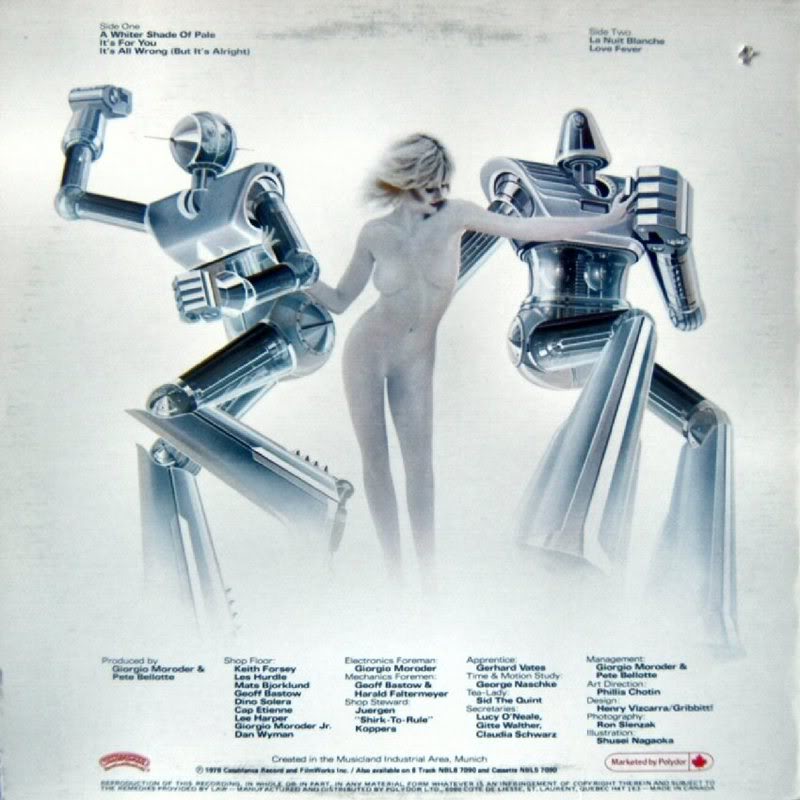
As well, the "Munich Machine" was not just a group of musicians, but also something of a brand for their distinct sound. In a 1978 interview with NME, Moroder branded the distinct sound of his productions and musicians as the "Munich Machine Sound" which the article characterized as their own disco-era, European equivalent of the Motown Sound. Evidently one of the common criticisms of the "Munich Machine Sound" was it's defined, formularized sound, a criticism which as the article points out, doesn't hold up quite as well when compared to the similar assembly-line, organized industrial quality of the Classic Motown sound, for example. Evidently the cover concepts on the first two Munich Machine albums with the dancing robots and the curious credit listings on this LP (musicians credited as the "Shop Floor," singers as the "Secretaries," engineer as the "Shop Steward" etc..) were, at least in part, a reply to that criticism (evidently Rinder & Lewis weren't the only disco producers with a sense of humour). Moroder himself explains it further in some key excerpts from that interview:

"Myself, I liked very much the sound of Motown in the early times, up to seven or eight years ago, but now they do not have such a recognisable feel. Mind you, the actual quality of their first recordings was not good. You know, they recorded in a little building and so on. But the music was good, so very good - and that is why they succeeded."

And quite why Moroder's work should be so disparagingly referred to in some circles as 'product' (as in production line, etc.) when Tamla (Motown) themselves formularised their songwriting - Holland, Dozier, Holland et al - and sound with similar success and without risking culpability is beyond this pair of ears. Tamla even worked out of a similarly and supposedly 'industrial' environment in Detroit.

All of which I put to Moroder, asking more specifically about the relevance of the credit listing on the 'Whiter Shade Of Pale' Munich Machine release (cf. 'shop floor, electronics foreman, mechanics foreman, shop steward, apprentice, time and motion study').

"This, you know, this is just another joke. We know people think this about what we do, so we play up to them. It is the same with the dancing robots on the covers of both Munich Machine records.

"All this talk of machines and industry make me laugh. Even if you use synthesisers and sequencers and drum machines, you have to set them up, to choose exactly what you are going to make them do. It is nonsense to say that we make all our music automatically.

"I know for myself how difficult or how easy it was to get a certain sound. Sometimes it's easy, sure, but as often as not it is at least ten times more difficult to get a good synthesiser sound than on an acoustic instrument. And of course we organise things - who does not? We have to be professional about this. There is nothing wrong with this, surely?"

Looking back today given their success and influence, the Motown comparison rings even more true. Much like Motown had been at it's height, at the time Moroder and company were at the helm of what was undoubtedly one of the most identifiable, defining sounds of the disco era.

As far as 'Munich Machine,' the recording project goes, the best known Munich Machine single would probably be the slick and sexy 15 minute disco workout "Get On The Funk Train" (which reached #7 on the Billboard Disco charts in 1977) off the first and excellent Munich Machine album. Although all three Munich Machine albums are worthwhile (the first two perhaps more so than the last, "Body Shine"), I'd say out of all three, this one has to be my personal favourite. The first album was essentially made up of sped-up, largely instrumental remakes of the so-called "soft-disco" productions from the albums he and Bellotte did for Donna Summer ("Love To Love You Baby," "Try Me I Know We Can Make It"), Roberta Kelly ("Trouble Maker"), as well as from Giorgio's own "Knights In White Satin" LP ("I Wanna Funk With You Tonite") which were all augmented with some heavy, loopy synths here and there for good measure.. This particular album, however, bears less resemblance to that earlier Munich euro-disco sound and a great deal more of the cooler, sharper and decidedly progressive electronic stamp of "I Feel Love" and "Chase" that would eventually become Moroder's most enduring trademark.

Looking back at his output, 1977 and 1978 especially seemed like banner years for Moroder and company. Between "I Feel Love," the first Donna Summer double-album "Once Upon A Time," "From Here To Eternity," the Midnight Express soundtrack and his Battlestar Galactica album which spawned the extended electro symphony that is "Evolution," Moroder seemed to be at the height of an extraordinarily fruitful period, both creatively and commercially.

In addition to all of that, last but certainly not least, I'd also include the "Whiter Shade of Pale" album in that list of notable Moroder productions from that time. Written (aside from the title track, of course) and produced by Giorgio Moroder and Pete Bellotte, this album is perhaps not as well-known as some of the other Moroder-produced works from the time, yet it's not only an excellent, cohesive album but one which seemed to perfectly bridge elements of his more conventional euro-disco/pop leanings with his more adventurous electronic ones ("Evolution," "From Here To Eternity")..

Additionally, this album also seemed like something of a springboard from which to launch vocalist and Moroder protégé, Chris Bennett, who appears beautifully and artfully photographed (along with Shusei Nagaoka's amazing dancing robot artwork, reprised from the first Munich Machine album) on both the front and back covers. Despite that and the album's subtitle ('Introducing Chris Bennett'), this wouldn't be her first release with Moroder. Prior to this, Moroder's earliest collaboration with Chris Bennett was a little-known 7'' single from 1976 called "Disco Man" produced by Giorgio & Pete and released in the UK on a label called Bradley's Records. Although this may not have been her first showcase and, in my opinion, her best vocal performances would come later on the Giorgio & Chris album and Midnight Express soundtrack; nevertheless, this album still represented the first true and full introduction to both her image and her crystal clear voice..

As far as the music goes, moreso than any of the other Munich Machine albums, this one also displayed, perhaps most boldly and beautifully, a flawless combination between that cool, forward-looking, hypnotic electro pulse and the exquisite orchestration and instrumental arrangements, which seem somewhat overlooked these days given Moroder's reputation as a pioneer in electronic music. Putting that aside for a moment, it was not just the electronics, but often the combination between the orchestral and electronic which not only set him apart as a producer, but also, generally speaking, disco as a genre.

One track which displays that combination especially well would be the second track on the album, "It's For You." The combination is evident right from the beginning, which starts off captivating the listener with a heavy robotic pulse and spacey synth, which is then quickly augmented by what sounds like a flute along with those gracefully sublime string arrangements. The beautiful juxtaposition between the two elements practically define this track, with the dreamy elegance of those strings both complimenting and contrasting the mechanical synth sounds, making this track both gentle and intense all at once.. Bennett's vocals exhibit a similar sort of juxtaposition, alternating between a calculated cool on the verses, and an almost pleading intensity on the title refrain with those echoed, multiplied vocal effects..

The title track, a cover of the Procul Harum classic "A Whiter Shade of Pale," with it's brilliant melody and elaborate lyrics (which no one really seems to understand), is perhaps the best display of Bennett's graceful vocals on the album.. Out of all the others, her vocals on this one seem to be more dynamic, expressing a greater range and seemingly hinting at things to come on future efforts.. Granted, the thought of a disco version of this track might seem a little far-fetched at first, but somehow everything seems to gel and the whole thing just seems to work (quite beautifully, I might add). Beyond their jaunty pulse on the surface, the synths, especially further down in the mix seem to have this certain airy, albeit robotic elegance to them that manages to marry elements of the original's misty ambience with the crisp energy of this electronic remake. That, combined with the classic melody of the track; Bennett's clear, unpretentious vocal affectations and the colouring from the sax and strings also give a definite warmth to this track, despite it's energetic electronic sheen. While electronic sounds are often associated with being cold and detached, the kind of electronic warmth found on this track was one especially unique quality that other excellent Moroder productions seemed to have as well (ie. Suzi Lane's "Harmony" to name one). "A Whiter Shade Of Pale" was apparently released as a single in both the US and the UK, making the lower reaches of the UK charts as well as the top 30 of the Billboard Disco Charts..

While the tracks on side one showcased a more conventional vocal style along with a more balanced electronic approach, side two on the other hand (with the exception of "Love Fever") seemed to take things to another level altogether. Opening with "La Nuit Blanche," Moroder's propulsive electronic interpretation of (part of) Richard Strauss'' "Also sprach Zarathustra" (as popularized by "2001: A Space Odyssey") and ending with "In Love With Love," which appears to have been a vinyl-era equivalent of a hidden bonus track (not listed on the back sleeve, but very much in the grooves and printed on the label), side two on the other hand seemed to be more of a showcase for Giorgio's more ambitious, electronic instrumentals.. Overall for me, "In Love With Love" with it's heavily vocodered vocals and beautiful, entrancing variety of shiny synth sounds and changes is the definite standout on side two. One of the things I love is how the track builds in the beginning with those beautiful, blissful synth textures and later seamlessly segues into this intense trance towards the end, with those darker synth sounds replacing the electro-sparkles of the first part. The sounds that they used along with the vocodered vocals on the track seemed to foreshadow (among other things) the direction he would take on both "Chase" and his own "E=mc²" (1979, Casablanca) album, not to mention a certain synth passage (at around 2.11) which bears an uncanny resemblance to something I've heard on a Eurythmics record at some point. Either way, the intricate electronics of "In Love With Love" certainly made a great ending for the album, almost like a kind of musical cliff-hanger ending things on a high point, leaving the listener with an expectation, an exciting glimpse of the future..

Despite the fact that Moroder gets a great deal of credit as an innovator these days (and rightfully so), some of his close collaborators like Pete Bellotte for example, seem to get lost in the shuffle, so to speak. Judging from interviews and the division of credits on his productions, Moroder seems to fall into that category of producers with a 'hands-off' production style, those who prefer to work with a team, leaving some of the details of their vision to an able, ensemble cast of musicians. As opposed to a hands-on producer putting their hands in practically every aspect of the recording, Moroder, judging in part from a 1996 interview with Future Music admitted: "I`ve rarely done a whole recording by myself." Despite the hands-off style, it certainly seems to speak to his ideas and his abilities as a producer that the sound of most of his productions still clearly bear his stamp more than anything else. Although as a result, it may be difficult at times to know just where Moroder's input ended and his co-producers' came in, it at least seems to explain the equal credit given to his co producers (usually Pete Bellotte or Harold Faltermeyer) on albums like this one and others.

Aside from the lyrics where Bellotte's contribution is much more clear, judging from Bellotte's style on his own solo productions (ie. Melba Moore's "Burn" LP, Marsha Hunt, Trax etc..), I can only speculate that his input also seemed to be pretty strong on the more acoustic, instrumental elements when it came to his productions with Moroder. Given that, Bellotte's stamp on this record is perhaps most evident on the two most instrumentally elaborate tracks on the album: "It's All Wrong (But It's Alright)" on side one with it's lyrical narrative and dramatic Spanish-inspired horn section, and "Love Fever" on side two. Although perhaps debatable on "It's All Wrong..," "Love Fever" seems to bear the closest resemblance to his solo productions with the quick intricacy of those background guitars and the dynamic, prominent horn arrangements, all of which seem to bear Bellotte's signature style.

This album would probably the last actual Munich Machine album that could be considered a guise for Moroder's backup band. The final Munich Machine album "Body Shine" (1979, Casablanca) seemed to move away from the original more anonymous concept of the first two albums and and into more of a conventional "band" formula. By that point, the 'band' officially consisted of Günter Moll, Stefan Wissnet along with singers Judith Jones and Yolande Howard with all four actually pictured on the back cover. With Moll and Wissnet also having production credit alongside Moroder, that record also had a significantly different sound to this one as well as to many of the other things Moroder was putting out at the time. In 1996, all the tracks from the first Munich Machine album along with this one were released on a CD compilation called "Get On The Funk Train," (1996, Oasis/Bud Music). Long out of print, it's not one which shows up often, in fact I've only ever seen the CD once on eBay. Needless to say, it was completely out of my price range at the time but I did manage to save a picture of it, in case anyone's curious about what it looks like. Luckily, I'd also acquired a CD rip of the compilation later on which is the next best thing, I suppose (and is where all the tracks up here come from)..

On future albums Chris Bennett would go on to be one of Moroder's most frequent collaborators, not only as a singer but as a songwriter, contributing lyrics and vocals for quite a few of his projects, most notably the Midnight Express soundtrack for which she'd share in it's Academy Award nomination. Another notable collaboration would be the duet album they'd do together as Giorgio & Chris, "Love's In You, Love's In Me" (1978, Casablanca), which given the romantic tone of much of it, makes me wonder if they were more than just creative collaborators at the time.. Based in Los Angeles these days, Bennett had reinvented herself as a contemporary jazz chanteuse in the 1990's, having recorded some seven albums since then in addition to her disco work. If anything, I'd say that the lady still looks and sounds great today. You can see and hear for yourself on her Myspace page and on her official website.

Given not only Moroder's legacy but the excellence of much of his disco output, hopefully this along with the other Munich Machine albums (and other out of print Moroder-produced records) will be revisited for future reissue at some point. Although like many disco producers at the time, Moroder seemed to be putting out records with such frequency, it seems inevitable that a few would have gotten lost in the shuffle, which probably explains why this one doesn't seem to be talked about or cited too often these days. While this album may not be among his more iconic productions, it was nonetheless an excellent record showing one of disco's greatest producers and production teams at the top of their game.

PREVIOUS RELATED ENTRIES:
DISCO DELIVERY #14: SUZI LANE - OOH LA LA (1979, ELEKTRA) (SATURDAY APRIL 8, 2006)
DISCO DELIVERY #5: GIORGIO MORODER - FROM HERE TO ETERNITY (1977, OASIS/CASABLANCA) (FRIDAY FEBRUARY 3, 2006)

LINKS:
MUNICH MACHINE @ DISCOGS
MUNICH MACHINE - A WHITER SHADE OF PALE LP (REVIEW) @ ALL MUSIC GUIDE
MUNICH MACHINE - A WHITER SHADE OF PALE LP @ DISCOGS
MUNICH MACHINE - A WHITER SHADE OF PALE LP @ DISCOMUSIC.COM
GIORGIO MORODER @ ALL MUSIC GUIDE
GIORGIO MORODER @ DISCOGS
GIORGIO MORODER @ WIKIPEDIA
GIORGIO MORODER @ JAHSONIC
MORODER'S MUSIC
GIORGIO MORODER: FATHER OF COMPUTER DISCO
MORODER-SUMMER TRIBUTE
GIORGIO MORODER COVER GALLERY
GIORGIO MORODER INTERVIEW WITH FUTURE MUSIC (1996)
MORODER'S MUSIC: GIORGIO MORODER INTERVIEW WITH NME (DECEMBER 9, 1978)
PETE BELLOTTE @ ALL MUSIC GUIDE
PETE BELLOTTE @ DISCOGS
BBC NEWS: IN TUNE WITH BRITAIN'S DISCO KING (PETE BELLOTTE INTERVIEW) (SEPTEMBER 19, 2004)
CHRIS BENNETT @ DISCOGS
CHRIS BENNETT @ WIKIPEDIA
CHRIS BENNETT @ ALL MUSIC GUIDE
CHRIS BENNETT'S OFFICIAL WEBSITE
CHRIS BENNETT'S OFFICIAL MYSPACE

PROCUL HARUM - BEYOND THE PALE: MEANINGS IN "A WHITER SHADE OF PALE"
PROCUL HARUM - BEYOND THE PALE: COVER VERSIONS OF "A WHITER SHADE OF PALE"
SONGFACTS: A WHITER SHADE OF PALE BY PROCUL HARUM
BBC NEWS: WHAT IS THE LIGHT FANDANGO? (NOVEMBER 14, 2006)
"A WHITER SHADE OF PALE" @ WIKIPEDIA
SHUSEI NAGAOKA GALLERY

CATEGORIES: DISCO DELIVERIES, WHAT EVER HAPPENED TO..

Sunday, May 07, 2006

Disco Delivery #18:
Claudja Barry - Sweet Dynamite (1977, Lollipop/Salsoul)


Claudja Barry - Love For The Sake Of Love (A Tom Moulton Mix)
Claudja Barry - Sweet Dynamite (A Tom Moulton Mix)
Claudja Barry - Dance, Dance, Dance (A Tom Moulton Mix)
Claudja Barry - Live A Little Bit (A Tom Moulton Mix)
Claudja Barry - Why Must A Girl Like Me (A Tom Moulton Mix)
Claudja Barry - Love For The Sake Of Love (Original Version)

One of my favourite disco divas this week.. Claudja Barry's probably best known for her hit "Boogie Woogie Dancing Shoes," but this album from '76 (released 1977 in the US) was her first and probably her best among her '70s albums. Overall her other '70s albums were a little bit on the inconsistent side, although there were classics on each of them. For me though, she wouldn't top this album until her "Made In Hong Kong" (1981, Lollipop/Polydor) LP some five years later.. Claudja, in my opinion, had one of the more unique voices in the disco era. A classically trained vocalist, she never really fit the typical mould of a black disco singer, that of the gospel/R&B inflected vocal style, but instead one that was perhaps more torchy than conventionally soulful. Although apparently a huge fan of classic blues and soul (she recently hosted a radio program dedicated to it), her voice was often in another category altogether.

In some ways, you could probably consider Claudja the Canadian Donna Summer, if you will. As much as that may be an unfair comparison, there are some parallels. Born in Jamaica and raised in Toronto, Canada; Claudja's career, much like Donna Summer's, would take off in Germany where she was working as a stage actor in various musicals. While in Germany she would become, albeit briefly, an early member of Boney M. Shortly after her brief association with the group, she would start an association with Jürgen S. Korduletsch, who would go on to become her long time producer, collaborator and later on, her husband. Like Moroder/Bellotte and Kunze/Levay, Korduletsch's sound was another part of that Munich disco sound that was riding pretty high at the time. That Munich sound, at least to me, was something of a hybrid of American elements of funk and soul, filtered through a distinctly European pop aesthetic. Claudja's "Sweet Dynamite" album is one of the greatest examples of it, undeniably influenced by funk and R&B, yet sounding totally different from anything that came from the US. It's interesting to note that many of the players and personnel on this record like Keith Forsey, Gary Unwin, Thor Baldursson, Pepe Solera, Roberta Kelly, Jürgen Koppers etc.. were ubiquitous on many of the disco records out of Munich..

The original issue of Claudja's album contained ten tracks, most of which were under five minutes. For the most part the album was still disco, yet somewhat more diverse than the US release. There was not only the disco tracks, but others showing a slower, smoother side like her take on Gershwin's "Do It Again" and "This Taste Of Love," as well as "Nobody Loves Me Like You Do Do" (originally done by a singer named Jeanne Burton) really showing off her torchy side. This version was originally released in much of Europe and in Canada on Lollipop/Philips among other labels. It wasn't until the following year when the album was licensed for the US by the legendary Salsoul label that it was disco-fied in a big way. For their stateside release, Salsoul would commission mix master Tom Moulton to re-mix the album. Even though the album was cut down to five tracks, the results, like many Tom Moulton mixes, are significant improvements on the originals. Speaking of Tom Moulton Mixes, I just have to say that I think it's a bit unfortunate that the classic extended mix seems to have fell out of favour in, say, the past fifteen years or so. While there's something to be said about the creativity in remixing today, taking a song out of it's original context and putting a competely different backing on it; as far as I'm concerned, you can't lose by extending and building on the elements of an already great song. Taking apart the layers and bringing them up front, zeroing in it's best elements and extending them, it's exactly the sort of thing Moulton did so well.

One of the most well known songs on this album, and one that exemplifies Tom Moulton's mixing style so well is "Love For The Sake Of Love," a slow, smouldering, sensual groove with a sly guitar and a sexy vocal. Takes you up and takes you down and back again during it's nearly eight minute span.. A simple groove, lyric and melody that manages to work so well. The Moulton mix brings up the tempo a little from the original, taking some of those great background vocals up front and not to mention adding those wonderful breaks. One of those songs that seem to embody sexy when "sexy" was an art form.. Several years back it seems the breaks on this song were pretty popular. "Love For The Sake Of Love" was most recently and successfully sampled on Montell Jordan's "Get It On Tonite" from 2000 (a top 5 hit in the US), and less successfully (in my opinion, anyway) on Da Brat's "What'chu Like" also from 2000. Now speaking of sexy as an art form, despite Brat's sexual "confessions," there was just something so decidedly un-sexy about her delivery on that track. Amusing, yes. Sexy? No.. But I digress.

On to the next song... "Dance, Dance, Dance" (no relation to the Chic song of the same name) is probably my favourite track on the album right now. A fabulous song about dancing your tears, fears and troubles away.. Can't get enough of those big-band horns and Claudja's tremendous vocal, complete with funky guitar in the background to keep things swinging. There's also a great bass solo and some hot percussion on the break as well.

The title track "Sweet Dynamite" follows in much the same vein as "Dance, Dance, Dance." Albeit this time with a fuller arrangement, faster tempo and a suitably dynamic, almost ferocious vocal from Claudja. Got to mention that great horn and string section as well. There are also some really funky bass and synth sounds in the background which really get to shine on the break.. Like the lyrics say, it's "like a burning fire.."

Claudja would go on to release even more great records after this album. Even if some of her subsequent albums wouldn't top this one, she'd manage to build a excellent canon of disco and dance classics well into the 1980's. The original version of this album was released on CD in 1993 by Hot Productions. As far as I know, it's out of print, but well worth tracking down, as the album is great and the sound quality on the CD is excellent. These days her producer/husband(?) Jürgen Korduletsch runs the Radikal Records label. Also, Claudja herself has been making something of a comeback lately after effectively retiring from music during the 1990s. Her latest single "I Will Stand" was released last month on her own label Donna Jean Records. It also seems to be her first record without the involvement of Jürgen, which leads me to wonder if they are even still married. In any case, I hope to do a post about her new single very soon.

If you've gotten this far, I'd just like to add that I probably won't be doing the Disco Delivery posts on a set schedule anymore. Some of you have probably noticed I'm no longer sticking to Fridays. It seems my "holidays" will be more busy than my school days, so time will be a little tighter for me in the next little while. I'll still try to bring the "Deliveries" at the end of every week, but that could be anytime from Friday to Sunday.

Anyway, with that out of the way, I just added a couple great new music blogs this week. Music Is My Boyfriend and Milk Carton Pop Stars.. Check 'em out!

PREVIOUS RELATED ENTRIES:
GET UP AND BOO-GIE! (FEBRUARY 1, 2006)

LINKS:
CLAUDJA BARRY - SWEET DYNAMITE (US LP) REVIEW @ ALLMUSIC.COM
CLAUDJA BARRY - SWEET DYNAMITE (US LP) @ DISCOMUSIC.COM
CANCONROX - CLAUDJA BARRY
CLAUDJA BARRY @ DISCOMUSEUM.COM
CLAUDJA BARRY @ ALLMUSIC.COM
CLAUDJA BARRY @ DISCOGS
CLAUDJA BARRY @ WIKIPEDIA
CLAUDJA BARRY BIO (circa. 2002)

PURCHASE:
CLAUDJA BARRY - SWEET DYNAMITE CD @ AMAZON.COM

CATEGORIES: DISCO DELIVERIES, CAN-CON DISCO, PAST REISSUES, WHAT EVER HAPPENED TO..

Sunday, April 09, 2006

Disco Delivery #14:
Suzi Lane - Ooh La La (1979, Elektra)


Suzi Lane - Ooh, La, La
Suzi Lane - Givin' It Up
Suzi Lane - No One Home In The City
Suzi Lane - Harmony
Suzi Lane - Morning, Noon and Night
Suzi Lane - Free Me

First off, sorry for this late post, I usually post the Disco Delivery entries earlier than this, but it's been a busy week with term papers due and finals coming up real soon, but I guess better late than never..

Anyway, with that out of the way... This week I'm putting up one of my favourite and possibly one of the most overlooked Giorgio Moroder productions out there.. I got turned on to this album several years ago by a guy I met at Recordland here in Calgary. He was from out of town and was also checking for disco records, so we struck up a little conversation about what we were looking for and so on, and among other things he strongly recommended this album. Immediately after finding it, I was struck by that amazing cover shot; quite possibly one of the most sexy, stunning cover photos I've ever seen and for sure one of my favourite album covers period..

Cover aside, once I got home and listened to it, I was immediately hooked after hearing the first few minutes of the title track.. Those sparse, yet intense synths building and pulsing with those sharp, layered drum beats and handclaps; classic Moroder right from the start. One other thing I found interesting about this song was this amazing sound, it seems to be either a prominent synthesized or manipulated, multi-tracked horn progression that they use throughout the song to great effect.. I could really go on and on, but to put it simply, everything about this song is exquisite; from the diverse arrangement, seamlessly combining electronic elements with light strings and horns; to Suzi's cool, yet willowy voice and even to the excellent lyrics. Those lyrics are probably some of the most well-written, poetic odes to love on the dancefloor that I've ever heard.. That said, I decided to put up the side one medley in it's entirety, but 'cause I love this song so much, took "Ooh La La" out into it's own stand-alone file, just in case anyone wants to hear this one by itself.

The second track in the medley, "Givin' It Up," is another great piece of songwriting; a gently hopeful yet melancholy song about new beginnings, culminating in a sharp, self-affirming chorus. Here's a sample of some of the lyrics:

take out your picture
and throw out your mail..
open the curtains
and let in the sun..
add up the bills
and divide them by one..

get out my best dress
and brush back my hair..
look in the mirror,
that's me standing there.
put on my make up
to face something new..
clear up the spaces
left empty by you..

Talking about the lyrics, one thing I noticed about the songwriting credits is that on all the side A tracks, Moroder protégé Chris Bennett (who is now an L.A. based jazz singer) is co-credited on all of them, which seems to explain the lyrical style of these songs. Bennett, in my opinion, seemed to write some of the best lyrics that were ever put to Giorgio's music. The vocal version of the Midnight Express theme and "Burning The Midnight Oil" from the Giorgio & Chris album to name two of my favourite examples..

Moving on to the final song in the medley, "No One Home In The City," which is probably self-explanatory.. After the hopeful "Givin' It Up" comes a song about the lonely city life, no one to call, afraid of the night's darkness with nowhere to go. A song that, as far as theme goes anyway, probably would have fit with the concept on Donna Summer's "Once Upon a Time" album..

The side B opener, "Harmony" was the single and the major hit off this album, reaching number one on the Billboard disco charts in 1979. In actuality, while "Harmony" was the A-side, it was listed together with it's B-side "Ooh La La" on the chart, so technically both were at number one at the same time, but since "Harmony" was the A-side I'll give it the distinction.. One thing they say on her otherwise barren Wikipedia entry is that this song reached number one partly because many seemed to think it was a Donna Summer track. Not hard to imagine I guess, given the gospel-esque vamps and heavy synth-driven production.. Nevertheless, it's a great song on it's own terms, yet it also seems to prove just how much weight Donna Summer's name carried at the time, that even the notion of it possibly being a Donna Summer record would be enough to carry it to the top..

The last track I included here, "Morning, Noon and Night" is another favourite of mine from side B. Just to give a frame of reference, it's one song that I think could have probably fit on Donna Summer's "Bad Girls," or perhaps "The Wanderer" albums quite easily.. It's disco with a few rock elements thrown in, plus a great melody and a nice, dramatic horn and string driven buildup halfway through..

About Suzi's voice, one thing I will say is that, unlike the Madleen Kane album Giorgio produced, this time around Giorgio manages to bring out the best quailties in Suzi Lane's voice.. That soft, graceful and sexy quality that seems to shine despite her limitations, which, after listening closely, do become apparent from time to time.. Which also makes me wonder who exactly sings that gospel-ish vamp in "Harmony".. It sounds vaguely like Suzi, although I suspect probably not. If it is indeed her, I guess that would pretty much cancel out anything I say about her limitations. Whatever the case, no one is specifically credited for it on the album..

Another thing the gentleman at the record store told me was that this album had evidently came out at the beginning of the disco backlash, which had pretty much killed it's chances. I suppose that was probably the reason why the album seemed to sink without a trace on the charts... Speaking of sinking without a trace, in disco circles Suzi Lane herself remains, to this day, one of the most enigmatic disco singers that has ever come along. Who she is, how this album came to be and what ever happened to her are, so far, complete mysteries. The one tidbit I did find was that she was a former model, which would be easy to imagine anyway given her stunning looks, but that's about it really. So if there's anyone, by chance, who knows anything about Ms. Lane or what ever happened her, I'd love to find out..

LINKS:
SUZI LANE - OOH LA LA LP @ DISCOMUSIC.COM
SUZI LANE - HARMONY 12" @ DISCOMUSIC.COM
GIORGIO MORODER COVER GALLERY: SUZI LANE - OOH LA LA
SUZI LANE @ WIKIPEDIA
CHRIS BENNETT BIOGRAPHY

CATEGORIES: DISCO DELIVERIES

Friday, February 03, 2006

Disco Delivery #5:
Giorgio Moroder - From Here To Eternity (1977, Oasis/Casablanca)

Holy moustachio!
Holy moustachio!

Giorgio Moroder - From Here To Eternity
Giorgio Moroder - Utopia-Me Giorgio

I hadn't pulled out this album in a long time, until recently when I heard "From Here To Eternity" in a scene from the recent movie C.R.A.Z.Y. which I saw not too long ago (excellent film, by the way) and I was reminded of the how great that particular song was, which leads me to the album..

Undoubtedly one of the most influential LPs in electronic music and one of the most significant to emerge from disco. Hot off the heels of "I Feel Love," he cemented his place as an electronic pioneer with this 1977 effort. Moroder, while not the first to dabble with electronic music (there were Kraftwerk and Tangerine Dream before him); he was perhaps the first to really expand the electronic sound outside of it's original, somewhat avant-garde context and into disco paving the way for other producers and many acts in the post-disco era to bring it more into the mainstream..

The first half of this album is the most epic in it's sound. "From Here To Eternity," "Lost Angeles," and "Utopia - Me Giorgio" have an almost dark, intense hypnotic pulse that, outside of "I Feel Love," his earlier productions only hinted at. The entire first half (which would have been Side A on the original album) is all segued together, an original disco innovation that Giorgio used to great effect, especially on some of Donna Summer's future albums. The songs on the second half (Side B): "First Hand Experience in Second Hand Love," "I'm Left, You're Right, She's Gone," and "Too Hot To Handle" (my favourite from this bunch) seem a little closer to a typical Euro-pop sound, just rendered through an electronic backing. Not quite as epic sounding, but still a good flipside to the Side A medley..

While this is Giorgio's first full-length electronic album under his name (I don't really consider "Knights In White Satin" to be among his electronic albums), he had previously done an experimental electronic album in 1975 under the name "Einzelganger" (apparently meaning "individualist" or "lone wolf"). It was largely ignored on it's original release, but highly sought-after today (and well overdue for a CD reissue). While "...Eternity" is certainly a landmark, I actually prefer his follow-up, 1979's "E=MC²" which continues in the same electro-disco vein but more cohesive and more straight ahead disco, but that's for a later update..

Just one more little note: "From Here To Eternity" was newly remastered and reissued on CD by Universal's Hip-O Select division in 2004. It's a limited edition pressing and available exclusively through their website (www.hip-oselect.com) and occasionally through Dusty Groove. I haven't got this edition yet (still have the older Repertoire Records reissue), but I do plan to get it one of these days though. So if you're interested in purchasing it, check out those websites..

OTHER REVIEWS:
GIORGIO MORODER - FROM HERE TO ETERNITY (2004 REMASTER) @ PITCHFORK

GIORGIO MORODER - FROM HERE TO ETERNITY (2004 REMASTER) @ GROOVE RADIO
GIORGIO MORODER - FROM HERE TO ETERNITY (2004 REMASTER) @ DISCOMUSIC.COM
GIORGIO MORODER - FROM HERE TO ETERNITY @ ALLMUSIC.COM

OTHER LINKS:
THE GIORGIO MORODER DISCOGRAPHY
GIORGIO MORODER TRIBUTE @ DISCO-DISCO.COM
ILIXOR.COM- GIORGIO MORODER: A FORGOTTEN INFLUENCE, OR NOT
THE STYPOD - UTOPIA BURNS: GIORGIO MORODER


CATEGORIES: DISCO DELIVERIES, PAST REISSUES

Search this blog