

Listen on Spotify:
Munich Machine - A Whiter Shade of Pale
Munich Machine - It's For You
Munich Machine - It's All Wrong (But It's Alright)
Munich Machine - La Nuit Blanche
Munich Machine - Love Fever
Munich Machine - In Love With Love
It's been a while since I've put some Giorgio Moroder up here and since this album has been a favourite of mine for a little while now and a frequent listen lately, I figure why not now?
Munich Machine was, for the most part, a moniker for the fairly regular cast of studio musicians on many of Giorgio Moroder's productions with Pete Bellotte (and others) which, at least on this album included the likes of Keith Forsey, Geoff Bastow, Mats Björklund, Dino Solera and singers Lucy Neale, Gitta Walther (AKA Jackie Robinson), and Claudia Schwarz among others. Aside from the three albums released as the Munich Machine, the "Machine" would also be anonymously credited for the "accompaniment" on a few of Donna Summer's albums, Roberta Kelly's "Trouble Maker" album and given top billing on the single Moroder produced for his sax player Dino Solera to name a few...
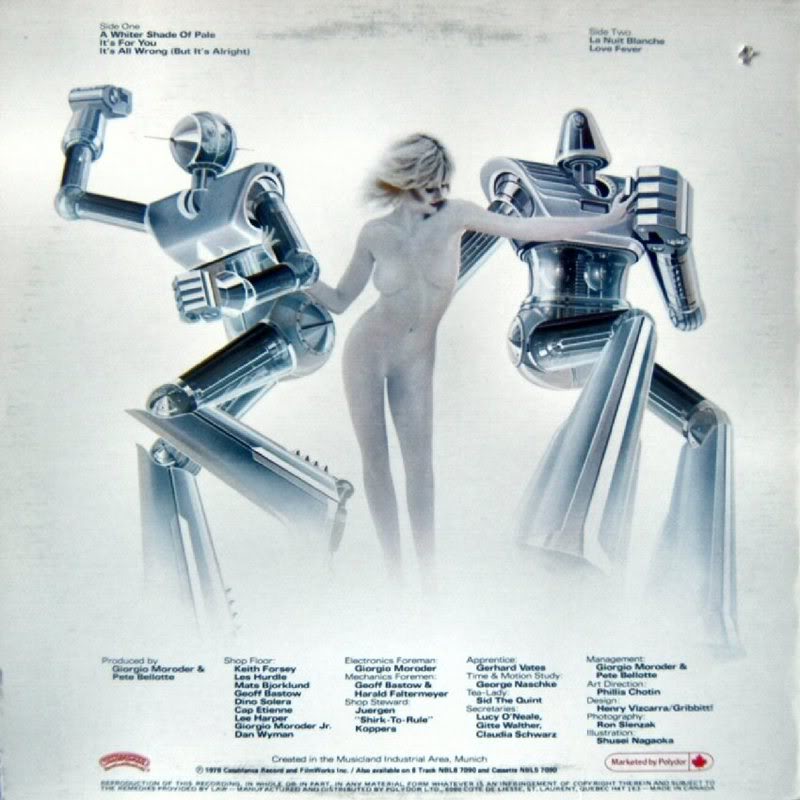
As well, the "Munich Machine" was not just a group of musicians, but also something of a brand for their distinct sound. In a 1978 interview with NME, Moroder branded the distinct sound of his productions and musicians as the "Munich Machine Sound" which the article characterized as their own disco-era, European equivalent of the Motown Sound. Evidently one of the common criticisms of the "Munich Machine Sound" was it's defined, formularized sound, a criticism which as the article points out, doesn't hold up quite as well when compared to the similar assembly-line, organized industrial quality of the Classic Motown sound, for example. Evidently the cover concepts on the first two Munich Machine albums with the dancing robots and the curious credit listings on this LP (musicians credited as the "Shop Floor," singers as the "Secretaries," engineer as the "Shop Steward" etc..) were, at least in part, a reply to that criticism (evidently Rinder & Lewis weren't the only disco producers with a sense of humour). Moroder himself explains it further in some key excerpts from that interview:
"Myself, I liked very much the sound of Motown in the early times, up to seven or eight years ago, but now they do not have such a recognisable feel. Mind you, the actual quality of their first recordings was not good. You know, they recorded in a little building and so on. But the music was good, so very good - and that is why they succeeded."
And quite why Moroder's work should be so disparagingly referred to in some circles as 'product' (as in production line, etc.) when Tamla (Motown) themselves formularised their songwriting - Holland, Dozier, Holland et al - and sound with similar success and without risking culpability is beyond this pair of ears. Tamla even worked out of a similarly and supposedly 'industrial' environment in Detroit.
All of which I put to Moroder, asking more specifically about the relevance of the credit listing on the 'Whiter Shade Of Pale' Munich Machine release (cf. 'shop floor, electronics foreman, mechanics foreman, shop steward, apprentice, time and motion study').
"This, you know, this is just another joke. We know people think this about what we do, so we play up to them. It is the same with the dancing robots on the covers of both Munich Machine records.
"All this talk of machines and industry make me laugh. Even if you use synthesisers and sequencers and drum machines, you have to set them up, to choose exactly what you are going to make them do. It is nonsense to say that we make all our music automatically.
"I know for myself how difficult or how easy it was to get a certain sound. Sometimes it's easy, sure, but as often as not it is at least ten times more difficult to get a good synthesiser sound than on an acoustic instrument. And of course we organise things - who does not? We have to be professional about this. There is nothing wrong with this, surely?"
Looking back today given their success and influence, the Motown comparison rings even more true. Much like Motown had been at it's height, at the time Moroder and company were at the helm of what was undoubtedly one of the most identifiable, defining sounds of the disco era.
As far as 'Munich Machine,' the recording project goes, the best known Munich Machine single would probably be the slick and sexy 15 minute disco workout "Get On The Funk Train" (which reached #7 on the Billboard Disco charts in 1977) off the first and excellent Munich Machine album. Although all three Munich Machine albums are worthwhile (the first two perhaps more so than the last, "Body Shine"), I'd say out of all three, this one has to be my personal favourite. The first album was essentially made up of sped-up, largely instrumental remakes of the so-called "soft-disco" productions from the albums he and Bellotte did for Donna Summer ("Love To Love You Baby," "Try Me I Know We Can Make It"), Roberta Kelly ("Trouble Maker"), as well as from Giorgio's own "Knights In White Satin" LP ("I Wanna Funk With You Tonite") which were all augmented with some heavy, loopy synths here and there for good measure.. This particular album, however, bears less resemblance to that earlier Munich euro-disco sound and a great deal more of the cooler, sharper and decidedly progressive electronic stamp of "I Feel Love" and "Chase" that would eventually become Moroder's most enduring trademark.
Looking back at his output, 1977 and 1978 especially seemed like banner years for Moroder and company. Between "I Feel Love," the first Donna Summer double-album "Once Upon A Time," "From Here To Eternity," the Midnight Express soundtrack and his Battlestar Galactica album which spawned the extended electro symphony that is "Evolution," Moroder seemed to be at the height of an extraordinarily fruitful period, both creatively and commercially.
In addition to all of that, last but certainly not least, I'd also include the "Whiter Shade of Pale" album in that list of notable Moroder productions from that time. Written (aside from the title track, of course) and produced by Giorgio Moroder and Pete Bellotte, this album is perhaps not as well-known as some of the other Moroder-produced works from the time, yet it's not only an excellent, cohesive album but one which seemed to perfectly bridge elements of his more conventional euro-disco/pop leanings with his more adventurous electronic ones ("Evolution," "From Here To Eternity")..
Additionally, this album also seemed like something of a springboard from which to launch vocalist and Moroder protégé, Chris Bennett, who appears beautifully and artfully photographed (along with Shusei Nagaoka's amazing dancing robot artwork, reprised from the first Munich Machine album) on both the front and back covers. Despite that and the album's subtitle ('Introducing Chris Bennett'), this wouldn't be her first release with Moroder. Prior to this, Moroder's earliest collaboration with Chris Bennett was a little-known 7'' single from 1976 called "Disco Man" produced by Giorgio & Pete and released in the UK on a label called Bradley's Records. Although this may not have been her first showcase and, in my opinion, her best vocal performances would come later on the Giorgio & Chris album and Midnight Express soundtrack; nevertheless, this album still represented the first true and full introduction to both her image and her crystal clear voice..
As far as the music goes, moreso than any of the other Munich Machine albums, this one also displayed, perhaps most boldly and beautifully, a flawless combination between that cool, forward-looking, hypnotic electro pulse and the exquisite orchestration and instrumental arrangements, which seem somewhat overlooked these days given Moroder's reputation as a pioneer in electronic music. Putting that aside for a moment, it was not just the electronics, but often the combination between the orchestral and electronic which not only set him apart as a producer, but also, generally speaking, disco as a genre.
One track which displays that combination especially well would be the second track on the album, "It's For You." The combination is evident right from the beginning, which starts off captivating the listener with a heavy robotic pulse and spacey synth, which is then quickly augmented by what sounds like a flute along with those gracefully sublime string arrangements. The beautiful juxtaposition between the two elements practically define this track, with the dreamy elegance of those strings both complimenting and contrasting the mechanical synth sounds, making this track both gentle and intense all at once.. Bennett's vocals exhibit a similar sort of juxtaposition, alternating between a calculated cool on the verses, and an almost pleading intensity on the title refrain with those echoed, multiplied vocal effects..
The title track, a cover of the Procul Harum classic "A Whiter Shade of Pale," with it's brilliant melody and elaborate lyrics (which no one really seems to understand), is perhaps the best display of Bennett's graceful vocals on the album.. Out of all the others, her vocals on this one seem to be more dynamic, expressing a greater range and seemingly hinting at things to come on future efforts.. Granted, the thought of a disco version of this track might seem a little far-fetched at first, but somehow everything seems to gel and the whole thing just seems to work (quite beautifully, I might add). Beyond their jaunty pulse on the surface, the synths, especially further down in the mix seem to have this certain airy, albeit robotic elegance to them that manages to marry elements of the original's misty ambience with the crisp energy of this electronic remake. That, combined with the classic melody of the track; Bennett's clear, unpretentious vocal affectations and the colouring from the sax and strings also give a definite warmth to this track, despite it's energetic electronic sheen. While electronic sounds are often associated with being cold and detached, the kind of electronic warmth found on this track was one especially unique quality that other excellent Moroder productions seemed to have as well (ie. Suzi Lane's "Harmony" to name one). "A Whiter Shade Of Pale" was apparently released as a single in both the US and the UK, making the lower reaches of the UK charts as well as the top 30 of the Billboard Disco Charts..
While the tracks on side one showcased a more conventional vocal style along with a more balanced electronic approach, side two on the other hand (with the exception of "Love Fever") seemed to take things to another level altogether. Opening with "La Nuit Blanche," Moroder's propulsive electronic interpretation of (part of) Richard Strauss'' "Also sprach Zarathustra" (as popularized by "2001: A Space Odyssey") and ending with "In Love With Love," which appears to have been a vinyl-era equivalent of a hidden bonus track (not listed on the back sleeve, but very much in the grooves and printed on the label), side two on the other hand seemed to be more of a showcase for Giorgio's more ambitious, electronic instrumentals.. Overall for me, "In Love With Love" with it's heavily vocodered vocals and beautiful, entrancing variety of shiny synth sounds and changes is the definite standout on side two. One of the things I love is how the track builds in the beginning with those beautiful, blissful synth textures and later seamlessly segues into this intense trance towards the end, with those darker synth sounds replacing the electro-sparkles of the first part. The sounds that they used along with the vocodered vocals on the track seemed to foreshadow (among other things) the direction he would take on both "Chase" and his own "E=mc²" (1979, Casablanca) album, not to mention a certain synth passage (at around 2.11) which bears an uncanny resemblance to something I've heard on a Eurythmics record at some point. Either way, the intricate electronics of "In Love With Love" certainly made a great ending for the album, almost like a kind of musical cliff-hanger ending things on a high point, leaving the listener with an expectation, an exciting glimpse of the future..
Despite the fact that Moroder gets a great deal of credit as an innovator these days (and rightfully so), some of his close collaborators like Pete Bellotte for example, seem to get lost in the shuffle, so to speak. Judging from interviews and the division of credits on his productions, Moroder seems to fall into that category of producers with a 'hands-off' production style, those who prefer to work with a team, leaving some of the details of their vision to an able, ensemble cast of musicians. As opposed to a hands-on producer putting their hands in practically every aspect of the recording, Moroder, judging in part from a 1996 interview with Future Music admitted: "I`ve rarely done a whole recording by myself." Despite the hands-off style, it certainly seems to speak to his ideas and his abilities as a producer that the sound of most of his productions still clearly bear his stamp more than anything else. Although as a result, it may be difficult at times to know just where Moroder's input ended and his co-producers' came in, it at least seems to explain the equal credit given to his co producers (usually Pete Bellotte or Harold Faltermeyer) on albums like this one and others.
Aside from the lyrics where Bellotte's contribution is much more clear, judging from Bellotte's style on his own solo productions (ie. Melba Moore's "Burn" LP, Marsha Hunt, Trax etc..), I can only speculate that his input also seemed to be pretty strong on the more acoustic, instrumental elements when it came to his productions with Moroder. Given that, Bellotte's stamp on this record is perhaps most evident on the two most instrumentally elaborate tracks on the album: "It's All Wrong (But It's Alright)" on side one with it's lyrical narrative and dramatic Spanish-inspired horn section, and "Love Fever" on side two. Although perhaps debatable on "It's All Wrong..," "Love Fever" seems to bear the closest resemblance to his solo productions with the quick intricacy of those background guitars and the dynamic, prominent horn arrangements, all of which seem to bear Bellotte's signature style.
This album would probably the last actual Munich Machine album that could be considered a guise for Moroder's backup band. The final Munich Machine album "Body Shine" (1979, Casablanca) seemed to move away from the original more anonymous concept of the first two albums and and into more of a conventional "band" formula. By that point, the 'band' officially consisted of Günter Moll, Stefan Wissnet along with singers Judith Jones and Yolande Howard with all four actually pictured on the back cover. With Moll and Wissnet also having production credit alongside Moroder, that record also had a significantly different sound to this one as well as to many of the other things Moroder was putting out at the time. In 1996, all the tracks from the first Munich Machine album along with this one were released on a CD compilation called "Get On The Funk Train," (1996, Oasis/Bud Music). Long out of print, it's not one which shows up often, in fact I've only ever seen the CD once on eBay. Needless to say, it was completely out of my price range at the time but I did manage to save a picture of it, in case anyone's curious about what it looks like. Luckily, I'd also acquired a CD rip of the compilation later on which is the next best thing, I suppose (and is where all the tracks up here come from)..
On future albums Chris Bennett would go on to be one of Moroder's most frequent collaborators, not only as a singer but as a songwriter, contributing lyrics and vocals for quite a few of his projects, most notably the Midnight Express soundtrack for which she'd share in it's Academy Award nomination. Another notable collaboration would be the duet album they'd do together as Giorgio & Chris, "Love's In You, Love's In Me" (1978, Casablanca), which given the romantic tone of much of it, makes me wonder if they were more than just creative collaborators at the time.. Based in Los Angeles these days, Bennett had reinvented herself as a contemporary jazz chanteuse in the 1990's, having recorded some seven albums since then in addition to her disco work. If anything, I'd say that the lady still looks and sounds great today. You can see and hear for yourself on her Myspace page and on her official website.
Given not only Moroder's legacy but the excellence of much of his disco output, hopefully this along with the other Munich Machine albums (and other out of print Moroder-produced records) will be revisited for future reissue at some point. Although like many disco producers at the time, Moroder seemed to be putting out records with such frequency, it seems inevitable that a few would have gotten lost in the shuffle, which probably explains why this one doesn't seem to be talked about or cited too often these days. While this album may not be among his more iconic productions, it was nonetheless an excellent record showing one of disco's greatest producers and production teams at the top of their game.
PREVIOUS RELATED ENTRIES:
DISCO DELIVERY #14: SUZI LANE - OOH LA LA (1979, ELEKTRA) (SATURDAY APRIL 8, 2006)
DISCO DELIVERY #5: GIORGIO MORODER - FROM HERE TO ETERNITY (1977, OASIS/CASABLANCA) (FRIDAY FEBRUARY 3, 2006)
LINKS:
MUNICH MACHINE @ DISCOGS
MUNICH MACHINE - A WHITER SHADE OF PALE LP (REVIEW) @ ALL MUSIC GUIDE
MUNICH MACHINE - A WHITER SHADE OF PALE LP @ DISCOGS
MUNICH MACHINE - A WHITER SHADE OF PALE LP @ DISCOMUSIC.COM
GIORGIO MORODER @ ALL MUSIC GUIDE
GIORGIO MORODER @ DISCOGS
GIORGIO MORODER @ WIKIPEDIA
GIORGIO MORODER @ JAHSONIC
MORODER'S MUSIC
GIORGIO MORODER: FATHER OF COMPUTER DISCO
MORODER-SUMMER TRIBUTE
GIORGIO MORODER COVER GALLERY
GIORGIO MORODER INTERVIEW WITH FUTURE MUSIC (1996)
MORODER'S MUSIC: GIORGIO MORODER INTERVIEW WITH NME (DECEMBER 9, 1978)
PETE BELLOTTE @ ALL MUSIC GUIDE
PETE BELLOTTE @ DISCOGS
BBC NEWS: IN TUNE WITH BRITAIN'S DISCO KING (PETE BELLOTTE INTERVIEW) (SEPTEMBER 19, 2004)
CHRIS BENNETT @ DISCOGS
CHRIS BENNETT @ WIKIPEDIA
CHRIS BENNETT @ ALL MUSIC GUIDE
CHRIS BENNETT'S OFFICIAL WEBSITE
CHRIS BENNETT'S OFFICIAL MYSPACE
PROCUL HARUM - BEYOND THE PALE: MEANINGS IN "A WHITER SHADE OF PALE"
PROCUL HARUM - BEYOND THE PALE: COVER VERSIONS OF "A WHITER SHADE OF PALE"
SONGFACTS: A WHITER SHADE OF PALE BY PROCUL HARUM
BBC NEWS: WHAT IS THE LIGHT FANDANGO? (NOVEMBER 14, 2006)
"A WHITER SHADE OF PALE" @ WIKIPEDIA
SHUSEI NAGAOKA GALLERY
CATEGORIES: DISCO DELIVERIES, WHAT EVER HAPPENED TO..


