Showing posts with label Motown. Show all posts

Sunday, March 21, 2021

Vintage Articles:
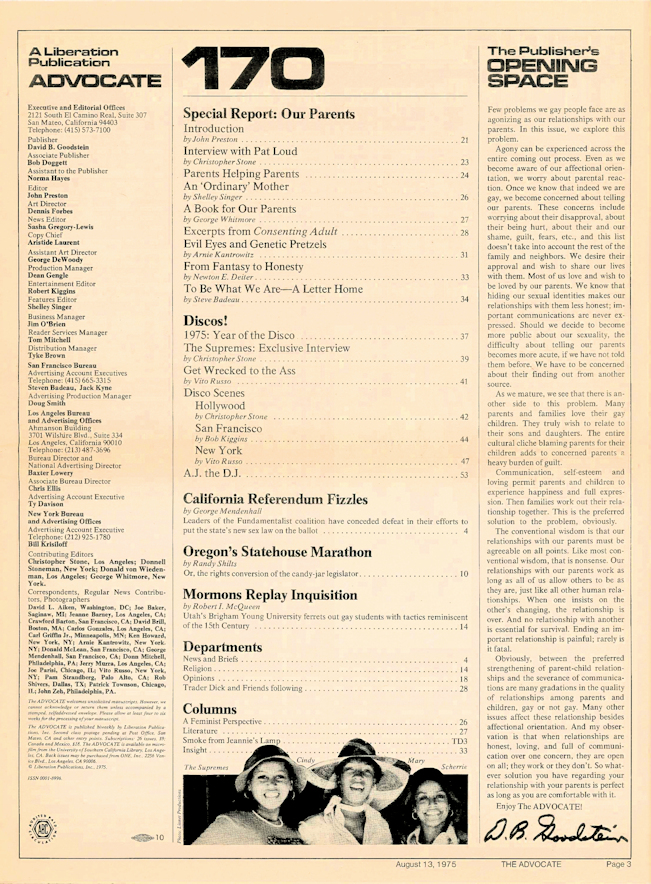
Exclusive Supremes Interview -
by Christopher Stone // The Advocate -
August 13, 1975


It has been over a month since the sudden passing of original Supreme Mary Wilson at age of 76, just weeks before her 77th birthday. Unfortunately we’re at that time when many of the musicians I’ve either written about or have been part of the music on this blog are passing away, that’s besides the pandemic we are in right now, when so many are dealing with death and loss.

Mary’s passing prompted me to go into my archives where I found some old issues of The Advocate that I had scanned several years ago. Still the American LGBT publication of record, their August 1975 Discos! issue is where I found this particular article - an exclusive interview with The Supremes by frequent Advocate entertainment contributor and editor Christopher Stone, who is still active today as an author in gay fiction and non-fiction.

I’ve covered The Supremes here on the blog several times in the past, so it’s no surprise that I have a soft spot for the last two Supremes lineups. While those groupings had less pop success than previous incarnations, they had some of their greatest showings in the discos, which certainly further solidified their loyal gay following, a fact that’s well-highlighted in this particular article. Their current single at the time “He’s My Man” was perfectly primed for disco action and marked something of a comeback for the group after a near 2 year gap between releases.

The interview generously touches on the strong gay following they have, namely the fondness drag performers had for them. While here Mary laments that they had yet to go to a gay venue to see any of the drag tributes to them, interestingly a few years ago, a defunct local publication here in Toronto where I live had a regular Then & Now column written by DJ and writer Denise Benson, documenting memories of bygone local clubs and discos. Her columns have since been compiled into a book, but I recall one particular column on a club called David’s which featured a memory of this particular lineup of Supremes making a surprise appearance there to judge a drag competition, probably not long after this interview had been conducted.

By this time the group consisted of Mary Wilson as the sole remaining original member, plus the return of Cindy Birdsong and the new addition of Scherrie Payne as their primary lead vocalist. Though Payne doesn’t have a great deal of quotes in this interview, Mary and Cindy’s comments here more than hint at their internal struggles with Motown and the uphill battle before them trying to re-establish The Supremes as a musical presence.

Though The Supremes would only last a couple more years as an active entity, Mary’s battle for recognition was really only just beginning. It would be the better part of a decade before her first book, Dreamgirl - My Life As A Supreme would come out and help turn the tide against the official line at the time which seemed to marginalize The Supremes as little more than Diana Ross’ launching pad, with Wilson and the late Florence Ballard as mere musical footnotes.

Together with the social discussions that have been rippling through society lately, the #metoo movement among them, has me thinking about what it means to be a woman, a black woman, in an industry that has often denied one's agency on both grounds. While I am neither, so many of the artists that I love are. That being said, even I have to admit that I have at times been guilty of that casual sexism that often exists in musical coverage, where often so much emphasis and credibility is placed on the (usually male) producer as the creative driver that the agency and artistry of the woman (usually the vocalist) goes underrepresented and unacknowledged even on work that bears their name.

Certainly when we talk about agency, Mary’s legacy is a testament to it. While much has been written about Diana Ross’ legendary ambition and tenacity, she certainly wasn’t the only Supreme with grit and determination. As someone who sustained a long performing career herself, Mary Wilson had to fight an uphill battle for agency nearly every step of the way. After spending years on the wrong side of Motown politics, battling the label throughout much of the 1970s and 80s (well documented in her second book and subsequent updates), she had emerged in the last decades of her life not only a seasoned performer, but an astute operator in the politics of the music industry and a tireless ambassador for the Motown legacy. To the point where her efforts helped change laws in Washington, she also ended up cultivating a working relationship with Motown's parent company, Universal Music, having been a part of practically every Supremes release and re-issue in the past 20 some years. It was perhaps a much more generative relationship than the one she had with the old Motown label when this article was written.

To paraphrase what the lady herself said in a 2017 interview; unlike some of her contemporaries, she had a chance to fight back and show the world what she was made of.

Rest in Peace and Power Ms. Mary Wilson.
____________________________________________


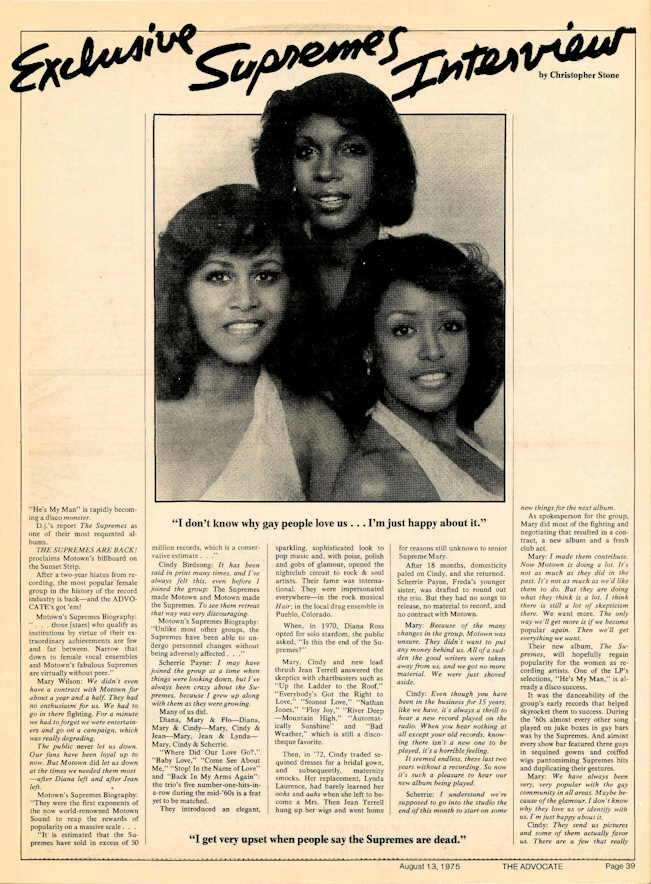
Exclusive Supremes Interview
By Christopher Stone

He’s My Man” is rapidly becoming a disco monster.

D.J.’s report The Supremes as one of their most requested albums.

THE SUPREMES ARE BACK! proclaims Motown’s billboard on the Sunset Strip.

After a two-year hiatus from recording, the most popular female group in the history of the record industry is back - and the ADVOCATE’s got ‘em!


Motown’s Supremes Biography: “…those [stars] who qualify as institutions by virtue of their extraordinary achievements are few and far between. Narrow that down to female ensembles and Motown’s fabulous Supremes are virtually without peer.”

Mary Wilson: We didn’t even have a contract with Motown for about a year and a half. They had no enthusiasm for us. We had to go in there fighting. For a minute we had to forget we were entertainers and go on a campaign, which was really degrading.

The public never let us down. Our fans have been loyal up to now. But Motown did let us down at the times we needed them most - after Diana left and after Jean left.


Motown’s Supremes Biography: “They were the first exponents of the now world-renowned Motown Sound to reap the rewards of popularity on a massive scale… “It is estimated that the Supremes have sold in excess of 50 million records, which is a conservative estimate…”


Cindy Birdsong: It has been said in print many times, even before I joined the group: The Supremes made Motown and Motown made the Supremes. To see them retreat that way was very discouraging.

Motown’s Supremes Biography: “Unlike most other groups, the Supremes have been able to undergo personnel changes without being adversely affected…”

Scherrie Payne: I may have joined the group at a time when things were looking down but I’ve always been crazy about the Supremes, because I grew up along with them as they were growing.

Many of us did.

Diana, Mary & Flo - Diana, Mary & Cindy - Mary, Cindy & Jean - Mary, Jean & Lynda - Mary, Cindy & Scherrie.

Where Did Our Love Go?,” “Baby Love,” “Come See About Me,” Stop! In the Name of Love” and “Back In My Arms Again”: the trio’s five number-one-hits-in-a-row during the mid-’60s is a feat yet to be matched.

They introduced an elegant, sparkling, sophisticated look to pop music and, with poise, polish and gobs of glamour, opened the nightclub circuit to rock & soul artists. Their fame was international. They were impersonated everywhere-in the rock musical Hair; in the local drag ensemble in Pueblo, Colorado.


When, in 1970, Diana Ross opted for solo stardom, the public asked, “Is this the end of the Supremes?”


Mary, Cindy and new lead thrush Jean Terrell answered the skeptics with chartbusters such as “Up The Ladder to the Roof,” “Everybody’s Got the Right to Love,” “Stoned Love,” “Nathan Jones,” “Floy Joy,” “River Deep-Mountain High,” “Automatically Sunshine,” and “Bad Weather,” which is still a discotheque favourite.

Then, in ’72, Cindy traded sequinned dresses for a bridal gown and subsequently, maternity smocks. Her replacement, Lynda Laurence, had barely learned her oohs and aahs when she left to become a Mrs. Then Jean Terrell hung up her wigs and went home for reasons still unknown to Supreme Mary.

After 18 months, domesticity paled on Cindy and she returned. Scherrie, Freda’s younger sister, was drafted to round out the trio. But they had no songs to release, no material to record, and no contract with Motown.

Mary: Because of the many changes in the group, Motown was unsure. They didn’t want to put any money behind us, All of a sudden the good writers were taken away from us, and we got no more material. We were just shoved aside.

Cindy: Even though you have been in the business for 15 years, like we have, it’s always a thrill to hear a new record played on the radio. When you hear nothing at all except your old records, knowing there isn’t a new one to be played, it’s a horrible feeling.

It seemed endless, these last two years without a recording. So now it’s such a pleasure to hear our new album being played.


Scherrie: I understand we’re supposed to go into the studio the end of this month to start on some new things for the next album.

As spokesperson for the group, Mary did most of the fighting and negotiating that resulted in a contract, a new album and a fresh club act.

Mary: I made them contribute. Now Motown is doing a lot, It’s not as much as they did in the past. It’s not as much as we’d like them to do. But they are doing what they think is a lot. I think there is still a lot of skepticism there. We want more. The only way we’ll get more is if we become popular again. Then we’ll get everything we want.

Their new album, The Supremes, will hopefully regain popularity for the women as recording artists. One of the LP’s selections,”He’s My Man,” is already a disco success.

It was the danceability of the group’s early records that helped skyrocket them to success. During the ‘60s most every other song played on juke boxes in gay bars was by the Supremes. And almost every show bar featured three guys in sequinned gowns and coiffed wigs pantomiming Supremes hits and duplicating their gestures.

Mary: We have always been very, very popular with the gay community in all areas. I don’t know why they love us or identify with us. I’m just happy about it.

Cindy: They send us pictures and some of them actually favor us. There are a few that really favour Diana. You know - the same eyes.

Mary: Why we have never gotten around to a gay bar to see one of these groups, I don’t know.

Cindy: They sometimes come backstage wearing jeweled gowns. From a distance you might actually think they were the Supremes. You know the wigs we used to wear? Their wigs would be almost identical. Their gowns would be something similar to something we had worn in the past.

Little was heard from the Supremes last year, but an ex-group member was making news. Florence Ballard, who was heard on over 20 of the trio’s hit records, was discovered living on welfare with her mother in a ghetto neighborhood.

Motown’s Supremes Biography: “In ’67 Cindy Birdsong stepped in to replace Florence Ballard, who had grown weary of the hectic pace of show business, preferring marriage and family.”

Rumors have persisted that Flo did not prefer to leave, but was forced into retirement.

Cindy frankly discussed the woman she had replaced: Florence was my favorite before I joined the group, because she was so outgoing and she welcomed strangers openly. I never thought I would be taking her place. When I met the Supremes, I was a member of Patti Labelle & the Bluebelles. Girl groups didn’t get along too well. Ignoring that, I became friends with the Supremes. I like their group - their style. Of course, I always loved our group. I thought we were better than them.

I knew the Supremes were having a lot of problems. The way Florence left was … rather … bluntly. It seemed that they just scooped her out of there so fast. She was on stage one night and I was on stage the next. She didn’t have any idea that she wasn’t going to be on that stage the night I replaced her.

I guess a lot of people point the finger at me. I came in there so fast. I was on stage within a day and a half after I joined the group. Of course, I was so wrapped up in what was happening to me that I didn’t really consider Florence. But I felt funny about it because I found out a little of what was really going on just before I went on stage.


And how do they feel about that other ex-Supreme - the one they performed several paces behind when they were re-dubbed Diana Ross & The Supremes?

Cindy: All those rumours about fights are completely untrue. I think our relationship with her is better then when she was singing with us - when we were singing with her.

Mary: We’re probably better friends now than we’ve ever been. That’s not saying that we see each other every day. But I think we’ve both grown up a lot. I see her… maybe once every time I’m home.

Cindy: Our paths cross so infrequently because she is busy with a movie career.

Mary: I thought she did a fantastic job in Lady Sings The Blues.

Cindy: She should have gotten the Oscar, I thought.

The Supremes are not preoccupied with the past. They’d much rather talk about the 50 million records they hope to sell rather than the 50 million-plus already sold. They have emerged from a crucial, grueling two years confident, rested and real.

Cindy: Everything has gotten very casual and relaxed. You see how we come dressed for an interview (she tugs on her T-shirt). When I first joined the group we would have walked in here decked out like we were going to church on Sunday - almost with gloves and hats on. Our lashes would not be missing.

Mary: With the responsibility of getting things back in order, we have not had as much of the fun or excitement as before.

Cindy: Scherrie asked, “Where are all the guys you told me I was going to meet?”

Mary: And all the glamorous parties …

Cindy: Scherrie’s the only single one now.

Mary: Don’t worry, Scherrie. It’ll all come in time.

Hit records, television, Vegas. “It’ll all come in time” seems to sum up the feelings of these optimistic voices.

Mary: For the mass public, we have not been around. For us, we’ve never stopped. Sometimes I get very upset when people say “Well, the Supremes are dead.” DEAD HOW? We work just as much as we’ve ever worked. In fact, we’re trying to cut down some of our work because we each have families and other things we want to do.

We’ve been popular among our fans. It’s the mass public, the people all over the world that you have to reach through television and records, that we have not been popular with. But that’s because we have not been involved in those mediums for two years. We’ve got to saturate those two markets again.

They say the other groups, the Three Degrees, Labelle, are beating us. I think they still have a long way to go before they can catch up with us.

As far as I’m concerned, the Supremes have never died, honey … I want everyone to know that
____________________________________________


PREVIOUS RELATED ENTRIES:
disco delivery #51: the supremes - high energy (1976, motown) (saturday january 26, 2008)
the supremes - mary, scherrie & susaye (reprise) (thursday march 8, 2007)
disco delivery #1: the supremes - mary, scherrie & susaye (1976, motown) (tuesday january 10, 2006)

LINKS:
the guardian - mary wilson: the supremes' tenacious star who refused to accept defeat (by alexis petridis) (tuesday february 9, 2021)
new york times - mary wilson, co-founder of the supremes, dies at 76 (by derrick bryson taylor) (february 9, 2021)
rolling stone - lamont dozier remembers mary wilson: ‘she was the glue that kept the supremes together’ (by elias leight) (february 9, 2021)
rolling stone: mary wilson's tireless music business advocacy (by ethan millman) (february 12, 2021)
soulmusic.com - motown spotlight february 2021 - mary wilson (by sharon davis)
eur web - mary wilson: reflections of a supreme journey! (by scherrie payne) (february 14, 2021)
the irish post - tribute to a musical legend: remembering mary wilson of the supremes (by michael j. mcdonagh) (march 3, 2021)

wikipedia: the supremes (1975 album)
discogs: the supremes - s/t lp
the funk & soul revue - rare cut: the supremes - he's my man (by george haffenden) (october 28, 2017)
christopher stone - author


CATEGORIES: VINTAGE ARTICLES, INTERVIEWS, IN MEMORIAM

Saturday, August 18, 2012

I've got love on my mind..


Held down by the most basic of disco basslines, this little number from 1979 comes courtesy of Marilyn McLeod, sister of the late Alice Coltrane, grandmother of Flying Lotus (who records for the über-hip Stones Throw and Warp labels), and also more importantly, one of Motown's most prolific staff songwriters of the 1970s. Alongside Pam Sawyer (with whom she also co-wrote this song), she had written classics like Diana Ross' "Love Hangover," and High Inergy's "You Can't Turn Me Off (In The Middle of Turning Me On) " (said to be originally intended for Ross). Outside of Motown, McLeod would also co-write one of Anita Baker's hits, "Same Ole Love" from her breakthrough "Rapture" (1986, Elektra) album, just to name a few.

Listen: (I Don't Wanna Dance Tonight) I Got Love On My Mind (1979, Fantasy)
Listen: (I Don't Wanna Dance Tonight) I Got Love On My Mind (Instrumental) (1979, Fantasy)

Produced by McLeod, Sawyer and Mel Bolton (also a Motown alumni and frequent collaborator), this song seems to recall elements of both of those earlier Diana Ross and High Inergy songs, (albeit with some added late disco tempo and thrust), with its sexy string-laden groove and tender vocal touch. Combining that unstoppable bassline, a delicate string arrangement and Marilyn's engaging, unaffected vocal style; this is possibly one of the most danceable songs about not wanting to dance that had ever been released. Call it a bit of before-the-bedroom boogie, if you will.

On a disco related tip; around this time, McLeod and Sawyer would contribute heavily to co-writer/producer Mel Bolton's group Flakes, who are probably best known for their disco singles "Miss Fine Lover" and "Sugar Frosted Lover" from 1979 and 1980, respectively. Both Bolton and McLeod would produce both of the Flakes albums, the last of which was released on the Salsoul label in 1981.

Despite McLeod being one of the more high profile Motown staff writers of the 70s, this single would remain one of McLeod's few releases under her own name. Among those few releases though was a notable 1978 promo album, borne out of a Motown campaign aimed at promoting some of their staff songwriters, for which McLeod and Sawyer were the first to be chosen, entitled "Pure Magic: The Songs of Pam Sawyer and Marilyn McLeod" with McLeod providing vocals on the bulk of the record. In a Billboard article promoting the Pure Magic release, it was mentioned that McLeod would be doing more recording of her own for Motown, under the name Supercloud, which apparently never materialized. More recently however, McLeod has been getting some attention for her work again, having released an album of her own in 2010, and with one of her earliest efforts at Motown - "A Heart is a House" with The Nu Page (a group which also included Mel Bolton) getting some positive notices via the recently released compilation "Our Lives Are Shaped By What We Love: Motown's MoWest Story 1971-1973" released last year on noted reissue label Light In The Attic, chronicling some of the long-forgotten singles from Motown's short-lived west coast imprint.

This particular song has also been gaining some notice on its own, too; with the vocal version having been included on one of the most recent installments of Harmless' Disco Discharge series, on their "American Hot" compilation (released this past March). In 2010, primo disco editor/producer Jacques Renault also got his hands on it, releasing a crafty edit/mashup entitled "Marilyn's Gold," combining this song's instrumental track with a break which (i believe) comes from First Choice's "The Player."


While on the subject, given the similar song titles, one can't help but draw a possible connection to one of Natalie Cole's greatest hits of the 70's, "I've Got Love On My Mind." Two very different songs to be sure, but both close enough in both title and essential feeling, that even if this wasn't inspired by it, it sure makes a nice disco response to it (at least in my mind, anyway).. Whatever the case is, if you're not going out and don't wanna get lost in a crowd, here's one way to enjoy some disco love tonight..

PURCHASE:
VA - DISCO DISCHARGE: AMERICAN HOT (2 CD)
AMAZON.CO.UK

PREVIOUS RELATED ENTRIES:
DISCO DISCHARGE AND OTHER RECENT/UPCOMING DISCO RELEASES & REISSUES (FRIDAY SEPTEMBER 18, 2009)
COME PUT OUT THE FIRE.. (TUESDAY JULY 24, 2007)
DISCO DELIVERY #6: FIRST CHOICE - THE PLAYER (1984, PHILLY GROOVE/BELL) (FRIDAY FEBRUARY 10, 2006)

LINKS:
DISCOGS: MARILYN MCLEOD - (I DON'T WANNA DANCE TONIGHT) I GOT LOVE ON MY MIND 12"
DISCOGS: VARIOUS - DISCO DISCHARGE: AMERICAN HOT (2 CD)
DISCOGS: PAM SAWYER
DISCOGS: MEL BOLTON
GOOGLE BOOKS: BILLBOARD MAGAZINE (SEPTEMBER 2, 1978) - JOBETE WRITERS SING ON LPS (BY JEAN WILLIAMS)
MOTOWN 50 PODCAST - THE ANATOMY OF A HIT: LOVE HANGOVER (PART 1)
PHOENIX NEW TIMES: MARILYN MCLEOD OF THE NU PAGE ON MOTOWN, MOWEST, ALICE COLTRANE AND FLYING LOTUS (BY JASON WOODBURY) (TUESDAY JULY 19, 2011)
JAZZ CORNER: MARILYN MCLEOD: A HIT MOTOWN SONGWRITER WITH A COLTRANE CONNECTION
JAZZ CORNER: NEW CD FROM MARILYN MCLEOD, AN ARTIST WITH A MOTOWN LEGACY AND COLTRANE CONNECTION
TWINN RECORDS

CATEGORIES: MINI DELIVERIES, NUDISCO

Thursday, September 24, 2009

Get up on it and ride..


The Temptations - Bare Back (1978, Atlantic)

The Temptations - Mystic Woman (Love Me Over) (1978, Atlantic)
The Temptations - Touch Me Again (1978, Atlantic)


For the record, while I'm definitely not endorsing any of the practices supposedly suggested or implied in this song, I do heartily endorse it's groove.

The title track from The Temptations' "Bare Back" (1978, Atlantic) album, their second and last during their brief, unsuccessful period on the Atlantic label in the late 70's, this was a single, but like all of their other Atlantic material, never went anywhere commercially. Supple basslines, spirited vocals (largely courtesy of lead vocalist Richard Street), and propulsive bass-heavy groove aside, perhaps it was better that it didn't, in retrospect. I suppose using the expression "riding bareback" as a metaphor for life and living may have been acceptable in 1978 pre-AIDS; to say that it's an expression which hasn't held up too well over the years would probably be an understatement. Then again, I suppose that depends entirely on one's perspective..

However, with the great production and the admittedly out-of-context naughtiness one can't help but read into it today, I personally can't get enough of it. With this track and practically the entire album produced and co-written by Motown veteran Brian Holland alongside brother Eddie Holland and their main writing partner at this time, Harold Beatty (essentially Lamont Dozier's replacement), this is just one of the many excellent, underrated productions that the Holland Brothers were involved with at the time. While there's no topping the legacy of Holland-Dozier-Holland as pop songwriters, Eddie Holland's bright, funk-bottomed, disco flavoured productions in the late 70's for acts like The Supremes (covered on here before), The Jackson 5, Eloise Laws and others like the short-lived group, New York Port Authority are top quality, in my opinion..

As far as the album goes, In spite of having pulled together a top-flight team of Philadelphia's finest (which included Norman Harris and future group member Ron Tyson) on their first Atlantic LP, "Hear To Tempt You" (1977, Atlantic), out of their two Atlantic albums, I'd consider this to be the best of them. While not as ambitious as their Norman Whitfield material, or their last big Motown record, the Jeffrey Bowen-produced "A Song For You" (1975, Gordy/Motown), the other disco-flavoured tracks on the record like "Mystic Woman (Love Me Over)" and "Touch Me Again," the sublime balladry in "Ever Ready Love" (also a single), and "I See My Child" (the only track not written by Holland, Beatty and Holland) make it solid and satisfying, nonetheless.

While I can't imagine any of the current Tempts revues get too many requests in their shows for the song in question, thankfully You Tube has video. One from a 1979 live performance on the Chicago TV show Soundstage, and another from the ever-reliable Soul Train. Also from the same Soul Train appearance, is a performance of one of the album's ballad tracks "Ever Ready Love," which, if I'm not mistaken, might have been their final single release for Atlantic.


The Temptations - Bare Back (1978)
Uploaded by 2007wiifit


Temptations - Bare Back (Soundstage Chicago 1979)
Uploaded by whatiship73


The Temptations - Ever Ready Love (1978)
Uploaded by 2007wiifit


PREVIOUS RELATED ENTRIES:
WHITNEY DOES LOLEATTA.. (FRIDAY AUGUST 7, 2009)
R.I.P. MICHAEL JACKSON (FRIDAY JUNE 26, 2009)
DISCO DELIVERY #51: THE SUPREMES - HIGH ENERGY (1976, MOTOWN) (SATURDAY JANUARY 26, 2008)
DISCO DELIVERY #41: TÁTA VEGA - TRY MY LOVE (1978, MOTOWN) (SATURDAY MAY 19, 2007)
THE SUPREMES - MARY, SCHERRIE & SUSAYE (REPRISE) (THURSDAY MARCH 8, 2007)
DISCO DELIVERY #12: DAMON HARRIS - SILK (1978, WMOT/FANTASY) (FRIDAY MARCH 24, 2006)
ALL I NEED'S A LITTLE POWER.. (WEDNESDAY FEBRUARY 22, 2006)
DISCO DELIVERY #1 - THE SUPREMES - MARY, SCHERRIE & SUSAYE (1976, MOTOWN) (TUESDAY JANUARY 10, 2006)

LINKS:
DISCOGS: THE TEMPTATIONS - BARE BACK LP
ALL MUSIC GUIDE: THE TEMPTATIONS - BARE BACK (REVIEW)
DISCOGS: BRIAN HOLLAND
ALL MUSIC GUIDE: BRIAN HOLLAND
WARR.ORG: THE TEMPTATIONS - BARE BACK (REVIEW)
ROBERT CHRISTGAU REVIEWS: THE TEMPTATIONS

CATEGORIES: MINI DELIVERIES, VISUAL DISCO

Saturday, January 26, 2008

Disco Delivery #51:
The Supremes - High Energy (1976, Motown)


The Supremes - High Energy
The Supremes - I'm Gonna Let My Heart Do The Walking
The Supremes - I'm Gonna Let My Heart Do The Walking (Extended Version)
The Supremes - Only You (Can Love Me Like You Love Me)
The Supremes - You Keep Me Moving On
The Supremes - You're What's Missing In My Life

A couple of years ago (yikes), I had done my first post on here on The Supremes excellent final album, "Mary, Scherrie & Susaye" (1976, Motown). I had promised another Supremes post a while back, so I figured I might as well do it now..

Produced by Brian Holland and executive produced by Edward J. Holland, both of the legendary Holland-Dozier-Holland production team, arranged by Dale Warren and featuring star session players like Wah-Wah Watson (credited here as Melvin Ragin, as on most of his Motown sessions), Joe Sample and even Ray Parker, Jr., this LP seemed to mark a reunion of sorts, being the first full album the Holland brothers (this time minus Lamont Dozier) had produced for the group since the 1960s. However, unlike it's predecessor or it's follow-up record (which the Holland brothers also produced), I don't really consider this particular album to be among their better records. In fact, I've always found this to be a rather average album at best. What salvages this album though, are the two disco classics that open the record, "High Energy," and "I'm Gonna Let My Heart Do The Walking," the latter being their last top 40 hit in the US and their biggest in a while by this point. Although the pop success that once defined them had long since faded, these two tracks are definitely among some of The Supremes' strongest records of the 70's, both having performed quite well in the discos - "I'm Gonna Let My Heart.." peaking at #3 and "High Energy," (which wasn't even a single) peaking at #9 on the Billboard disco charts.

By this point The Supremes were on their fourth and final lineup (Mary Wilson, Scherrie Payne & Susaye Greene) since Diana Ross' departure, with longtime member Cindy Birdsong having departed (or rather having been fired by Wilson's then husband/group manager) just after the album was completed. Enter Susaye Greene; widely known these days as "The Last Supreme," the pint-sized multi-octave vocalist already had quite an accomplished resume upon joining the group, having worked with the likes of Ray Charles, Stevie Wonder, New Birth and having written for Deniece Williams (and later on, Michael Jackson post-Supremes). Having joined just after the album was finished, Birdsong's background vocals were evidently kept in the mix, with Susaye's vocals overdubbed on a few songs (although Susaye herself disputes this, saying she was in fact on all of them).. Regardless of the circumstances surrounding it, "High Energy," the album opener and title track is, quite appropriately, the defining statement of this album. Reportedly intended for departed member Birdsong, Greene, in her recording debut with the group (and one of her few full lead vocals for The Supremes) puts her indelible stamp on it; her soaring vocals perfectly complimenting the lush, high flying arrangements. Harold Beatty, the Holland Brothers' main collaborator on the album and co-writer of this song explained to writer Brian Chin years later (for his essay on the Supremes Box Set): "I always liked the lushness of a symphony, that's where the concept behind the 'High Energy' album came about." An elegant disco-funk opus, nothing else on the album would summarize Beatty's concept better. Combining the rich sounds of orchestral disco, the assertiveness of Norman Whitfield and Isaac Hayes' funk symphonies with the well-established grace and class of The Supremes, "High Energy" seemed like a bold step forward..

Despite not sounding anything like the synthesized disco subgenre of the 80s that would take it's name, one would be hard-pressed to deny the uplifting feeling of this track. With an entrancing looped guitar (?), warm keys, orchestral tympanis and a burning wah-wah laying the foundation in the intro - which runs nearly two minutes before Mary Wilson's sensual spoken intro kicks in: "share what you got to keep what you need, right?.... Wrong!," the song has an incredible, understated buildup. With Susaye's vocals right in the stratusphere by the second half of the song, complimented by those string washes and serene background vocals (anyone else hear shades of Marvin Gaye's "I Want You" here?), the track peaks in truly epic, exciting fashion towards the end..

"I'm Gonna Let My Heart Do The Walking," the second track into the album, is for me another one of those disco songs which radiate nothing but pure, unadulterated joy. It's likely the best remembered track on the album, and perhaps the most enduring out of all The Supremes' disco hits. Opening with those unforgettable strutting drums and percussion, propelled along by Wah-Wah Watson's scorching guitar work; with it's rousing, uplifting arrangement and it's empowering theme, "I'm Gonna Let My Heart Do The Walking" proved to be a surefire winner.. Between Scherrie Payne's confident, brassy vocals being a perfect fit for the track's theme, understated string sweetening, wah-wah going wild towards the end, it's a pity this never got a true extended remix. With all the amazing elements in play here, the possibilities for not only extending it's length, but for heightening the song's feeling seem endless. At a perfunctory three and a half minutes in length, it certainly speaks to it's excellence that it did as well as it did in the discos, and continues to be a mainstay today.

So far, the only official 'extended' version of this song seems to be a four minute version, that if I'm not mistaken, was unreleased until it's inclusion on the Motown compilation "Funkology, Volume 3" (1996, Motown). Less of a special extended disco mix and more like a slightly longer alternate mix, the main difference with the extended mix seems to be a new bridge placed earlier in the song, which, at least to me, seems to throw a bit of a wrench into the upward, uplifting dynamic of the song.

The rest of Side A is filled out with the two remaining uptempo tracks on the album: "Only You (Can Love Me Like You Love Me) and "You Keep Me Moving On." While they don't exactly live up to the excellence of the first two tracks, they're probably among some of the more enjoyable tracks on the album with Scherrie Payne's vocals making all the difference, injecting them with enough energy to carry them across, even in some of their more laboured sections (some of the verses in "You Keep Me Moving On," for example).. For me, the most exciting of these two tracks would have to be "Only You..," with it's bold intro, memorable refrain, and the background vocals' perfect, balanced interplay with the lead, which add a great deal to the track..

As far as the rest of the record goes, Side B was pretty much turned over to the ballads, largely featuring Mary Wilson on vocals. Although tracks like "Don't Let My Teardrops Bother You," a cover of an earlier Dionne Warwick (in her Dionne Warwicke days) song and a medley pairing an original "Til The Boat Sails Away" with the Thom Bell/Linda Creed standard "I Don't Want To Lose You," (originally for The Spinners) spotlighted Mary's vocals quite well; the latter, in particular, with it's sparse arrangement and 8 minute length, felt much too plodding than it needed to be. The bright spot on Side B however was the final track, "You're What's Missing In My Life" (later covered by Motown labelmate/former Spinners singer G.C. Cameron) featuring Wilson and Scherrie Payne on vocals. A beautifully arranged ballad that seemed to bring things full circle, bringing back the lush, dynamic orchestration of the title track (especially in that killer intro), making it a perfect album closer.

Overall, while their self-titled album from the previous year marked The Supremes' emergence in the discos, the two leading tracks off this album seemed to solidify their presence. With the Holland Brothers' storied history and them having produced a couple of the best tracks off their 1975 self-titled LP, perhaps there was an idea that this reunion might be able to re-create some of the old magic from The Supremes and Holland-Dozier-Holland's hitmaking glory days. While it didn't quite happen that way commercially speaking, even with their follow-up record "Mary, Scherrie & Susaye" which would prove to be a much more solid, consistent and better album overall; at the very least this LP, with it's standouts: "High Energy" and "I'm Gonna Let My Heart Do The Walking" showed that there were definitely still life left in the group. Unfortunately, strong material aside, with the rise of other female groups like First Choice, The Three Degrees, The Pointer Sisters, The Emotions and former rivals Labelle, it seemed the Supremes' bid for mainstream relevance had become something of a losing battle by this point. Still though, the fan in me can't help but wonder with their success in the discos, their glamorous image and their strong gay following if they still stood a chance. Perhaps as a disco act, they would have been able to recapture some of their former glory with disco's explosion into the mainstream, which was just around the corner by this time. The 'what-if's' are endless, I suppose.. However, while the group would last for barely another year and for only one more album, the disco classics that The Supremes left us with would prove to be the final triumph for one of Motown's most successful, legendary groups..

Just a note about CD availablility: While this album has yet to be released on CD in it's entirety, "I'm Gonna Let My Heart Do The Walking" and "You're What's Missing In My Life" along with an inferior alternate version of "High Energy" were all included on the excellent Supremes 70's Anthology (2002, Motown/Universal) double-CD set, which it appears has just recently gone out of print (though a digital download is still available). Despite the Motown Funkology CD being out-of-print as well, the extended version of "I'm Gonna Let My Heart Do The Walking" is still available on CD, included on the Supremes box set from 2000 along with the full LP version of "High Energy." For another option, the full version of "High Energy" is also available on the more recent (and much more accessible) double cd compilation "Motown Disco" (2005, Motown/Universal), compiled by the good people at Six Million Steps to whom I'm forever grateful for including this..

Also, I couldn't possibly do this post without including some Supremes videos from this time.. Although it has to be said, as much as I love seeing these ladies on video, sometimes the videos showed the weakness in this particular lineup. Between Mary towering over the other two ladies, and often being made the visual centre (even when she wasn't the lead vocalist), Susaye's sometimes exaggerated expressions etc.. visually the lineup seemed rather awkward at times, even as their recordings were some of their most exciting...

This first video is of the ladies doing a stellar live performance (for what appears to be a stone-faced audience) on The Mike Douglas Show, which they pull off marvelously.. Also included is a brief interview with the ladies, where Mary Wilson speaks about the then recently deceased original Supreme, Florence Ballard, with some emotional difficulty. On a visual note, Supremes fans will probably notice those dresses as holdovers from the Diana Ross & The Supremes days..


The Supremes - I'm Gonna Let My Heart Do The Walking (Mike Douglas Show)
Uploaded by gmcclo1974


Part two of their Mike Douglas appearance, taking things down a bit with a performance of one of the album's ballads "Don't Let My Teardrops Bother You" with Mary taking the lead.


The Supremes - Don't Let My Teardrops Bother You (Mike Douglas Show)
Uploaded by gmcclo1974


The next two are from their early music video project, which was given an extremely rare home video release as "The High Energy Video Collection." That collection included selections from both this LP and "Mary, Scherrie & Susaye." Looking at these videos, I gotta give props to Mary here for holding her own, even while visibly pregnant (notice the bump in the first video and the big red dress in the second). Got to mention also how much I love the graceful, coordinated choreography at the beginning of "You're What's Missing In My Life" - the disco Supremes at their most glamorous! I should also mention that they also did a video for "High Energy," which was unfortunately deleted from YouTube some months back. Here's hoping someone reposts it one of these days.. Anyway, If you're still curious to see more Supremes videos from the same collection, click over to the Mary, Scherrie & Susaye (reprise) post from earlier last year, where you can see the awesome videos for a couple of their later disco stormers "You're My Driving Wheel" and "Let Yourself Go"..


The Supremes - I'm Gonna Let My Heart Do The Walking
Uploaded by ivyfield


The Supremes - You're What's Missing In My Life
Uploaded by ivyfield


PREVIOUS RELATED ENTRIES:
DISCO DELIVERY #41 - TÁTA VEGA - TRY MY LOVE (1978, MOTOWN) (SATURDAY MAY 19, 2007)
THE SUPREMES - MARY, SCHERRIE & SUSAYE (REPRISE) (THURSDAY MARCH 8, 2007)
DISCO DELIVERY #1 - THE SUPREMES - MARY, SCHERRIE & SUSAYE (1976, MOTOWN) (TUESDAY JANUARY 10, 2006)

PURCHASE:

THE SUPREMES - THE 70'S ANTHOLOGY (2 CD) (INCLUDES 'I'M GONNA LET MY HEART DO THE WALKING,' 'YOU'RE WHAT'S MISSING IN MY LIFE')
AMAZON.COM | AMAZON.CO.UK
VA - MOTOWN DISCO (2 CD) (INCLUDES 'HIGH ENERGY')
AMAZON.CO.UK | CD UNIVERSE

LINKS:
THE SUPREMES - HIGH ENERGY LP @ DISCOGS
THE SUPREMES - HIGH ENERGY LP @ WIKIPEDIA
THE SUPREMES - HIGH ENERGY LP @ DISCOMUSIC.COM
THE SUPREMES - HIGH ENERGY LP (REVIEW) @ ALL MUSIC GUIDE
THE SUPREMES - HIGH ENERGY LP (REVIEW) @ WILSON & ALROY'S RECORD REVIEWS
THE SUPREMES @ WIKIPEDIA
MARY WILSON - OFFICIAL SITE
SCHERRIE PAYNE & LYNDA LAURENCE - FORMER LADIES OF THE SUPREMES
MYSPACE - SUSAYE GREENE
SOULFUL BOHEMIAN MAGAZINE - SUSAYE GREENE INTERVIEW (DECEMBER 2007)
WEB DIGEST WEEKLY - SUSAYE GREENE INTERVIEW (DECEMBER 10, 2006)
TRI-STATE DEFENDER - SUPREMES DRAMA CONTINUES.. (BY STEVE HOLSEY) (OCTOBER 19, 2006)

CATEGORIES: DISCO DELIVERIES, VISUAL DISCO

Sunday, September 16, 2007

Disco Delivery #44:
Cook County - Pinball Playboy (Playboy Theme) (1979, Motown)


Cook County - Pinball Playboy (Playboy Theme)
Cook County - Comin' To Getcha
Cook County - Olympiad '84
Cook County - Funky Get It
Cook County - State Street Samba
Cook County - Little Girls & Ladies

First of all, I have to thank Disco Delivery reader Enrique (Happy Birthday!) for tipping me off on to this record.. I found it a few months ago on eBay, and finally received it last month. It took a little bit of prodding on my part to get the seller to send it to me, but thankfully it's finally here. Anyway, eBay issues notwithstanding; so far, this is one of the more odd and obscure Motown releases that I've found. Looking at the credits, it's quite possibly the only record to thank both Berry Gordy and Hugh Hefner in the same sentence. With the album credited to an anonymous studio group complete with blatant promotional-tie in; on the surface, it might come across as a fairly insubstantial disco novelty. Getting down to the grooves, however, the record doesn't disappoint. If anything, certainly more musically satisfying than it's appearances might suggest..

Vic Caesar, the producer behind Cook County was himself a rather unlikely Motown alumnus. A singer, actor, music producer, and it seems, all-around renaissance man, Caesar was something of a lounge legend.. A friend of Hugh Hefner's (which perhaps partly explains this project), he had apparently lived in the Playboy Mansion at one point (staying for some ten years) and had also, among other things, wrote the theme to Richard Nixon's 1968 presidential campaign, "Nixon's The One." Although there isn't a whole lot on him on the internet, from what I have read, Vic Caesar sounded like one of those interesting old Hollywood characters who, despite not achieving the same sort recognition that many of his contemporaries did, apparently had a million entertaining "done it all," "seen it all" stories to tell from all the notables he rubbed elbows with. A 1997 article from the Phoenix New Times has a brief tribute:

How about Mr. Vic Caesar, king of the lounge singers? Vic had stories about every celebrity that has walked the face of the Earth since talkies were introduced. I'll refresh your memory: Vic played piano for Marilyn Monroe. Vic said he smoked dope with Bobby Kennedy and Sammy Davis Jr. Vic lived at the Playboy Mansion. Vic hugged Dick Nixon. Vic! My man! Phoenix doesn't deserve you, baby!

Peter Gilstrap, the same writer who wrote the above quote wrote an affectionate bio/tribute article on Caesar the year before entitled "Hail, Caesar," which not only traces his life story but also many of his interesting, entertaining encounters.. Well worth reading if you want to know more..

In a nutshell though, Vic Caesar, born Vittorio Cesario in Chicago would have a childhood immersed in music. During the Korean War, Caesar would end up serving with the US Army as a Dental Technologist. While in the army, his musical abilities would lead to a chance encounter with Marilyn Monroe, who while performing for the troops, needed someone to back her up. Coming home, the encounter would leave enough of an impression that he ended up leaving his Army profession behind to continue in music. Playing drums and piano professionally, another chance encounter with Frank Sinatra in Las Vegas would eventually led him into singing:

"He says, 'Are you Italian?' I said, 'Yes, sir.' He says, 'You don't have to call me sir. You sing good; get the fuck off the drums, and get yourself a little group, and get out there.'"

Caesar would go on to release at least one or two albums under his name, one of them called "Vic Caesar Sings." Along with that, he would also be involved in a club in Phoenix, Arizona; an apparently swinging joint in it's time called "Caesar's Forum." Around that time, in 1968, Caesar would be approached to perform at an event for Richard Nixon. Although as time went on, he, like many others, would sour on the Nixon Administration, that gig nonetheless led to one of his best remembered works:
"Setting aside his staunch Democratic loyalties, Vic wrote the simple, seven-word tune in 20 minutes, and when Nixon heard it at the rally (after some idiot came on before Vic and sang "The Impossible Dream"), he loved it. Life went on, Nixon won, and just days before the Inaugural, Vic got a telegram demanding his performing presence at an Inaugural ball. A Nehru-jacketed Vic and band made the scene, drove the crowd wild with "Nixon's The One."

Caesar's Nixon theme was most recently used in one of Lasse Hallstrom's latest films, "The Hoax." About his encounter with Nixon, Caesar would later say this:

"When you become president," the composer urged, "please do for the young men in Vietnam what you and the General did for me in Korea, end it!" You'll never guess how Nixon answered. "He looked me straight in the eyes," Caesar remembers, "and without as much as one blink said in a flash, 'I will do the very best I can to end it Vic, I believe it to be an unjust war.'" Unfortunately, that didn't happen any time soon after that -- and history records that public opposition soon spread far beyond Arizona bandleaders.

Politics aside, in the 1970's, he had also tried his hand at acting. One of the films he appeared in was the cult Godfather-esque grindhouse film "Massacre, Mafia Style" (AKA "The Executioner") which has been described as a "ragged, low budget exercise in vanity" with "ludicrous excesses," among other things (see the trailer on YouTube). In addition to his acting roles, he would also score a few of them, including a 1974 sex comedy "Gosh" (AKA "Alice Goodbody") (which he also had acting role in) and perhaps most notably a 1977 blaxploitation film called "Bare Knuckles" to name just a couple. The disco-funk soundtrack for "Bare Knuckles" (like many films of it's genre, I suppose), has evidently held up much better than the picture itself, having become highly regarded and sought after over the years. These days, original pressings are pretty hard to come by, athough bootleg "reissues" are practically everywhere..

As far as this project is concerned, how it came up and how it ended up on Motown, no less, is probably another story in itself. Unfortunately, none of sources that I've found on Vic Caesar go into any depth about this record, much less even mention it. Peter Gilstrap's "Hail, Caesar" article does mention some of the work he would do for the Playboy enterprise while resident in Hef's mansion, like directing the Singing Playmates, for example. Perhaps this was yet another one of those.

The title-track and selling-point of this record is basically a disco remake of Cy Coleman ("Hey, Big Spender") & Carolyn Leigh's classic "Playboy's Theme." Originally written for Hugh Hefner's "Playboy's Penthouse TV Party" (clearly, before Guccione came along) it's re-worked here as a kind of discofied promo vehicle for Bally's then new Playboy pinball machines, complete with additional quirky game machine sound-effects and some choice jingle-y double-entendres: "pinball playboy, light the night.. pinball playboy, tonight is the night, pinball playboy, make my number rise, let this bunny know she's gonna fly..." Of course, the album's cover shot pretty much makes the intent obvious, with the pinball machine sharing centre stage with February '79 Playmate, Lee Ann Michelle - face to the camera, legs spread out over the machine... That said though, as far as the track itself is concerned, it's not surprisingly the standout on the album. A brilliantly swinging, lounge-meets-disco concoction that's ultimately and totally irresistible. Even those crazy sound effects which might come across as silly and gimmicky at the beginning, end up becoming a major part of it's charm. Generously used as to be catchy, yet not overdone as to be annoying..

Complete with a breathless chorus of cooing females (courtesy of Jody, Amy & Lauri Taylor), those awesome strings, and of course, that great sax - a major part of the jazzy, swinging vibe on the track, "Pinball Playboy" is perhaps the most enjoyable disco novelty track I've yet to hear. It's so well done, it feels almost unjust to call it a mere novelty, yet evidently the label probably didn't see it as anything more. For one thing, the track clocks in at a relatively modest (at least in disco standards) 5.44 on the album. Usually, the standout track on an anonymous disco production album such as this one would cover most, if not all of an entire side. In hindsight, it's too bad nobody did an extended 12'' mix of the track, since the funky swinging groove of the track practically cries out for it. They could have possibly done two mixes, a regular extended version and a kind of instrumental mix, taking out the sound-effects and pinball references, for those who might not have cared for the novelty stuff.. Perhaps it wasn't the sort of sound that was burning up dancefloors at the time, yet one still can't help but feel more could have been done with it.

Regardless of that, thankfully the rest of the album doesn't disappoint. The rest of the record is made up of six more Vic Caesar originals, who, to his credit, instead of making the rest of the record into a glorified 12'' single, used the it as a kind of creative playground of sorts, going from lite disco funk, grandiose theme music, MOR balladry, soft jazz mood music, and even a samba, of sorts.. Despite there not being any sort of unifying concept between the rest of the record, the songs (aside, maybe from the MOR ballad - "Reach Out For Love") are all quality. The more disco flavoured tracks, "Comin' To Getcha" and "Funky Get It" have become particular favourites of mine.. The latter track, "Comin' To Getcha," basically continues in the sort of swinging disco mode as the title track. Anchored by a great horn section and those airy female vocals (courtesy of Trish Turner and Terri Fischer) which make the most of the minimal lyrics, culminating in a hypnotic harmony with the refrain: "comin' to getcha, getcha, getcha." The vocals and horns are used to especially great effect on here, particularly at the three minute mark, when the vocals are punctuated by those deep horn stabs.

The other swingin' disco track on side two, "Funky Get It," opens with an unexpected, luxuriously dark, moody intro; the sort of thing one might have expected in a 70's blaxploitation films or as a opening TV theme or something (perhaps not surprising given his movie scoring background). The track later settles into a faster, harder disco groove carried by some heavy, rattling percussion and the ubiquitous chorus of females (once again courtesy of Turner and Fischer) that, with the help of those handclaps towards the end, practically drill that refrain into your head: "funky groove..funky get it.."

The side two opener, "Olympiad '84" continues with a bit of a disco vibe, albeit in a different way than the other tracks. If the title didn't make it obvious, this one fills in the "grandiose theme music" section of the album. The last sort of thing one might have expected on an album like this, it sounded as if Caesar had been inspired by John Williams and/or Meco when he did this. Seemingly referencing both, yet not quite reaching the heights of either, it's the sort of thing that sounds grand and pleasant enough to get one's attention, but perhaps becuase of it's brief duration, never quite goes beyond pleasant background music..

"State Street Samba" later brings the album to a close with a pleasantly classy groove, bringing back some of the swinging disco along with a bit of a latin flavour and some nice jazzy riffs towards the end. The song and album end rather nicely with a fittingly classy piano solo.

One other track I just had to include here as well is the soft, atmospheric instrumental "Little Girls & Ladies." Written by Vic Caesar and beloved poet, musician and author Shel Silverstein, the mood of this particular track is especially beautiful, carried by an outstanding tenor sax solo (courtesy of Sly and the Family Stone's Pat Rizzo). It's soothing, uplifting and engaging all at the same time. Though not disco in any way, it's undoubtedly one of the best tracks on the album and ultimately, one of the hidden surprises on this record.

That being said, while this album likely won't be on too many disco essentials lists, it nonetheless remains an intriguing release, musically and otherwise. At it's best, the album flawlessly combines a disco sensibility with a slightly jazz-influenced lounge style. In other words, a quintessential "Playboy disco" record.. Also, given Caesar's background, the length of much of the album's tracks, and the mood and vibe that runs through it, it's almost as if some of the tracks on the record might have possibly been created for a soundtrack that never was. Although not a perfect record, and probably not the sort of thing that might have been hitting the discos hard in 1979, the soundtrack aesthetic is perhaps one of those things which gives this record it's listenable quality, along with it's share of irresistible charms and pleasant surprises. That being said, while the album itself may not be anyone's disco essential, "Pinball Playboy" would, in my opinion, be one of the ultimate disco novelty records. A little bit cheesy, perhaps, yet not to the point where the fromage overshadows the excellent musicality of the record. It's the type of thing that's charming, well-executed and musically solid enough to keep one coming back for more..

Sadly, the man behind the music, Vic Caesar, passed away in 2000 of a stroke. He spent his last years in Phoenix, Arizona, where he was involved in the local jazz scene, was on local radio for a time and still dabbled in music and recording, cutting an album with pianist Jessica Williams (no relation to the Simon Soussan-produced disco diva of the same name) among other things. Vibist Monty Stark's website has some more info on that record as well as a lot of great background on Vic Caesar himself. Despite being relegated to the minor leagues of fame, no one could ever say the man didn't have a full, exciting life and career. Here's to you, Vic!

PREVIOUS RELATED ENTRIES:
DISCO DELIVERY #39: PENTHOUSE PRESENTS THE LOVE SYMPHONY ORCHESTRA (1978, TALPRO) (TUESDAY APRIL 10, 2007)

LINKS:
COOK COUNTY - PINBALL PLAYBOY (PLAYBOY THEME) LP @ DISCOGS
THE PHOENIX NEW TIMES - HAIL, CAESAR! (BY PETER GILSTRAP) (SEPTEMBER 5, 1996)
VIC CAESAR @ ALL MUSIC GUIDE
VIC CAESAR @ IMDB
VIC CAESAR @ DISCOGS
CY COLEMAN OBITUARY @ PLAYBILL (NOVEMBER 19, 2004)
PLAYBOY PLAYMATE DIRECTORY - LEE ANN MICHELLE (MISS FEBRUARY 1979)
REC.GAMES.PINBALL - PINBALL PLAYBOY BY COOK COUNTY (NOVEMBER 17, 1995)
INTERNET PINBALL DATABASE PRESENTS - PLAYBOY PINBALL
PINBALL REBEL - PLAYBOY PINBALL BY BALLY

CATEGORIES: DISCO DELIVERIES, WHAT EVER HAPPENED TO.., IN MEMORIAM..

Saturday, May 19, 2007

Disco Delivery #41:
Táta Vega - Try My Love (1978, Tamla/Motown)


Listen on Spotify:
Táta Vega - Get It Up For Love (LP Version)
Táta Vega - Get It Up For Love (12'' Version)
Táta Vega - Come On And Try My Love
Táta Vega - I Just Keep Thinking About You Baby (LP Version)
Táta Vega - I Just Keep Thinking About You Baby (12'' Version)
Táta Vega - Whopper Bopper Show Stopper
Táta Vega - I Need You Now

Carmen Rose AKA 'Táta' Vega (sometimes with the á, sometimes not) was, in my opinion, one of the more unique voices at Motown in the late '70s.. Prior to her Motown days, Tata got her start as part of a group called Pollution, which featured her and Dobie Gray on vocals, and according to at least one source (I wish I had the albums to confirm), future members of Sylvester and The Hot Band, no less. Just to add another dimension of colourful intrigue, Pollution was managed by none other than Max Baer, Jr. of the Beverly Hillbillies fame..

After two albums as part of Pollution, Tata would eventually end up on Motown as part of another group called Earthquire, who had released one album on Motown's Natural Resources imprint. Needless to say, she wasn't exactly a newcomer to the label or to the industry upon the release of her debut album "Full Speed Ahead" (1976, Tamla/Motown). Though despite releasing four albums as a soloist on Motown's Tamla imprint, apparently she wouldn't rack up any real massive hits with them, yet she still put out some excellent material during her time at the label. Judging from the chart positions on the All Music Guide, this album, "Try My Love" would have likely been her most commercially successful record and, in my opinion, right along with "Totally Tata," (1977, Tamla/Motown) perhaps the best out of her Motown albums..

Before really getting to the album, however, I can't go any further without paying some special attention to Tata's voice.. This was the first album of hers that I ever got and I have to say, there was just a certain something about her voice.. Something that managed to be both endearing and captivating, yet also somewhat odd at the same time. Initially, my first impression was that it reminded me of a higher, slightly nasal Chaka Khan.. I'm likely not the first to make the Chaka Khan comparison, but just to take that a little further, another way to look at it would probably be like a cross between Chaka and then Motown labelmate Teena Marie. A voice with the soulful warmth and commanding power of a Chaka Khan, combined with the spunkiness of Teena Marie, among other things. My own lazy comparisons aside though, beyond all other things, there was just a certain charming, soulful sweetness to Tata's voice that was truly all her own. It's one of the things which made this album particularly satisfying, with the material on here showcasing it beautifully, from the cover shots and into the grooves, perfectly zeroing in on that soulful, powerful sweetness..

Taking on uptempo, soulful R&B, sublime balladry, a touch of playful funk along with some great uplifting and sexy disco; with it's diverse, high-quality, accessible material, it seemed like one of those albums that was specially engineered to garner a hit or two. Yet even if it didn't break her through like Motown execs might have expected, it's an album which remains thoroughly enjoyable, not so much because of any unifying concept, but because all the songs were of such a high quality and with Tata bringing so much personality to them, they all end up sounding excellent.. Like all her other Motown records, this album was primarily produced by Winston Monseque, although I believe this is the only one largely co-produced and arranged by former Rufus drummer (Chaka connection number two!) and future Mr. Natalie Cole, André Fischer, whose credited on much of the album. On that note, this album, along with Brenda Russell's first album, are both notable for being among Fischer's first production credits..

The two major standouts on the album, especially from a disco perspective would have to be, without a doubt, "Get It Up For Love" and "Just Keep Thinking About You Baby." Both tracks were evidently released in the US on a double A-side 12'' single, with both recieving special disco mixes. To me, both tracks are not only some of Tata's best, but definitely among some of the best disco Motown was putting out at this time. "..Just Keep Thinking About You Baby," is just simply one of those immediately infectious, dare you-not-to-hum-along kind of songs. One of those grooves which is practically bursting with such pure, unadulterated happiness and joy, one can't help but feel free and happy inside just listening to it.. The rich, layered production with the strings, horns and piano in the mix and that awesome drum track right up front make this an energetic, soulful, veritable disco tour-de-force, especially when the strings punctuate the mix and start to take part of the melody towards the end.. Topping it all off, Tata herself is outstanding on this track, with her lively, dynamic performance, especially with some of those 'how'd-she-do-that?' vocal ad-libs both matching and enhancing the fullness and energy of the song, note-for-note..

The 12'' version extends the track by around a minute and a half giving it a slightly longer intro and a nice instrumental break two-thirds of the way through, with the whole thing punctuated by a bigger, fatter bass drum. Just for maximum dancefloor impact, the bass drum is even further augmented at one point with some deep, overlayed synth effects (which are on the LP version as well, just louder on here), making the beat practically bounce out of the mix.. Overall though, it's still a rather conservative remix, yet it ably does the job enhancing just a few key elements to give things a bit of extra presence..

Years later, in 2001, Gloria Gaynor would do a cover version of this, which was released as a single and included on her last album, "I Wish You Love" (2002, Logic/BMG). She would end up having a #1 Billboard club hit with it, but with all due respect to Gloria, her version, although good in it's own right, can't touch Tata's spirited rendition here..

The other big disco track on the album, Ned Doheny's "Get It Up For Love," was one that had made the rounds somewhat during the late 70's.. Prior to this release, versions had also been done by the likes of Doheny himself, David Cassidy, Ben E. King and the Average White Band among others, yet out of all of the others I've heard so far, in my opinion, Tata's has got to be one of the best. Produced by Monseque and Fischer, Tata's version is propelled by an instantly catchy synth refrain and further augmented by those sublime arrangements featuring those airy synth sounds; richly textured, galloping percussion and a dynamic, supple bassline. Overall, there's a definite sexiness and sensuality to this version which, combined with it's energetic, irresistable danceablilty, turns it into an absolute disco scorcher..

One of my favourite parts of the album version is that part in the middle when it plays a little trick on the listener with that surprise fade-out.. Just when you think it's all over, it fades right back into a tasty synth break giving prime exposure to that hypnotic synth refrain and frenzied synth solo. Another absolutely killer moment in this song which also deserves some appreciation is when Tata sings the line: "you can flee in terror, you can stay and fight, you can stand in line and scream it's.. just..not..right, baby.." With that perfect, gritty emphasis on "scream", her vocals are just so absolutely on-point here..

Interestingly, the 12'' version, at around 5.49, is actually shorter than the album version, which is just over six minutes. Again, a fairly conservative remix with the main difference being that the 12'' mix takes out that little surprise fadeout in the middle, giving it a much more steady, focused danceable dynamic..

Just to make another Chaka Khan connection, the writer, Ned Doheny had also co-written (along with the Average White Band's Hamish Stuart) one of my favourite Chaka singles: "What Cha' Gonna Do For Me," from her '81 album of the same name..

Aside from the two big disco tracks, I also had to include some of the other uptempo tracks as well, namely the bright album opener "Come On And Try My Love" which, quite appropriately, makes the perfect showcase for the sweet warmth of her vocals; as well as a little funky moment from side two, "Whopper Bopper Show Stopper." The latter track is easily one of the funkiest, quirkiest, most enjoyable things she's ever put her name to. Given that "Whopper Bopper Show Stopper" is also the title to Motown labelmate Junior Walker's 1976 Motown album and given, as well, the penchant for Motown artists to cover each other's material from time to time, I'm guessing Tata's version is perhaps not the only one.. Either way, hell if I actually know what the damn song's about anyway, but as usual, Tata totally turns this one out with a fun, spunky vocal..

Lastly, I also had to include a great R&B track off side one, "I Need You Now," written by legendary classic Motown writers Brian and Eddie Holland. Driven by that great piano and Tata's powerful, heartfelt vocals; melodically speaking, it's beautiful and brilliant in it's own humble way and is, at least to me, one of the hidden gems off this album..

After this, Tata would end up doing only one more album for Motown, "Givin' All My Love" (1981, Tamla/Motown). According to her: "...after about nine years with Motown, a Motown executive told me I was too old, too fat, and that my career as a recording artist for the label was washed up.." and with that, evidently her career as a Motown artist came to an end. Although her Motown period would remain the most prolific for her as a soloist, one of her biggest moments was yet to come.. Even if her name isn't instantly recognizable to many people, her voice would be featured quite prominently on the Quincy Jones-produced soundtrack to "The Color Purple," where Tata provided the singing voice for Margaret Avery's character. It's been so long since I've seen the movie, I can barely remember it, but hearing her on a tracks like "Miss Celie's Blues (Sister)" and "Maybe God Is Trying To Tell You Something," her performances on the soundtrack are easily one of the high points in her career, showcasing her voice and abilities like nothing else before..

Although she had dabbled in Christian music on her Motown albums (ie. "Try God," "Come In Heaven, Earth Is Calling"), later into the 80's after her departure from the label, she would start collaborating with contemporary gospel pioneer Andraé Crouch who, in her words "took me in when I had no place to go".. After battling a crack addiction in the mid 80's, Tata would end up committing herself even more fully to Christian music and faith..

In a very revealing interview with Today's Christian Woman magazine in 2000, Tata chronicled some of her life experiences and how she, to quote the article, "..had found hope and healing from her painful past." If anything, after reading about her struggles with, among other things, rape, self-esteem and drug addiction, the woman's certainly led one hell of a life.. Although I'm hardly a religious person, and despite my own reservations about elements of Christianity, one can't help but empathize with her after reading her story; that in spite of everything she's gone through, she finally seems to have found healing and a sense of peace in her life..

Since leaving Motown, Tata's only recorded a couple of albums to her name, "Time's So Right" in 1988 and most recently, a gospel album in the late '90s on Quincy Jones' Qwest label called "Now I See" (1998, Qwest/Warner Bros.).. Aside from her own albums, since the 1980's and even into more recent years, she's also become a pretty prolific background/session vocalist, appearing on albums by the likes of Pat Benatar, Melissa Manchester, Patti Austin, Patti LaBelle, and Elton John, just to name a few.

Unfortunately, Motown/Universal have yet to release any compilations or album reissues of Tata's recordings. Given some of her excellent material at Motown, hopefully that omission will be rectified in the near future.. On the bright side, "Totally Tata" was recently reissued on CD in 2005 by the P-Vine label in Japan, where they seem to get all the good stuff..

Despite being relatively under-represented on CD, the full 12" versions of Tata's "Get It Up For Love" and "..Just Keep Thinking About You.." have both found their way to CD at different times.. "I Just Keep Thinking About You Baby" appeared on the now out-of-print compilation "Funkology, Volume Three: Dance Divas" (1996, Motown/PolyGram) and "Get It Up For Love" currently appears on the excellent (and highly recommended) double-disc set, "Motown Disco" (2005, Motown/Universal), which was exceptionally compiled by the very cool people over at Six Million Steps..

These days, Tata has apparently signed with a label called Do Rite Records, so it seems there's a possibility of some new material on the way. If anyone's interested, you can hear and read more about Tata on her official Myspace page.

To sum things up, no matter what the woman sings, be it R&B, disco, gospel or whatever, there's a quality in Tata's voice which never fails to capture and convey a certain uplifting joy. Even on a track like "I Need You Now," there's this twinge of endearing optimism and sweetness to her voice which ultimately always shines through. It's a quality which is well showcased on the album and a perfect fit for the kind of uptempo, uplifting disco which it featured.. Anyway, until next time, enjoy these tracks..

LINKS:
TÁTA VEGA - TRY MY LOVE LP @ DISCOGS
TÁTA VEGA - I JUST KEEP THINKING ABOUT YOU BABY/GET IT UP FOR LOVE 12'' @ DISCOGS
TÁTA VEGA - I JUST KEEP THINKING ABOUT YOU BABY/GET IT UP FOR LOVE 12'' @ DISCOMUSIC.COM
TÁTA VEGA @ ALL MUSIC GUIDE
TÁTA VEGA @ SOULWALKING
TÁTA VEGA'S OFFICIAL MYSPACE
TODAY'S CHRISTIAN WOMAN: AMAZING GRACE - AN INTERVIEW WITH TÁTA VEGA (BY GINGER E. MACFARLAND) (JULY/AUGUST 2000)
LOS ANGELES BUSINESS JOURNAL: PURCHASE OF APARTMENTS HAS SWEET SOUND FOR PERFORMERS (TÁTA VEGA INTERVIEW QUOTES) (OCTOBER 23, 2000)
WINSTON MONSEQUE @ DISCOGS
ANDRÉ FISCHER @ DISCOGS
ANDRÉ FISCHER @ ALL MUSIC GUIDE
ANDRÉ FISCHER @ STUDIOEXPRESSO
ANDRÉ FISCHER VIDEO INTERVIEW @ RECORDPRODUCTION.COM

PURCHASE:

VA - MOTOWN DISCO (2 CD)
AMAZON.CO.UK | DUSTY GROOVE | CD UNIVERSE | AMAZON.COM

CATEGORIES: DISCO DELIVERIES, WHAT EVER HAPPENED TO..

Search this blog