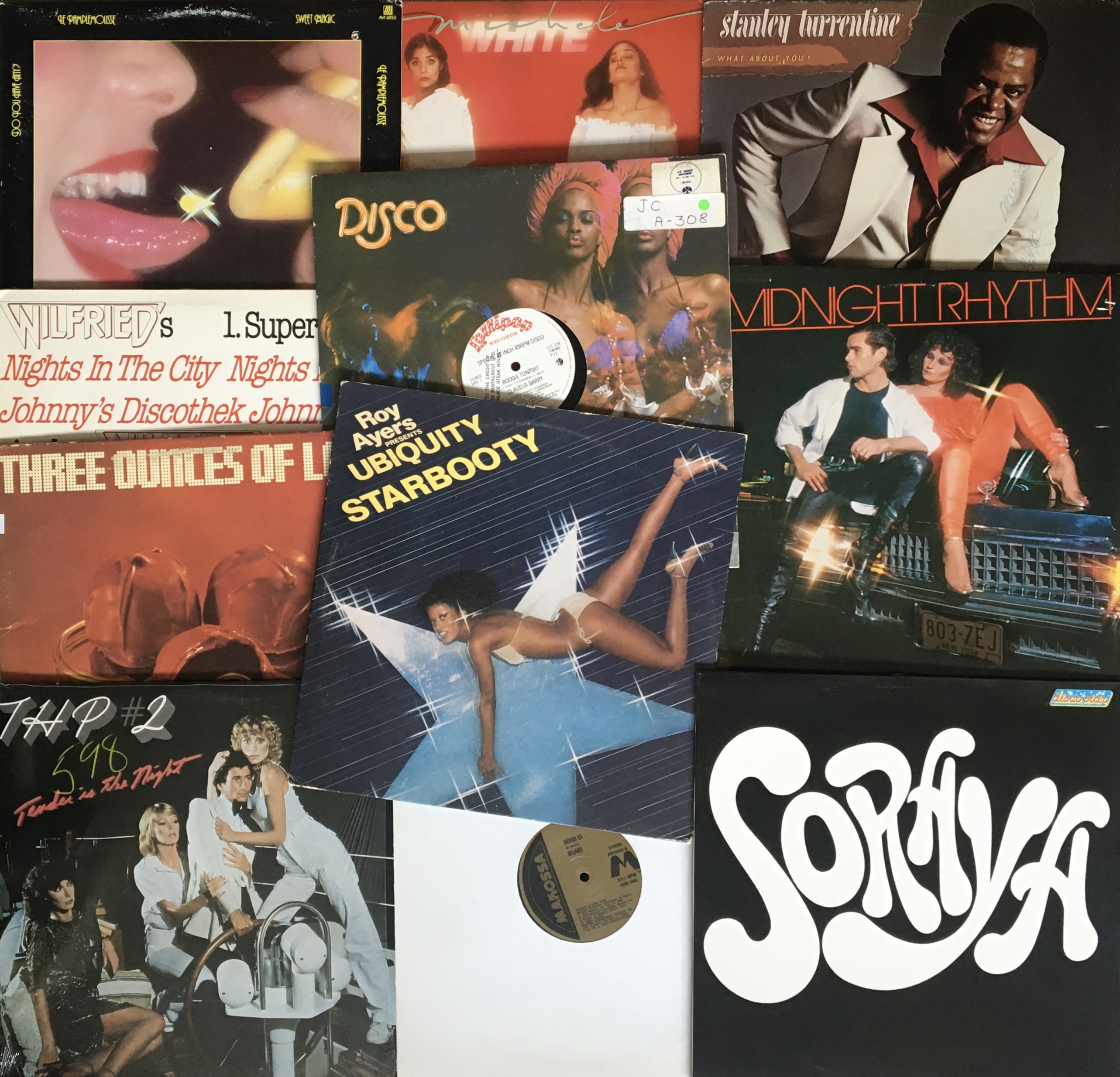
Midnight Rhythm - Workin' & Slavin' (I Need Love)
Midnight Rhythm - Midnight Rhythm
Midnight Rhythm - Climb/Rushin' To Meet You
Updated 8/23/07
A couple of months ago, I received a kind email from one of the producers of Midnight Rhythm;
Robby Adcock, who clarified a few of the questions I had along with some of the factual errors in the original post.
Robby also kindly offered to give me a history behind the Midnight Rhythm project, which was not only generous on his part, but also quite interesting in how far back the genesis of Midnight Rhythm went and the names and influences that went into it's production.
Anyway, I've only now gotten around to updating this entry with all of the additional information. With the wealth of information that Robby gave me, I decided to revise this from a regular 'Disco Delivery' mini-essay into both an overview and interview of sorts with producer, Robby Adcock about the record and his own background in the music business..
Major thanks to Robby for giving me the permission to reproduce his emails and for taking the time out to write down his recollections for me..
____________________________________________________
Midnight Rhythm was one of those many records which I had come by at the used record shop, practically by accident. There were no preview stations at the store, so I knew absolutely nothing about it. Nevertheless, this would be one of the most rewarding record purchases that I would make at that time. That was some four years ago now, and it's been a favourite of mine ever since..
Produced by
Joe Long and
Robby Adcock (who were also behind the disco version of
Handel's Messiah - "
Hallelujah 2000," among other things), this one-off project is an excellent slice of the darker side of disco. It sounds like the sort of thing that would have been played at a steamy leather bar, right along side a "dark disco" staple like the
Skatt Bros' "
Walk The Night." You can practically smell the poppers and sweat just listening to this.. Robby Adcock would later mention to me that the sound he envisioned on the record was, quite appropriately, tailored to the Midnight to 1 A.M. peak-hour crowd at the gay discos - combining a soaring, theatrical sensibility with a harder, grittier edge. Essentially, to paraphrase Adcock's own description: like "
Voyage meets
The Village People."
While the chain gang and commanding male chorus almost immediately set a deep, dark atmosphere; it ends up being deep and dark in the most grand, epic and climactic sort of way. I'd credit that to the beautiful and highly effective juxtaposition between the harder, deeper elements like those propulsive, hypnotizing synths, guitars, basslines and drums with the uplifting female vocals, glistening harp and piano as well as those occasional, yet essential touches of orchestral strings..
The opening track "
Workin' & Slavin' (I Need Love)" is perhaps most representative of those elements. While not quite as climactic or intense as the others, it's probably the track which best displays both the heaviness and richness of the production in it's full splendour, giving just enough room in the mix for the various layers to come through.. The section right after the middle is probably my favourite with the strings, synths, bass, guitars and piano given full exposure in that sublime breakdown.. In one of his e-mails (below), Robby Adcock described how the atmospheric sound effects on this song came about:
"The 'factory' sounds on "Workin’.." were a combination of a couple of iron skillets, a length of chain and a wooden crate, and an early primitive synthesizer making the steam sound. It was all played manually one part at a time.... skillet and chains on one, steam on two, grunts on three, rest on four, etc..etc... The “factory whistle” at the beginning of the record was a toy train whistle I had and I overdubbed it several times at different tape speeds to make it sound the way it did."
The title track at the end of side one is perhaps the boldest, most effectively climactic track on the LP. "
Midnight Rhythm" takes that epic juxtaposition of the previous track even further, adding a choral element and a horn section which add an extra richness to the whole thing. Those verses with the sweet vocals of
Kathryn Ward and
Tricia Johns along with the addition of
Hodges, James and Smith (whose contributions were added later, by co-producer Joe Long) acting as a counterpoint to the gruff male vocals just after the beginning is one of the best examples: "
Takes so long, but it's worth the wait (midnight.. rhythm..)" with the two parts escalating right after one another into a brief, yet epic trance driven by what sounds like a layered piano and deep, heavy synths. That section is simply a teaser however for the other two climax points, one right in the middle leading into a bright, uplifting melodic chorus; the other right at the end. The final climax at the very end is, quite fittingly, the ultimate buildup with the ladies leading into that tense, escalating wall of sound, building and building until it abruptly peaks, dropping off into a soft, heavenly choral sound. That ending for me, is pure bliss..
The last track, "
Climb/Rushing To Meet You" covering all of side two, takes the epic grandiosity of side one to new heights and lengths, or at least attempts to in any case. At some fifteen minutes in length, it tends to wear a little thin before the end. That said, first half picks up where side one left off, escalating and propulsive, juxtaposing the gruff chanting with the sweet, elevating female vocals (once again courtesy of Kathryn Ward, Tricia Johns along with Hodges, James and Smith), although with a greater melodic emphasis this time, especially on the "Rushing To Meet You" section. "Rushing To Meet You" is perhaps the closest thing to a conventional disco track on this album, with the female vocals in full display effectively adding to that melodic element. The track only wears thin once the male vocals come in again later on, attempting perhaps to bring a little focus to the extended instrumental section. Overall, in this case, one of those times where a shorter version may have been more effective. While side two for the most part, doesn't have the tight consistency of side one, nonetheless, it still has it's worthwhile moments..
Though the theme and sound of the record is firmly entrenched in the late 70's, the genesis of this project however goes back to the early 70's. Robby Adcock explains the story of Midnight Rhythm, from the very beginning, with his first association with co-producer Joe Long:
"...Where to start? Joe Long (Joseph William Long aka Joseph W. Long) was the owner of a little 8-track studio in Tarzana called Fat Chance Recording. In late 1971, I dropped over there on a tip from steel guitar player Al Perkins, to see about a recording engineer job he told me was available. I met Joe Long and his sidekick Andrea Krusoe. The very first recording session I did there was with Freddy Cannon ("Palisades Park," "Tallahassee Lassie," etc.) and a guy named Harry Garfield who later became a big-time A&R guy at Capitol Records.
Probably within 6 months, two things of significance happened. A huge bombastic guy named Oliver Walrus (aka Gary Levine) who had a band named after him came through the door of the studio looking to be recorded. About the same time, another group called C. M. Lord came rolling through the door. Oliver Walrus and his guitar player, Robert Franklin, were both fairly prolific songwriters and outstanding performers. In fact, the whole band was outstanding and were a hardworking club band all over the greater L.A. area. C.M. Lord named after lead singer and writer Cathy Mitchell Lord, was also a formidable local band. Most notable was keyboardist and writer Stephen J. Hines or Steve Hines as he was known.
I was enlisted by Joe Long to record and develop both of those groups into recording acts using Fat Chance as a springboard for the careers of all concerned. The studio was a very popular place mostly because of the price, but also because of the unique sound of the room. It had very little modern equipment, but the room was the draw. Many “big-timers” from the Hollywood music scene of the early 1970s came to record or overdub there. They would then take their tapes to a state-of-the-art studio in Hollywood and do their final mixes.
I did the music part and Joe Long did the “business” part. I wasn’t very savvy about the business in those days and was very trusting. Needless to say my trust was misplaced.
At any rate, Oliver Walrus and crew ended up with a one shot contract on Janus Records and their first (and only) album was entitled “Walrus”. I have a copy somewhere, but right now I can’t tell you the album number. Fighting between band members and some funny business stuff with Joe Long blew the whole thing apart. I haven’t listened to it in over 30 years, but I know there were some hits on the record that never saw the light of day. The record company also didn’t have a clue how to choose singles even though they had huge success with Z.Z. Top, and others, at the time. (stay with me because there’s method in my long-winded story)
C.M. Lord also ended up with a singles deal on London/Hi Records. I believe the first and only single was “Your Love is Like The Morning Sun” written by Al Green. Cathy Mitchell Lord was a great writer but none of her songs saw the light of day. (Tommy's note: Years later, in 1981, Cathy Mitchell Lord would eventually release an album, "Flashback" (1981, Montage) using the name C.M. Lord, which would later be reissued on CD by the disco reissue label Hot Productions)
Walrus and C.M. Lord were happening right at the beginning of the underground disco scene that had come over from Europe and was making inroads into gay clubs on both coasts by 1972 or ‘73.
Gary Levine (Oliver Walrus) had written some songs I recorded in the beginning with his group that were great performance songs but had little or no value as commercial radio singles at that time. They were too long and didn’t seem right for the radio play of the day. I don’t remember when it was (probably in 1977), but an idea popped into my head about two of his songs, “Workin’ and Slavin’" and “I’ve Got So Much Soul.” I started thinking that if the two were juxtaposed musically and texturally, so to speak, they might make an interesting disco record. The Village People had already hit the scene with their male dominated group vocal sound, and another favorite of mine, Voyage, had a first single/album out with soaring white female-sounding vocals that really appealed to me. Voyage was very theatrical and descriptive. My idea was part Village People, part Voyage, but with the male part much grittier. The idea was to juxtapose the gritty, sweaty laboring men in the “Workin’ and Slavin’.." part with the sweet, clear beckoning white girls on “I’ve Got So Much Soul” part. It was geared for the Midnight to 1 AM peak at mainstream gay discos. This was all before Saturday Night Fever introduced it to straight clubs.
Let me go back to Steve Hines. Steve became a most integral part of the whole process. Another musician named Randy Mitchell (guitar player), who I believe still plays live with Donna Summer, formed the core rhythm section with Steve on almost every record. Mitchell did all guitar parts and Steve played all keyboards and helped arrange most all the records we did. He and Joe Long and I wrote the two songs for “Love at First Bite” ("Dancin’ Through The Night" and "Fly By Night") although Joe left my name off of one of them.
Anyway, “Workin’ and Slavin’” prompted a whole album, “Midnight Rhythm,” and I turned to Gary Levine songs again. “Climb, Climb, Climb” which had appeared on “Walrus” was chosen as well as C.M. Lord’s “Rushing to Meet You.” Another choice was Steve Hines’ instrumental “Beans” which was reworked and renamed “Midnight Rhythm.” These songs were chosen mostly because Joe Long had wrangled the publishing rights earlier to Levine’s and Lord’s songs. This had been a main cause of friction between the artists and Joe when they later realized the value of their intellectual property that they had signed over to a less-than-upright music biz character. This is, of course, an old, old story.
All of the “Midnight Rhythm” songs were recorded at a little studio in Culver City, California (just up the street from MGM Movie Studios) called Golden Age (formerly Golden Avatar). It was owned by a Hari Krishna guy named Carl Lange or Krishnakanti as he preferred. It was a totally cool little place designed by Jeff Cooper and apparently funded by the Krishnas, although Carl was the actual owner. Carl did most of the engineering of the recording. I backed him up from time to time.
The players included Hines and Mitchell. I can’t even remember who played bass and drums on the basic track as they were replaced later on to improve the sound of the kick drum and snare as well as the performance of the bass. (I seem to remember playing the bass drum with my hand and a beater. There was not much “midi” in those days and we didn’t record with time code or any syncing devices). The singers
included Hines, Mitchell, Long, and me on the “Workin’ and Slavin’ part, and Kathryn Ward, Tricia Johns, and Charlie Merriam on “So Much Soul”... Charlie Merriam also wrote and conducted the string arrangements for the whole album.
The Hodges, James, & Smith stuff was added after the fact. Joe Long took the finished tapes, without any consultation, to New York, added a different bass player (Jimmy Williams) and had Richie Rivera do the mix.
I am going to stop at this point about Midnight Rhythm. There is one other person who never received much credit for his contribution to Midnight Rhythm. That person’s name is Robert (“Bob”) Small. He was chiefly responsible for "Workin’ and Slavin’ " getting signed at Atlantic. He was pretty much marginalized by Joe Long after it was all over..
Robert "Bob" Small, as Robby would later tell me was an ad executive who had notably come up with the slogan for
Playtex's "
Cross Your Heart Bra." On the back cover, Small was prominently credited for the conception of Midnight Rhythm. Small was also credited as a producer on the
12'' of "Workin' and Slavin" (though not on the LP). Small would later apparently go on to be a director of music videos as well as one of the co-creators of
MTV's "
Unplugged"..
Richie Rivera, who is co-credited (along with Joe Long) for the mix on the album (with Richie's 'trademark': "Midnight Mix by Richie Rivera" on the back cover) was apparently one of the more well-known DJs/disco mixers at the time. That said, his output is perhaps one of the more underrepresented out there today. While his most famous mix would easily be the 12" of
Anita Ward's "
Ring My Bell," I'm especially fond of his mixes on
Asha Puthli's
L'indiana (1979, Dash/TK) LP (which I hope to put up here very soon) and for the
Jürgen S. Korduletsch production,
Gaz (1978, Salsoul). Some of his other mixes include
Liquid Gold's hit "
My Baby's Baby," (which he co-mixed with none other than Joe Long) as well as others for the likes of
Voggue,
Erotic Drum Band,
Bob-A-Rela (highly sought after, apparently) and
Melba Moore. Like many disco mixers, Rivera started out as a DJ in places such as the
Sandpiper on
Fire Island and other venues before making bringing his expertise to the studio as a mixer, like many other DJs in the late '70s.. Judging from the precious few mentions of him on the internet, evidently and unfortunately Rivera has since
passed away. Aside from that not a whole lot seems to be known about Rivera.
DJ's Portal does however have a small picture of him, right beside a request for more info. With the movement these days towards cataloguing and recording the works of some of the disco era's DJ pioneers (see recent compilations of
Tom Moulton,
Walter Gibbons and
Larry Levan's work), perhaps Rivera might be one of the next.
In regards to Joe Long and Richie Rivera's final mixes in New York, I later asked Robby about his opinion on their mixes and what elements he was happy or unhappy with. Evidently we agree on the rather overwrought results on side two..
I thought the mix on "Workin' and Slavin'" was the best. The track was kept simple so the parts stood out pretty well. I really liked what bass player Jimmy Williams did with his overdubbed part. I thought whatever he did was totally appropriate and brought a great feel to the track. I thought Richie's mix and edit on "Workin'.." was very good. I expect at that time Joe was intimidated by Ritchie and the whole NY gay music biz scene and he was all caught up in his insecurities, etc., so it sounded like he just let Richie do his thing without interfering or giving much input. I remember at the time I thought the mixes of "Climb..." and "Midnight..." were not up to what they should have been.
These tracks were recorded after the Atlantic deal was made based on "Workin' and Slavin'." When I listened to them again recently, I realized the same thing. There were so many musical parts that weren't brought out that would have made those cuts stronger. Those cuts also had more "junk" added by Joe Long in New York that muddied up the track and made it less musical. The edits were also too long and the whole thing, especially "Climb..." became too grandiose. There was always this thing with Joe Long about "adding" something else to the track. It seemed like in his brain a song was never finished, and he would want to keep adding the next “great idea” until it was just a big mush of sound without any focus. He would then insist on having all the parts "up front" which is impossible sonically, but he would keep pushing faders up and knocking the mix out of balance. The modest success of "Workin' and Slavin'" must have boosted his sense of grandiosity and he let it all loose on "Climb.." and "Midnight..". There were some really musical and melodious parts that were overshadowed by his attempts to always keep trying to make everything intense. Nothing ever subtle. I remember feeling disappointed then and I felt the same way recently. It's too bad. What was pretty good could have been bordering on great if it had been kept more simple. I always suspected drugs played a part in all of that. That was always a point of contention.
It would have been interesting to hear the difference in mixes and see the difference in sales if Richie Rivera would have been able to just mix and edit the tracks without help from Mr. Long. It's all theory. The same thing happened with "Hallelujah.." Steve Hines, Charlie Merriam and I recorded the whole thing ourselves in LA with C.M. Lord doing the “Christmas Story” middle part. It's another tale I won't go into here, but the final product was also a disappointment compared to what it could have been.
That said, one of Robby's more positive memories of his Midnight Rhythm experience is when the record broke at New York's legendary
12 West, particularly witnessing the dancefloor reaction and hearing the record over the club's renowned
Graebar sound system:
12 West was one of the "break out" clubs for new records and often set the standard for new releases, etc. "Workin' and Slavin'" was broken there and I was there for that. I remember seeing Ahmet Ertegun and Clive Davis sitting there in their suits while hundreds of gay guys without shirts sweated and danced. Their Graebar Sound System was the smoothest, clearest, most "hi-fi" system I had ever heard in a club. It was like listening to the best studio monitors in the best mix room. It was totally loud and totally clear.
Aside from the "Halleljuah 2000" single, as Robby mentioned above, Long and Adcock would also produce the
soundtrack for the 1979 film "
Love At First Bite." The soundtrack was released on the
Casablanca subsidiary label,
Parachute Records. It would be the last thing Long and Adcock would do together. Evidently, as Robby hinted above, the partnership would not end well; the result of what has become an unfortunate, but all too common music business story.
He apparently spent so much of Parachute Records’ money, by the time it was all said and done, that it pretty much became their demise. What he was good at was taking other people’s work and putting his hands on it, then taking credit. He has a long, long history of that.... I parted company with Joe Long after the “Love at First Bite” songs were finished and submitted for the film. I had had more than enough of him and being cheated out of money and credit. My name was most noticeably omitted as producer when the record came out. It was not a good record, although it could have been. It was even more grandiose than “Climb/Rushing to Meet You” if that’s possible. It took me a long time to finally understand what was going on and to break through my naivety. It was a hard lesson to learn.
A 12" of "
Fly By Night" would be released from the soundtrack album, which featured
Pat Hodges (one of the ladies of Hodges, James and Smith) on vocals.
In 1979, Long would go on to produce a disco version of the Christmas carol "
O Holy Night" (1979, Pronto) as
The Joe Long Sound featuring, once again, Pat Hodges along with well renowned session singer
Clydie King on vocals. Some twenty years later in the 90's, Joe Long would work with Pat Hodges once again and produce another 12", a remake of one of the C.M. Lord/Midnight Rhythm tracks - "
Rushin' To Meet You" (1999, Raw Nerve) which I haven't heard yet, but am certainly curious to. In addition to these, Long also produced, for and along with
Edwin Starr a little known 1980 remake of one of Edwin's classic hits - "
Twenty Five Miles" for
20th Century Fox Records as well as a little known 12" on
Salsoul entitled "
Megatron Woman" (a companion to
Patrick Cowley's "
Megatron Man" by any chance?) under the guise of
Native Love ..
As far Robby Adcock's individual credits were concerned, they were a little convoluted to me at first. Initially I had thought Robby Adcock and the cellist on this record
Robert L. Adcock were one in the same. However, Robby Adcock later confirmed to me that this was not true, but he and Robert L., however, were regular collaborators:
I must say, I am not nor have I ever been "Robert L. Adcock" or most of the other names you tagged me with. I actually used to request that string contractors call Robert Adcock, the cello player, to be on orchestral sessions I was producing (in L.A.). I would then kid him about us being cousins throughout the session. When I was in Nashville, there were a couple of Adcocks who played on sessions. One was a banjo player and the other a violinist with the Nashville Symphony. The main name switch has been done by others before I had enough understanding to ask for proofs of things before they were released. Because of that ignorance on my part, my name was often misspelled "Robbie" Adcock. A few times it was listed as "Robert" Adcock. I don't remember it ever being "Bob" but it might have been. Who knows!? The music business was a screwy place. I am sure little has changed with the people in it.
After the disco era, Adcock would relocate to Nashville where he would continue his work as a producer for acts like
Riders in The Sky, for whom he'd produce
a couple of albums and
Clint Eastwood protégé,
Jill Hollier. On the disco side of things,
Yuki Takahashi (thanks for the comment!) of the
Disco45 blog also mentioned another single he had produced - "
Monday Mona Lisa Club" for the Japanese duo
Pink Lady (apparently big stars in Japan at the time, but in the US probably best remembered in the annals of camp obscurity for their ill-fated
NBC variety show "
Pink Lady.. and Jeff"). Along with Pink Lady, Robby would evidently produce another Japanese artist named
Jun Sugisawa around the same time. Robby briefly explains how the Japanese projects came along:
After I split from him (Joe Long), I started getting lots of offers to work from many sources. The Pink Lady stuff was one of those things. Paul Drew (major AM Radio legend) had signed them for management in the States and his office called to ask if I would record some “Disco” tracks with them. Their label in Japan also asked me to cut a disco single with Jun Sugisawa. “The Boy Next Door” was one side and the other was a Japanese song (I am sure they published) whose title I cannot recall. It was actually the ‘A’ side of the single. Pink Lady’s ‘A’ side was “Mona Lisa...” It was all recorded at Golden Avatar. My long time engineering mentor Bart Chiate did the recording. We mixed it at the Record Plant in L.A. The late Angelo Solar of “Backstreet” in Atlanta did the disco mix. Charlie Merriam did the orchestral arrangements, and he, Kathryn Ward and Trisha Johns did the background vocals. We ate lots and lots of Sushi and had a wonderful time.
Just before the disco crash of 1979, Adcock was also in the process of working on some other disco projects for
Motown, one for two of the key session personnel on Midnight Rhythm: Charlie Merriam and Kathryn Ward as
Merriam & Ward, as well as another for which
Carl Bean (he of the excellent, classic gay disco anthem "
I Was Born This Way") would cut a vocal. Unfortunately, due to the disco crash of that year and the resulting industry turmoil, neither of those projects would see the light..
After disco and his time in Nashville, Adcock would retire from the music business in the late 1980's and would earn his masters degree in clinical social work. Today he currently teaches and runs his own practice in Miami, Florida.
Overall, Midnight Rhythm, regardless of it's relative obscurity today, is nothing less than a grand, epic and excellent hard-driving disco production. If nothing else, in my estimation, one of the more unique disco albums I've come across; combining the complexity and polish of an orchestral disco masterwork, along with a darker, heavier element to the sound which brings it into a different class altogether. Certainly one album that I recommend picking up if you ever come across it..
Once again, special thanks to Robby Adcock for his generous contributions
SUBSEQUENT RELATED LINKS:
MIDNIGHT RHYTHM REDUX (THURSDAY AUGUST 23, 2007)
LINKS:
MIDNIGHT RHYTHM LP @ DISCOMUSIC.COM
MIDNIGHT RHYTHM LP @ DISCOGS
MIDNIGHT RHYTHM - WORKIN' & SLAVIN'/I NEED LOVE 12'' @ DISCOMUSIC.COM
MIDNIGHT RHYTHM - WORKIN' & SLAVIN'/I NEED LOVE 12'' @ DISCOGS
MIDNIGHT RHYTHM - CLIMB/RUSHIN' TO MEET YOU 12'' @ DISCOMUSIC.COM
ROBBY ADCOCK @ DISCOGS
JOE LONG @ DISCOGS
ROBBY ADCOCK @ ALL MUSIC GUIDE
RICHIE RIVERA @ DISCOGS
CATEGORIES: DISCO DELIVERIES, INTERVIEWS