Showing posts with label Jacques Morali. Show all posts

Friday, May 28, 2021

Vintage Articles:
Sean Lawrence's Discaire Column -
Kitchen Disco // Christopher Street - June 1979


Picking up where I left off a while back with some more transcriptions of Sean Lawrence’s short-lived Discaire columns in Christopher Street. The title of this second installment still feels appropriate, even 40 years later. Kitchen Disco - "the way one moves between the sofa and the dishwasher" has basically been the name of the game since the beginning of this pandemic.

Lawrence here has good words for Barry White’s The Message is Love, The Mighty Clouds of Joy and Linda Clifford; pans for Ashford & Simpson, Parlet, and especially the late Patrick Juvet’s Lady Night.

I’m not quite sharing the enthusiasm he has for Roberta Kelly’s gospel-disco album Feelin’ The Spirit (though “To My Father’s House” is a standout on that one) and unlike Lawrence, I quite enjoyed Parlet’s Invasion of the Booty Snatchers (it’s lead track “Ridin’ High” is still a jam).

That being said, just like his earlier column, I'm enjoying the general position he writes from - in “the space between inspiration and camp,” as he so astutely puts it. His observation about disco and its relationship to nostalgia in the fifth paragraph is also spot on, in my view.

For now, enjoy this little time capsule..

____________________________________________


Discaire: Kitchen Disco

by Sean Lawrence

Barry White makes me feel sorry for the emotionally poverty-stricken of the world. What can someone who has a hard time squeezing just a little feeling out in life do in the face of a man like this—a man whose songs, musically and lyrically, are as understated as the flowers at a Mafia funeral? Barry White doesn’t just sit down at a piano—he arrives at it in a limousine, articulate as an anniversary card, uvula climaxing, hands and heart a-pounding. The news is that his new album on CBS’s Unlimited Gold label (JZ 35763) is surprisingly likeable.

   The Message Is Love (was it ever anything else?) is full of the romanticism of the overbearing. The album’s most successful songs (that is, most likely to touch the feelings of us mere mortals) are the ones in which White is vocally somewhat laid back. For those who see White as instant camp there are Roy Lichtenstein-type moments of self-dramatization and pop sentimentality. A couple of the melodies sound downright experimental for the normally predictable BW, and a couple are danceable even if they don’t qualify as heavy disco.

   Another occasionally danceable album in the gray area of off-disco is Changing Times (Epic JE 35971) by Mighty Clouds of Joy. Ostensibly commercial gospel music, Changing Times is a stirring album of songs sung to God and his/her reps on earth that can be danced to and enjoyed by atheists everywhere. I suspect that nowadays most people listen to gospel songs and think about their lovers (conversely, many of us listen to Barry Manilow singing about lovers and think of God). Changing Times is sometimes-perfect apartment/kitchen disco (one doesn’t really dance at home; the way one moves between the sofa and the dishwasher while listening to albums like Changing Times never works at overheated discos like Studio 54). The pared, unsynthesized gospel ruggedness and ripe voices working up a sweat on this album will be a pleasure to anyone used to disco superproduction. Like Barry White’s album, Changing Times inhabits the space between inspiration and camp where so many of us dance and think these days.

   It’s hard to say what space Patrick Juvet occupies (he sang last summer’s popular “I Love America”). I think Juvet’s producers want us to know he’s French, the way Claudine Longet’s producers wanted us to know she was French. In fact, Juvet even sounds a little like Longet. And Tiny Tim. I must admit, I’m somewhat prejudiced against Juvet. I once caught him on the Merv Griffin show and would easily deem him to be one of the more obnoxious talk-show presences of late. His new album, Lady Night (Casablanca NBLP 7148) is worse, a truly contemptuous (if not cretinous) work of non-art. Produced by Jacques Morali with a monotonous metronome, Lady Night is one of the most tiresome and grating albums you may be forced to listen to at the discos this summer. Even the one song transparently directed at “our” scene (“The ‘Gay Paris’”) is a boring co-optation.


Had Linda Clifford’s new two-record set, Let Me Be Your Woman (RSO RS-2-3902) been a one-record set including only “Bridge Over Troubled Water” and “It’s One of Those Songs,” each of which fills a side, the album would still have been a triumph. As head pompon girl in the hyper produced cheerleader arrangement of “Bridge Over Troubled Water,” Clifford seems almost as excited by life, love and show business as Barry White. Purists may say that discoizing this song is nothing short of sacrilege (in some ways disco treats the past with the same respect Punk Rock does), but I think it points out the schizzy nature of most disco rehashes—that is, the dancer divides his pleasure in two: the part he or she dances to at 120 thumps a minute and the evocation of the past the song reminds the dancer of. Disco is up to its neck in nostalgia; those who say that disco is mindless are simply out of touch with what disco is mindful of.

   And speaking of mindlessness and the past … recent disappointments include Ashford and Simpson’s “Flashback” single (Warner Bros. PRO-A-803), which at this moment is either in the hands of discaires or (as I suspect) in their wastebaskets. Ashford and Simpson have spent enough time in discos to know the beat better and the importance of innovation. “Flashback” is a bore. Equally disappointing is Parlet’s Invasion of the Booty Snatchers (Casablanca NBLP 7146), which sounds downright ugly.

On the brighter side, I am pleased to see the renewed interest in Roberta Kelly’s Gettin’ the Spirit (Casablanca NBLP 7089), which was released last year and somehow got buried commercially. “Oh Happy Day” was one of the five most nutritional songs to dance to at the Pines last August. Like some of the work of Donna Summer, Loleatta Holloway, and Grace Jones, Gettin’ the Spirit is a disco classic and deserves a second chance ■


____________________________________________


PREVIOUS RELATED ENTRIES:
vintage articles: sean lawrence’s discaire column: supply without demand // christopher street - may 1979 (sunday february 23, 2014)

LINKS:
wikipedia: barry white - the message is love (album)
discogs: barry white - the message is love lp
discogs: the mighty clouds of joy - changing times lp
discogs: patrick juvet - lady night lp
wikipedia: linda clifford - let me be your woman (album)
discogs: linda clifford - let me be your woman lp
discogs: ashford & simpson - flashback (promo 12” single)
wikipedia: parlet - invasion of the booty snatchers (album)
discogs: parlet - invasion of the booty snatchers lp


CATEGORIES: VINTAGE ARTICLES

Sunday, February 23, 2014

Vintage Articles:
Sean Lawrence's Discaire Column -
Supply Without Demand // Christopher Street - May 1979

Recently, while doing a bit of research, I had come across some old issues of Christopher Street - a long defunct gay magazine published from 1976-1995, often referred to as "The Gay New Yorker" in its time. Finding out about Christopher Street for the first time felt, quite honestly, like uncovering a treasure. While perhaps quite a bit more highbrow and New York-centric next to other gay offerings on the newsstands of its day—and certainly compared to what exists now—I'd have to rank Christopher Street, at least what I've seen from this period, as easily one of the best gay magazines that I've read. While the quantity and accessibility of information available online can compensate somewhat for the beleaguered state of print media these days, reading something like Christopher Street, one can't help but feel a touch of nostalgia for a time when something as culturally literate and intelligent as Christopher Street had a solid place in newsstands and in gay culture at large.

Being the sophisticated cultural arbiter that it was, aside from covering society, politics, literature and the arts; given the times and their audience, that usually meant that the topic of disco was weaved into their general coverage fairly regularly (record labels pushing their disco product were some of their biggest advertisers at the time, which probably helped too). One column that stood out in that regard was Sean Lawrence's Discaire, which debuted in May of 1979 as their "on the disco scene" column. It was never really 100% exclusively disco and not so much a look at the 'scene' as much as a record review column, and quite honestly, I wasn't even really familiar with the term 'Discaire' before this, (a slightly disused term for a DJ, or anyone who plays, selects and comments on music) but unfortunately given its timing, the column would be relatively short-lived. Debuting right around the time of the great disco backlash in America, which the column would at times make reference to, Discaire would run, barring a couple of issues, from May 1979, until February 1980.


While Christopher Street had carried record reviews before this, Discaire came across as a much more personalized take on things than your standard record review column. Although Sean Lawrence was not nearly as prolific as, say, Vince Aletti; armed with sharp prose that was generally clever and witty without being merciless; given that he came with a well-cultivated gay sensibility (obviously) and knew his way around disco; even if I didn't always share his opinions, they're always a pleasure to read. While Lawrence is hardly breathless and uncritical about disco—as the title of this very installment proves—I have to admit how refreshing it is to find serious disco record reviews from this time. Specifically, coverage of disco which isn't loaded with the usual, dare I say, straight white male rock critic biases, where even a positive disco review usually has the writer twisting themselves into some sort of awkward, apologetic stance just for doing so.

Anyway, for now, here's the first Discaire column, Supply Without Demand - pans for Patti LaBelle and Gladys Knight, praises for Johnny Mathis, Montreal's Alma Faye Brooks and Ferrara, among others..


____________________________________________


Discaire: Supply Without Demand 

by Sean Lawrence
B Songs reveal more than we want to know about the record industry: they sound as if the company needed more product, or the artist needed more money, or the disco/radio station needed more anything to play. When B songs appear on the albums of performers we like and whose work we have followed, they spoil the neighborhood. What, we wonder, can the performer have been thinking when the decision was made to record that junk? And who really made the decision?

         Let's talk about Patti Labelle.

         To those of us who have trekked with the hordes of urban renaissance gays and Bloomingdale's blacks to just about every concert Patti Labelle has given in the New York metropolitan area, her new album, It's Alright With Me (Epic JE 35772), is at once a delight and a disappointment. “Music Is My Way Of Life” is a disco upper if ever there was one, with a full, unstoppered sound of happiness. It's the kind of song that moves swarms of people to rush Labelle on stage when she sings it at the end of a concert – and it almost carries this album. But someone has surrounded this gem with B dross and should be charged with artist abuse.

         Another performer who deserves better packaging is Gladys Knight, and she'd better get it soon. Waiting for an A song on Gladys Knight (Columbia JC 35704) is like waiting for Godot. Knight's efforts on Buddah (Miss Gladys Knight [BDS 5714] and The One and Only ... Gladys Knight & the Pips [BDS 5701]) at least had bonbons such as “I'm Still Caught Up With You” and “It's A Better Than Good Time” (which had a nifty retro-disco quality). Yes, there is life after the Pips, but not much. Like Linda Ronstadt, Gladys Knight is best when she sings about lost or remembered love. Gladys Knight is a collection of mediocre songs that neither departs from nor enhances this terrain, and a waste of time for such a gifted performer. Knight herself is listed, with Jack Gold, as co-producer; insofar as she may be responsible for the selection of material on this album, she deserves a better producer.

         Jack Gold, on the other hand, can't be faulted for his work on Johnny Mathis's new release, The Best Days of My Life (Columbia JC 35649). This is a surprisingly fine album, including the now requisite disco hit (“Begin the Beguine”) and the predictable heterosexual duet (“The Last Time I Felt Like This” from the film Same Time Next Year, sung with Jane Olivor and not awful at all). The rest of the songs on the album are smarter and more authentically moving than the stuff Mathis sings on the Tonight Show just before Johnny Carson starts asking him about his love life.


On the heavy disco scene, “Disco Nights (Rock-Freak)” (Arista SP-38) is an elegantly mellow hit containing disco roller-skating rhythms (they skated to it at Manhattan's Twelve West at the opening of the Disco Convention) that some people have been adapting to non-roller-skating dancing. Although disco roller-skating is not the hottest thing to hit the gay community since typhoid, it seems apparent that Arista Records is serious about trying to get its share of the disco market.

         Whereas “Disco Nights” embodies Andrew Holleran's definition of “light disco,” Madleen Kane's “Forbidden Love” (Warner Bros. 8772) marks the entrance onto the scene of Erotic Funeral Disco. It's about time that intercourse had a new song. (“Hold Your Horses” by First Choice is already worn from play.) “Forbidden Love” is full of dark sexual exhortations that will surely make it the national anthem in the darker corners of the baths. It even smells like poppers.

         From the “Why Not?” Department comes a new disco album based on a Victorian novel, and produced by John Ferrara, Wuthering Heights (Midsong International 0798) is one of the more inspired of the recent disco releases. Three acts on its title side build to a danceable frenzy with the same kind of fervor and calculation we remember of Donna Summer's classic Love Trilogy album. How, you ask, can an album be based on Wuthering Heights? Just keep singing “Heathcliff” over and over, with lots of strings, congas, and orchestra bells in the background. Can War and Peace be far behind?


Two of the latest releases from Casablanca, the mogul disco label, introduce new performers. Alma Faye's Doin' It! (NBLP 7143) indicates that she has promise as a disco diva (we've heard her touted as the Aretha Franklin of disco). On “Don't Fall In Love” her voice overwhelms the normally pushy instrumental, thus breaking new ground for disco. One of the songs even proves that disco is ecology-minded - “It's Over” sounds like a recycled “I'm A Victim of the Very Songs I Sing.”

         Dennis Parker's Like An Eagle (NBLP 7140), produced by Jacques Morali, sounds like a California album about New York. One of its longer cuts (“New York By Night”) contains references to tricking, hustling on 53rd and Third, dancing at Studio 54, and eating gossip at Elaine's, but sounds as if it's being remembered from inside a soundproof limo cruising an L.A. Freeway. Parker is clone-attractive and has been packaged for disco j.o.

         And...

         Now that everyone is coming to the realization that “Disco Saves” (careers, homes, marriages), Paul McCartney has turned to it for salvation. Too bad. His “Goodbye Tonight” [sic] (Columbia 23-01940) is the disco turkey of the year. It makes us look forward to Ethel Merman's “conversion” ■
____________________________________________

LINKS:
wikipedia: christopher street (magazine)
facebook: newmanology - christopher street magazine
arbery books: christopher street back issues
ephemera forever: christopher street

discogs: patti labelle - it's alright with me lp
discogs: gladys knight - s/t lp
discogs: johnny mathis - the best days of my life lp
discogs: gq - disco nights (rock-freak) 12"
discomusic.com: gq - disco nights (rock-freak) 12"
discogs: madleen kane - forbidden love 12"
discomusic.com: madleen kane - forbidden love 12''
discogs: ferrara - wuthering heights lp
discogs: alma faye - doin' it! (us lp)
discogs: dennis parker - like an eagle lp
discomusic.com: dennis parker - like an eagle lp
discogs: wings - goodnight tonight 12"
discomusic.com: wings - goodnight tonight 12"


CATEGORIES: VINTAGE ARTICLES

Thursday, December 24, 2009

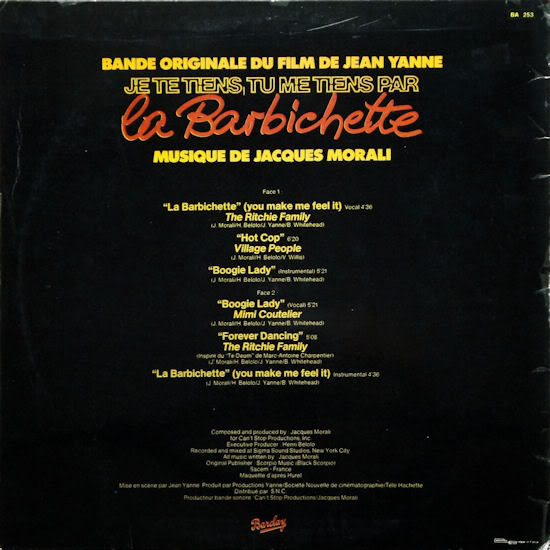
Disco Delivery #63: Je te tiens, tu me tiens par la barbichette (Bande originale du film de Jean Yanne) (1979, Barclay)


The Ritchie Family - Forever Dancing (Te Deum)
Mimi Coutelier - Boogie Lady
The Ritchie Family - La Barbichette (You Make Me Feel It)
Village People - Hot Cop
Mimi Coutelier - Boogie Lady (Instrumental)
The Ritchie Family - La Barbichette (You Make Me Feel It) (Instrumental)

Unfortunately I don't have anything especially seasonal for this year, but I figure something colourful, cheesy and fun like this would do for the time being..

Produced by Jacques Morali (who, for those who may not know, was the late mastermind behind The Village People and The Richie Family etc..); the soundtrack to the late French writer, director, actor and satirist Jean Yanne's 1979 film "Je Te Tiens, Tu Me Tiens Par La Barbichette" (based on the French nursery rhyme, which apparently translates into "I've Got You, You've Got Me by the Chin Hairs" or "I've Got You, You've Got Me By the Hairs of My Chinny Chin Chin") seems to be, at least on these shores, one of Morali's lesser known releases. A full-on disco soundtrack featuring exclusive originals by The Richie Family and one of the film's stars Mimi Coutelier (also Jean Yanne's paramour, it seems), along with one recycled Village People tune ("Hot Cop," from 1978's "Cruisin'" LP), it's not an especially long LP by any stretch. Filled however, with big, effusive vocals and the sort of Philly-on-steroids production bombast one would expect from Morali, anyone (like me) who has a soft spot for his work will likely find more than enough to love here anyway.

While, as far as I know, none of the soundtrack exclusives have been made available digitally as of yet, the film itself is currently available on DVD. I had actually ordered the DVD recently, but since I haven't been able to get the damn Region 2 thing to work on on my PC's DVD yet, I still have yet to see the film (not that I'd understand a whole lot with my severely limited French anyway, but still..). That being said, from what I've gathered through stilted Babelfish translations of the DVD synopsis and various viewer reviews out there (someone correct me if I've got any of this wrong), the film is apparently a big send-up of the French television business, revolving around the kidnapping of a famous TV presenter by anti-TV terrorists (how quaint) and the subsequent staging of a big disco TV special in order to generate the ransom revenue. Jean Yanne and Mimi Coutelier play two of the inspectors, with Coutelier's character eventually getting a part in the actual special itself (as seen below). Naturally, all of this along with Morali's soundtrack also make perfect excuses for The Ritchie Family and the Village People to make notable musical cameo appearances.

Aside from Morali and business partner Henri Belolo, notably the film's writer/director and star Jean Yanne and regular Morali collaborator Beauris Whitehead (AKA Peter Whitehead) are all given writing credits on the soundtrack exclusives. Two of those originals "La Barbichette (You Make Me Feel It)" and "Boogie Lady" are also included on the soundtrack album in their instrumental versions. A hat-tip to DJ's or perhaps just something to fill space, they're worthy additions, since they're just about as enjoyable as their vocal versions.

The Ritchie Family's "Forever Dancing" would have to be, at least in my opinion, one of the soundtrack's showpieces. Stumbling across that song's YouTube clip (and subsequently having that tune and those images burned and looped in my head) practically compelled me to go track the whole album down.

A disco adaptation of Marc-Antoine Charpentier's "Te Deum" (also known as the Eurovision theme song) I think this one has to be both heard and seen to be appreciated in its full colourful campy glory. With the bright, spandex costumes, stare-down dance routines and neon lights in the clip, I dare anyone to not have this running in their head for a good week or so thereafter.


Ritchie Family - Forever Dancing
Uploaded by DiscoLoverMiami


One of my other favourites here is Mimi Coutelier's "Boogie Lady." Granted, her voice is practically weightless, with the Ritchie Family (I'm assuming) on background doing most of the heavy lifting, but it's so damn sweet and catchy, it hardly matters. The clip of Mimi's dance sequence (choreography courtesy of Marilyn Corwin) looks like yet another one of THE disco glamour moments here (which, it appears Madonna was quite taken with, also). With that high kicking, arm twirling solo dance routine, blinking projections in the back surrounded by every other manner of disco variety show glitz; for what was probably supposed to be a stinging parody, it looks so damn fabulous it might as well have been a tribute..


Mimi Coutelier - Boogie Lady
Uploaded by fotoplastikon


The Ritchie Family perform the title theme for the closing disco sequence, but you can see almost everyone, including a couple of the Village People and Jacques Morali himself (2.52-2.54 in the glasses and red shirt), as well..


Je Te Tiens, Tu Me Tiens Par La Barbichette (closing credits)
Uploaded by artescenes


Running just over thirty minutes and with only three original/exclusive tracks (not including the two instrumental versions), it may be somewhat short, but still a whole lot of fun and well worth tracking down for fans of Morali's work. Happy Holidays and Merry Christmas everyone.

PREVIOUS RELATED ENTRIES:
LOOK FOR AN ASCOT, A BIG CIGAR.. (WEDNESDAY DECEMBER 31, 2008)
DISCO DELIVERY #11: PHYLICIA ALLEN - JOSEPHINE SUPERSTAR (1978, CASABLANCA) (FRIDAY MARCH 17, 2006)
THE FUGITIVE COP (WEDNESDAY MARCH 8, 2006)

PURCHASE:
JE TE TIENS, TU ME TIENS PAR LA BARBICHETTE (REGION 2 DVD)
AMAZON.FR

LINKS:
DISCOGS: VARIOUS - LA BARBICHETTE - BANDE ORIGINALE DU FILM DE JEAN YANNE
DISCOGS: THE RITCHIE FAMILY - LA BARBICHETTE/FOREVER DANCING (7" SINGLE)
DISCOGS: JACQUES MORALI
DISCO-DISCO: HENRI BELOLO & JACQUES MORALI
IMDB: JE TE TIENS, TU ME TIENS PAR LA BARBICHETTE (1979)
ALL MOVIE GUIDE: JE TE TIENS, TU ME TIENS PAR LA BARBICHETTE (1979)
NEW YORK TIMES - MOVIES: JE TE TIENS, TU ME TIENS PAR LA BARBICHETTE
WIKIPÉDIA: JE TE TIENS, TU ME TIENS PAR LA BARBICHETTE
IMDB: JEAN YANNE
THE INDEPENDENT - OBITUARIES: JEAN YANNE (BY PIERRE PERRONE) (MONDAY MAY 26, 2003)
ALL MOVIE GUIDE: JEAN YANNE
THE TELEGRAPH - OBITUARIES: JEAN YANNE (MAY 31, 2003)
IMDB: MIMI COUTELIER
WIKIPÉDIA: MIMI COUTELIER
IMDB: MARILYN CORWIN

CATEGORIES: DISCO DELIVERIES, VISUAL DISCO

Wednesday, December 31, 2008

Look for an ascot, a big cigar..


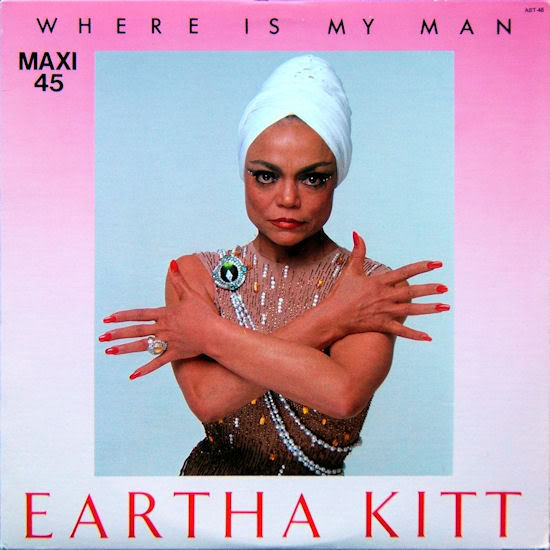
Eartha Kitt - Where Is My Man (1983, Able)
Eartha Kitt - Where Is My Man (Instrumental) (1983, Able)

A little something before I get on with the final part of the Grace Jones post..

As anyone whose payed attention to the news lately must know, the legendary Eartha Kitt passed away this Christmas, at the age of 81. I just borrowed her 1989 autobiography "I'm Still Here" at the Public Library. So far, I'm still only at the beginning, but what a life she packed into those 81 years. Barring any requisite showbiz mythmaking, I don't doubt the obstacles and the desperate circumstances she had to claw out of to get to where she was. While all the tributes were pouring in all over the news, I couldn't help but pull out some of my records and take a listen to her mid-80's disco hits..

I had been introduced to them around three years ago, before YouTube really took off, after downloading a video of her performing "Where Is My Man." After that, I just had to have a copy for myself.. Prior to that, I had seen copies of the singles and her album "I Love Men" (1984, Able) in used shops many times before. It undoubtedly piqued my curiosity, but until that time though, I don't think I ever really had the nerve to pick any of them up..

Equal parts campy and catchy, "Where Is My Man," was the single which helmed her musical comeback at the time. Produced by Jacques Morali, top purveyor of disco camp and quality (see The Village People, The Ritchie Family, Phylicia Allen, Dennis Parker etc.) and credited to Morali, comedy writer Bruce Vilanch, and musician Fred Zarr, this seemed like a second moment for both Eartha and Jacques after their respective dry spells..

As an aside, although there isn't much mention of him, one of the song's co-writers, Fred Zarr, appears to have been one of Jacques Morali's main collaborators around this time, having been credit on almost everything he released around this time.. Given his credits and his apparent synth wizardry, I'd venture to guess that he was a large part of Morali's energized sound in the early/mid 80's. In a little bit of disco trivia, aside from his high profile gigs for Madonna, Whitney Houston, Debbie Gibson etc.. Zarr was also involved as a co-producer in a lot of the somewhat shady Began Cekic records of the early 1980's.

Back to the record though - a song that brings images of the Dallas/Dynasty 1980's and old Hollywood types (Zsa Zsa Gabor and her "love or money - why not both?" philosphy comes to mind), the meeting of Eartha, Vilanch and Morali couldn't have been a better recipe for instant camp. The combination of Vilanch's hilarious lyrics, the production combining old school disco finesse (those string highlights) with those catchy guitar hooks and of course Eartha's performance put it right over the top.. Complete with signature feline growl right at the beginning, she camps it up spectacularly, with a little wink or two, simultaneously paying tribute and poking fun at her image. I suppose they didn't call her the "original material girl" for nothing..

A big leopard printed 80's fantasy dripping with Diamonds and Champagne, the video is a classic, too.


Eartha Kitt - Where Is My Man (Official Video)
Uploaded by earthakitt


My favourite line in the song (not in the video, sadly), has to be in a little section toward the end. Her drawn out phrasing and the little dose of innuendo is classic: "I want.. a billionaire.. with a big, big.... big.. BIG......yacht!.. Who can take me to....Monte Carlo... Saint Tropez... and eventually..... Tiffany!"

Bruce Vilanch himself wrote a great little article in The Huffington Post about his meeting with Eartha and how "Where Is My Man" (and those lyrics, no less) came about:

"In another pocket of his existence, Jacques annually created a score for the Crazy Horse show in Paris. Spectacular showgirls lip-synched the English lyrics as well as spectacular showgirls could to an audience of non-English speakers who had about as much interest in the lyrics as Lorenz Hart might have had in the showgirls. Armed with this knowledge, Jacques asked me to write a lyric to one of his disco tunes. And he had another reason. 'The girrrrl will be lap-sinking to Eartha Kitt. And zo the lyrics need to be special.' Will she be doing an Eartha Kitt impression? 'Don't be bizarre. It is not a drag show. Eartha is sitting on a hill in Connecticut, not working. She will record this one thing.' The song was called 'Where is My Man?' It's about Eartha and her endless search for a soul-mate who never met Bernard Madoff.

I sent the lyrics to Eartha. A day later, she called. 'Brrrrruce, my love. Where have you been since 1952? This is so, so Eartha. But listen, I've never done this disco music before, so you must make a recording of this just the way you want me to phrase it so we get the maximum Eartha out of it.' If I didn't know that Ashton Kutcher had not yet been born, I would assume I was punked. Moi, teach Eartha Kitt how to phrase? Naturally, I fired off the cassette, which prompted another call from Eartha, threatening to sue me into the next world if I ever dressed up like Jim Bailey and did her act. She then went to New York and recorded the song with Jacques. During the session, they called. There was a long dance break on the record and Jacques felt she should cover it with something, something Eartha-esque. I dragged out my best trans-continental Eartha and purred, 'I want a man...with a big...big...big...big.....big....yacht.' Notice I resisted dinghy. And please enter it into the record. They loved the song at the Crazy Horse, Jacques and his business partner Henri Belolo released the song as a single, it became a gigantic dance record all over the world, I got to tip several people lavishly, and suddenly Eartha was Back.
"

Although it was largely a club hit in the US, it seems like it had hit the pop charts in parts of Europe (Number 5 in Sweden, apparently), judging from the TV appearances she made and from what others have said. Strangely, the single version of the song wasn't included (at least not on my pressing, or any of the ones I've found) of her "I Love Men" album from the following year. It was replaced, instead by a 10 minute Megamix version, which judging from the track timings, makes me wonder if it bears any relation to the Hot Tracks East-West Remix.

I skimmed through Eartha's autobiography for a little something more on this period in her career, and the few morsels that I did find were not exactly positive. As of the publishing of her book, she claimed, in an all too common music industry grievance, that she never got paid properly for the records she made under the auspices of Morali & Belolo:

"...At the end of Timbuktu I found myself scrounging again. An offer here, an offer there - Australia, England, or a few places in America. And no recording contract could be obtained anywhere.

Jacques Morali came along and offered me a contract to make a disco record. He and Bruce Vilanch wrote "Where Is My Man" which became a gold record in Sweden. (I did not know this until I walked into the office of Scorpio Records in Paris where I saw it hanging on the wall of Henri Belolo's office.) The album, I am told, especially 'Where Is My Man?' was a huge success, but no royalties were paid to me in the four years we worked together. I didn't enjoy making the record, but at least I was in the charts again, riding back into popularity, which I am extremely grateful for..
" (pgs 345-6)

I suppose, for her, it was a career opportunity she couldn't really refuse at the time.. Whatever her misgivings, "Where Is My Man" and the singles and album that followed have gone down as dance classics, especially within the gay community. For many, "Where Is My Man" will comfortably sit alongside the likes of "Santa Baby" or " C'est Si Bon" as emblematic of her style and appeal as anything else she'd ever done..

To end things off, I had to include this video - the same one that I had downloaded three years ago. Eartha performing "Where Is My Man" on the German program Musikladen, teasing the poor fellow in the front.. Notice how she forgets to 'sing' into her microphone at 1.55 and 1.58


Eartha Kitt - Where Is My Man (Musikladen)
Uploaded by fritz51333


PREVIOUS RELATED ENTRIES:
DISCO DELIVERY #11: PHYLICIA ALLEN - JOSEPHINE SUPERSTAR (1978, CASABLANCA) (FRIDAY MARCH 17, 2006)
THE FUGITIVE COP (WEDNESDAY MARCH 8, 2006)

LINKS:
EARTHA KITT FAN CLUB
EARTHA KITT @ DISCOGS
EARTHA KITT - WHERE IS MY MAN 12'' @ DISCOGS
EARTHA KITT - WHERE IS MY MAN @ WIKIPEDIA
QUEERTY - EARTHA KITT: HERE'S TO A LIFE (BY JAPHY GRANT) (MONDAY DECEMBER 29. 2008)
THE HUFFINGTON POST - EARTHA KITT: MY ENCOUNTER WITH A LEGEND (BY BRUCE VILANCH) (FRIDAY DECEMBER 26, 2008)
GUARDIAN - OBITUARY: EARTHA KITT (BY ADRIAN JACK) (FRIDAY DECEMBER 26, 2008)
BBC NEWS - OBITUARY: EARTHA KITT (THURSDAY DECEMBER 25, 2008)
PHILADELPHIA CITYPAPER - 20 QUESTIONS: EARTHA KITT (BY A.D. AMOROSI) (FEBRUARY 27-MARCH 6, 1997)

CATEGORIES: MINI DELIVERIES, IN MEMORIAM.., VISUAL DISCO, DISCO NEWS

Friday, March 17, 2006

Disco Delivery #11:
Phylicia Allen - Josephine Superstar (1978, Casablanca)


Side One Medley: St Louis, Broadway, Star Of Paris
Around The World
Side Two Medley: J'ai deux amours, Josephine Superstar

If you have an aversion to all things camp, you might want to skip today's entry. Then again if you did, you probably wouldn't be looking at a disco music blog..

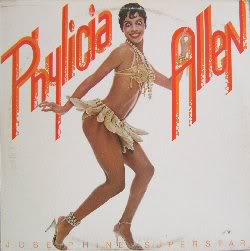
In case you're wondering, yes that is in fact Mrs. Huxtable AKA Tony Award winner Phylicia Allen Bowles Willis Rashad imitating one of Josephine Baker's iconic images on the cover. Essentially this album - "Josephine Superstar" (a play on "Jesus Christ Superstar" perhaps?) is a kind of truly over-the-top, broadway style, discofied musical tribute to Josephine Baker herself.. Was Ms. Baker turning in her grave? I'll let you be the judge..

Mind you, I'm not sure what they were thinking when they decided to do this album. Looking at it now, I don't think something like this would stand a chance of being released today. It's about as likely as, say, a hip-hop tribute to Nat 'King' Cole, if you will. Perhaps they were trying to pitch this as an actual musical but decided to make an album first, similar to how Evita came about (thanks to JungleRed for this tidbit).. Whatever the case, it was a moment of camp genius from the mind of Jacques Morali. Equating Morali with camp is perhaps a tad redundant, but this is easily the campiest thing he's ever produced, and that's really saying a lot.

Jacques Morali, as you may already know, was the producer and brainchild behind such groups as the Village People and The Ritchie Family. Phylicia was married to Village People member Victor Willis at the time this album was made, which was perhaps what brought her to Morali's attention. The album starts off quite dignified, with Allen speaking softly and sincerely about the honor of paying tribute to "the first black female international star," within a few seconds it all descends into some serious fromage.. Instead of covering Josephine's songs disco style, which is perhaps what one might expect, they decided to throw any pretense out the window and do an original narrative of her life sung mostly in first person.. Starting with side one chronicling her life in disco medley style, from her beginnings in "St. Louis," to "Broadway" to becoming the "Star of Paris." Side one ends with the rousing "Around The World," which is, you guessed it, a discofied chronicle and travelogue of her international fame.. They do manage to cover at least one of Josephine's original hits though; side two begins with an excellent disco version of her hit "J'ai deux amours," followed by the title track "Josephine Superstar," which mostly consists of the backup vocalists chanting "Josephine.. Superstar! She's the star of the stars!" At one point Phylicia replies, in true 70's fashion "She's a mighty mighty mighty foxy lady!" Yes, indeed she was Phylicia, indeed she was... The story draws to a close with the Diana Ross-esque "Colors" and "Don't Cry Mommy," complete with fake sobbing and a children's choir.

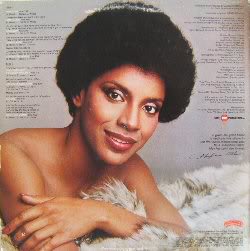
Just in case the lyrics themselves weren't literal enough, on the back cover they even wrote a little bit about the songs and what they mean.. Check it out for yourselves.

Gotta thank Chicago Sexbox for prompting me to pull this album out again. To be honest I really do enjoy this album, for sure one of my (very) guilty pleasures. I'm not sure how this compares to, say, the Ethel Merman Disco Album, but I'm guessing it's pretty damn close. I remember reading recently on the discomusic.com message boards about an interviewer who once asked Ms. Rashad about this album. You'd probably expect her to be a bit embarrassed and to maybe shrug it off, but instead she outright denied it's existence (or at least denied that she'd actually done it) and promptly ended the interview. Can you say "diva"? Somehow I imagine this album won't be on Ms. Rashad's CV anytime soon..

A little bit of trivia: both the Village People and the Ritchie Family do the backing vocals on this album..

LINKS:
PHYLICIA RASHAD BIO @ HOLLYWOOD.COM
WIKIPEDIA: PHYLICIA RASHAD
PHYLICIA ALLEN @ DISCOMUSEUM.COM
PHYLICIA ALLEN - JOSEPHINE SUPERSTAR LP @ DISCOMUSIC.COM
THE LOUD BASSOON: PHYLICIA ALLEN - JOSEPHINE SUPERSTAR LP REVIEW

CATEGORIES: DISCO DELIVERIES

Search this blog