While Mandate folded in 2009 along with many other Mavety Media titles, these earlier, seventies issues of Mandate and other competing titles from the era like Blueboy and In Touch (no relation to the current tabloid) are, aside from being great time capsules generally, a veritable treasure trove of gay disco history and ephemera. With extensive cultural coverage - sections dedicated to artist profiles, record reviews, (in pop, rock and even classical) alongside fairly comprehensive theatre and literary columns; Mandate and its contemporaries, at least at this point in time, seemed intent positioning themselves much like Playboy had done - as "lifestyle" titles for the culturally sophisticated, sexually liberated, affluent gay male. Looking through their back issues, the difference between the "international magazine of entertainment and eros" of the 70s and the all-out skin mag it would later become is quite stark.
As far as this profile on Grace is concerned, while I wouldn't call it an especially in-depth one, (it's quite brief and something of a puff-piece); it's an interesting glimpse at the kind coverage she was getting at the very start of her career. With her first album, "Portfolio" new on record shelves and true to that title with Grace still better known as a model in many circles, this is perhaps one of the earliest documents of her rising stardom. Quoting Vince Aletti, Richard Bernstein and Francesco Scavullo and mentioning breaks she had gotten as a model from the likes of Antonio Lopez, Bruce Laurance and Hans Feurer, one thing this article does do quite well is trace the trajectory of her modeling career in a way that very few profiles of her have done since. The 1973 Bruce Laurance photograph that helped launch her modeling career opens the article, (although I, for one, would have loved to have seen a picture of the Richard Bernstein designed amyl nitrate costume described in the first paragraph also, but I digress..)
It also has to be said, that the writer seems to be taking more than a bit of license when she mentions how Grace "managed to become a successful recording artist without ever taking a singing lesson." Tom Moulton would likely beg to differ, having mentioned in two of his recent interviews promoting her new Disco box, that despite whatever reservations he may have had about her abilities in the beginning, just how dedicated she had been to her vocal training at this period of her career. A listen to some of her earliest recordings, like "Again and Again" or "I'll Find My Way To You" from the Italian film "Quelli della calibro 38" (Colt 38) - later re-recorded for the final installment of her Disco trilogy - "Muse" (1979, Island) - certainly show as much.
Exaggerations aside, enjoy this early glimpse at a budding icon...
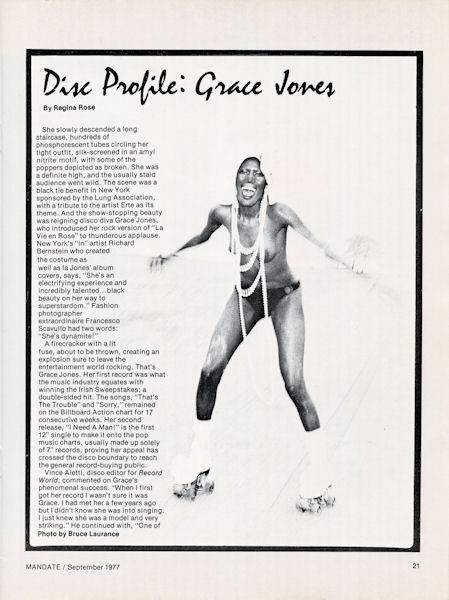


Disc Profile: Grace Jones - The Lady Is A Vamp!
by Regina Rose
She slowly descended a long staircase, hundreds of phosphorescent tubes circling her tight outfit, silk-screened in an amyl nitrate motif, with some of the poppers depicted as broken. She was a definite high, and the usually staid audience went wild. The scene was a black tie benefit in New York sponsored by the Lung Association, with a tribute to the artist Erte as its theme. And the show-stopping beauty was reigning disco diva Grace Jones, who introduced her rock version of "La Vie en Rose" to thunderous applause. New York's "in" artist Richard Bernstein who created the costume as well as la Jones' album covers, says, "She's an electrifying experience and incredibly talented... black beauty on her way to superstardom." Fashion photographer extraordinaire Francesco Scavullo had two words: "She's dynamite!"
A firecracker with a lit fuse, about to be thrown, creating an explosion sure to leave the entertainment world rocking. That's Grace Jones. Her first record was what the music industry equates with winning the Irish Sweepstakes: a double-sided hit. The songs, "That's The Trouble" and "Sorry," remained on the Billboard Action chart for 17 consecutive weeks. Her second release, "I Need A Man!" is the first 12" single to make it onto the pop music charts, usually made up solely of 7" records, proving her appeal has crossed the disco boundary to reach the general record-buying public.
Vince Aletti, disco editor for Record World, commented on Grace's phenomenal success. "When I first got her record I wasn't sure it was Grace. I had met her a few years ago but I didn't know she was into singing. I just knew she was a model and very striking." He continued with, "One of the things that striked me about her is her voice is not one of those polished singing voices. It has a lot of character. It's like a whole lot of voices put together. I like the rough edge to her voice. Her image, her whole look and style, come across on the record. I like the way they package her."
Grace Jones was born and raised in Jamaica, moving with her family to Syracuse, New York, when she was twelve. Her childhood aspiration was to be a movie star, and she constantly played with make-up and nail polish, something her mother dubbed "vain." At Syracuse University she took a drama course which led her, after graduation, to Philadelphia where her professor was producing a summer stock play. After the run of the show, Grace headed for New York in pursuit of a modeling career. Armed with photographs, slicked back hair and high cheekbones, she was hired by Wilhelmina and spent the next two and a half years struggling in the highly competitive New York modeling jungle. Her beauty was considered too avant garde for the time, but her picture taken by photographer Bruce Laurance and used on the cover of his party invitations got Grace's face into all the right mail boxes. Five and a half years later, Laurance says, "She's a really good friend. Grace is a very sensitive girl and intuitive and a little bit of a psychic. She's got the voodoo in her." It shows!
On the advice of fashion illustrator Antonio Lopez, Grace went to Paris where Lopez had arranged introductions to Europe's elite fashion circle. Photographer Hans Feurer showed her how to look more in tune with the haute couture market, even having real gold teeth made at tremendous expense for a photograph of her lips that appeared on the cover of Uomo Vogue (sic). Her pictures began showing up in all of Europe's major fashion magazines, and she modeled in some of the top Paris designer collections.
In 1976 Grace was having dinner with a group of model and photographer friends and began singing at the table. A record producer was present and asked her on the spot to make a recording for him. The result was "That's The Trouble," first released in Paris, but not destined to be a hit until Tom Moulton, Grace's U.S. producer, rearranged the recording.
Grace's managers, Sy and Eileen Berlin, watch over her with parent-like guidance and supervision, approaching her career with a definite science, preventing the public from become over-saturated with too many records or performances. The sizzling artist, at age 25, is up for a major role in a Broadway musical and will soon act and sing in a movie to be filmed in Jamaica. In true diva tradition, the girl is going to wind up on top. After all, she managed to become a successful recording artist without ever taking a singing lesson.
In New York, Grace Jones recently dropped in unnanounced at two "in" discos, 12 West and Les Mouches, and of course she found herself spinning on the turntables. But then, the girl is spinning on every turntable in reality.
PREVIOUS RELATED ENTRIES:
i'm very superficial, i hate everything official (tuesday september 15, 2009)
strange weather - the tumultous re-emergence of grace jones (part two) (tuesday january 6, 2009)
strange weather - the tumultous re-emergence of grace jones (part one) (wednesday december 24, 2008)
the return of grace jones? (friday june 20, 2008)
LINKS:
facebook: grace jones (official fanpage)
gaybackissues.com - mandate magazine
queerty: george mavety's noble cause behind creating a bunch of skin rags for gay men (september 23, 2009)
queerty: say goodbye to these porn mags (may 12, 2009)
the guardian: tom moulton on grace jones: 'they were just like her slaves, just looking at her all goo-goo eyed' (by alexis petridis) (friday may 8, 2015)
ransom note - interviews: drama, disco & divas: tom moulton talks (by ian mcquaid)
udiscover: grace jones' disco years in new box set (march 12, 2015)
facebook: the art of richard bernstein
1stdibs: bruce laurance - grace jones at compo beach, 1973
dangerous minds: grace jones modeling card, 1973 (august 30, 2012)
new york times - obituary: richard bernstein, 62; created covers for interview magazine (by stuart lavietes) (november 2, 2002)
the antonio lopez book
designspiration: vogue hommes - spring 1975 (grace jones photographed by hans feurer)
CATEGORIES: VINTAGE ARTICLES