
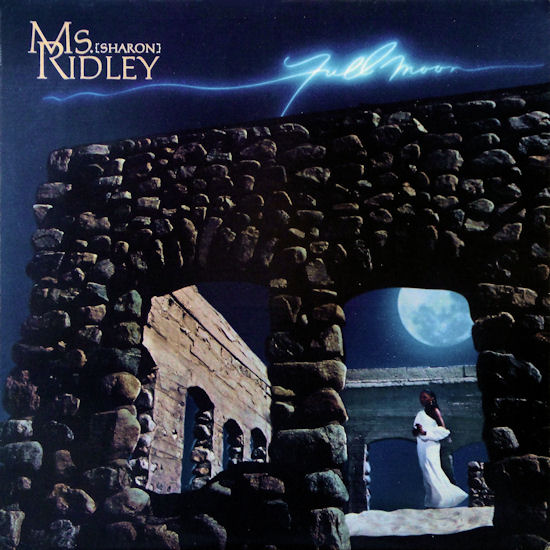

"the sun is going down and the truth is the night..."
Sharon Ridley - You Beat Me To The Punch
Sharon Ridley - Just You and Me (Walking Along Together)
Sharon Ridley - Changin'
Sharon Ridley - Forever Yours
Sharon Ridley - Ode To My Daddy
Sharon Ridley - Ain't That Peculiar
Sharon Ridley - Guess I'm Gonna Have To Say Goodbye
Sharon Ridley - Nothing Else Means More To Me Than Our Love
Sharon Ridley - Full Moon
Out of the 60 some Disco Delivery posts thus far, this is probably the one which has the least in actual disco. In fact this record probably has more in common with quiet storm than disco itself, yet in that time between Smokey Robinson's coinage of the very term 'quiet storm' and its peak with the rise of Anita Baker and Luther Vandross, in one of those musical accidents that exists completely outside the official channels of promotion and hype; the lone single off this record - “Changin’” would end up finding its greatest audience through the skills of DJ heavyweights like Larry Levan, Robbie Leslie, Roy Thode and Bobby Viteritti in the gay discos. It would be one of the songs that would become emblematic of perhaps its most innovative height, when the gay disco scene existed not so much with a finger on the pulse, but in some ways, perhaps beyond it altogether.
Prior to this, Sharon Ridley had been a collaborator of the late Van McCoy, pre-Hustle, having recorded an earlier album with McCoy as producer, "Stay Awhile With Me" in 1971 for industry impresario Clarence Avant's ill-fated Sussex label. While Avant remains one of the most powerful figures in the music industry today; prior to the label’s messy bankruptcy, through Sussex, Avant had brought artists like Zulema, Bill Withers, Dennis Coffey and the much lauded Sixto Rodriguez - subject of the recent award-winning documentary "Searching for Sugar Man" to the forefront. After her Sussex album, aside from a couple of solo singles, Van McCoy and Ridley apparently inked what was optimistically called a “long-term recording contract” as reported in Billboard and Variety with Joel Diamond's Silver Blue label, apparently as a duo act, which never fully materialized (perhaps due to the take off of Van McCoy's own career) beyond a lone single - “I’m In Your Corner,” in 1973.
Not long after the demise of Sussex, Clarence Avant would go off on his next label venture, establishing Tabu Records. Prior to their success with the SOS Band and Jam & Lewis protégés Cherrelle and Alexander O’Neal, Tabu’s roster at the time was dominated by their breakout act, Brainstorm along with Trini jazz guitarist Michael Boothman and noted film composer Lalo Schifrin. Also among the label’s roster were former Sussex acts Jim Gold (who, like Sixto Rodriguez, was produced by Dennis Coffey and Mike Theodore who’d go on to make their own mark in disco) and Sharon Ridley. Ridley, it seems, would be among those who would have little mileage with the label, recording this lone album for Tabu before seemingly retreating from the industry altogether.
Like many others, I had first heard of Sharon Ridley through "Changin'," a ballad that would become without question, one of the penultimate classics in the great morning music/sleaze tradition in the gay discos. Sleaze, for those who may not be familiar, was not necessarily named for being ‘sleazy’ as the name may have implied, but for the slower, melodic, often emotional vocal quality of the early morning cool-down sets, of love songs extolling both its agony and ecstasy in what is perhaps one of the ultimate testimonials to the artistry of the DJs who championed it.
Initially though, for me it was purely by proxy. In 2001, at a time when I was just beginning to fully acquaint myself with disco, my first time hearing “Changin’” was through Linda Clifford’s Ralphi Rosario-produced cover. Combining some of the major forces of the disco era: the late Mel Cheren, founder of West End Records then in the process of reinvigorating his long dormant label with one of the top divas of disco, Linda Clifford, covering one of both Mel and Larry Levan's favourite songs, Linda Clifford's version was something of a landmark release at the time. With its attendant 8 remix single package, it seemed specially targeted to both back in the day disco queens and their turn of the millennium circuit party forerunners. Even though I didn’t exactly fall into either of those categories, having already known and loved many of Linda Clifford’s classic records by that time, along with their then recent package of Larry Levan’s West End remixes, I wasn't about to pass this one over.
When I finally heard and compared Sharon Ridley’s version for myself, not knowing anything about 'sleaze', I had been surprised at how completely unlike the Linda Clifford remake it was. Despite the overarching sense of conceptual continuity between them; with Linda’s peak hour versions giving off sass where Sharon was reflective, Sharon and Linda’s takes feel almost like opposite versions of the same song. Not to slight Linda Clifford in this case, but while perhaps a creative way to school (then) new audiences about a great singer, label and legacy; the emotional power of Ridley’s version remained then and still today undiminished in all its heartfelt, understated early morning glory.
Finally having bought a copy of Sharon's "Full Moon" album nearly a decade later, in late 2010, only served to deepen my appreciation for “Changin’” and the wider work of Ms. Ridley. Not having heard anything else from the album, it was practically a blind buy on my part (and hardly the cheapest of them either), but like the best of them, "Full Moon" has become more than just another record I own, but one of those special records that one takes to their heart.
Produced by Jerry Peters, a producer whose credits have spanned across both the R&B and Jazz worlds for artists like Phyllis Hyman, Syreeta, Deniece Williams, Ronnie Foster, Gene Harris and perhaps most notably in the disco world - Tabu labelmates Brainstorm and their hit “Lovin’ Is Really My Game,” this album feels slotted right in the middle of the disco-funk of Brainstorm and the fusion jazz of some of the other Tabu acts of the time. Peters surrounds these songs the kind of backing that takes his jazz experience and his work with the likes of Hyman and Williams, into crafting what have to be the richest, warmest surroundings ever given to Sharon’s voice.
At around 6 and a half minutes in length, longer than any of the other songs on the album, “Changin’” seems to have been singled out early on as one of the album’s centrepieces. From its opening notes and Sharon’s gently drawn-out phrasing, if there was ever an ideal theme for the sleaze ethos, or the agony and ecstasy of love and the many complex and conflicting emotions at the end of a relationship, it is this. As a portrait of the end of love - the gratitude, the regret, the good and bad memories; listening to Sharon feel her way through these lyrics makes this seem like a guide to the relationship grieving process in song. As music journalist Brian Chin once described it, Ridley’s vocals “convey regret, but she doesn't sound all that broken-hearted." While there’s a definite sadness here, it’s not of the kind of sadness that renders the woman completely hopeless without her long-gone love, nor is it the sadness of the wronged woman who comes out utterly self-reliant and defiant, wishing she never loved at all, but the sadness that comes with the end of any relationship that has been invested with love, a love that had changed, but won’t - that can’t - simply extinguish itself, even when it has run its inevitable course. This is a song for those endings when the road apart seems daunting, but the emotional reality of the situation, even more so; for all those endings and new beginnings, when love is no longer enough and there's no choice but to move on; with sadness, perhaps, but without regret.
Although "Changin'" never did receive a 12" single release when it originally came out (both a Canadian 12" and another in the Mixed Masters series came later), an extended 8.56 edit, originally done for Hot Tracks in 1984 does exist, which has since been circulating on a bootlegged white label 12".
As far as cover versions go, aside from Linda Clifford’s 2001 version, the late Esther Phillips would cover this song a few years later on her album “Good Black Is Hard to Crack” (1981, Mercury), produced by Benny Golson. In 2004, rapper Xzibit and producer Thayod Ausar would sample the opening notes of “Changin’” for the track “Back 2 The Way It Was” on Xzibit's album "Weapons of Mass Destruction" (2004, Columbia).
Although as the first version released, I've always considered Sharon Ridley’s version the original; one of the writers of the song, James McClelland - better known in Soul circles as Jesse James, recorded the earliest version of this song. Then titled, “I Feel Your Love Changing,” James had recorded his version in 1975 while under contract to the 20th Century label, which remained unreleased until 2010, when the Soul Junction label in the UK released it on 7”, later including it on their compilation of James' work, “Let Me Show You” (2012, Soul Junction).
Jesse James - I Feel Your Love Changing
Uploaded by Mark Speakman
James’ version, straddling the line between the rougher, rawer Northern Soul sound and the more polished sheen of 70's Modern Soul, also carries some subtle and not so subtle differences in interpretation. Where Sharon’s interpretation was, to a point, more impartial; a plea for a mature, even amicable parting of ways amid the sadness, James’ version feels like an impassioned plea to salvage what has been broken. Though Sharon may have portrayed a woman who was wronged, whatever her feelings, she doesn’t necessarily place herself as a victim here. Sharon seems to approach the song as a woman who's made her choice and is at peace with it; whereas James’ version, with its desperate vocal, feels more like a portrait of a man's inner turmoil; grappling with all the changes he's been put through, knows he's at a crossroads, but not quite ready to leave it all behind. Perhaps one of the reasons why the writing credits differ slightly across both the Jesse James and Sharon Ridley versions. While James McClelland/Jesse James is credited on both, producer Jerry Peters and background singer Lynn Mack get additional credit on Sharon’s version. Musical similarities notwithstanding, while they may not be entirely different songs altogether, they’re not entirely the same, either.
Though "Changin'" completely eclipsed the rest of the record in terms of recognition, in the context of the album itself, the whole thing is so uniformly strong that not even a song like "Changin'" can completely overshadow anything else on offer here in terms of strength, quality or feeling. Though the record includes a couple of originally executed Smokey Robinson-penned Motown covers, the Robinson connection dovetailing ever so appropriately with its quiet storm credentials, opening with Mary Wells' "You Beat Me To The Punch" and later on in side two with a version of Marvin Gaye's "Ain't That Peculiar," the real moments here are the originals, which with the exception of "Changin'," were all written by Ridley herself, where the record's intimacy really takes shape. While "Changin'" was the invitation and the welcome, Sharon's songs are the full experience here. The album's centre, both literally and figuratively, "Forever Yours" and "Ode To My Daddy" are both delivered with a tenderness that manages to be both moving and personal without feeling overbearing. The latter - “Ode to My Daddy” - humble in title but as personal and specific as it gets, out of all the songs on the album, this is one which in it’s own unassuming way, cuts straight to the heart. Singing about grief as adeptly and sensitively as she sang about the parting of lovers in “Changin’;” as a eulogy in song, whether or not one has experienced the loss of a parent, her lyrics summarize the feelings of love, loss and regret with an emotional clarity and honesty that’ll take you there, to that moment, whether you’ve already been there or not.
"Forever Yours" is yet another, right on the heels of "Changin'" that's so good it felt practically wasted at only half the time. Having opened with the most splendorous of orchestral intros, carried forth with an impossible to forget "darling, forever.." refrain, it's one moment that felt like it deserved to be elaborated on just a bit more than its allotted three minutes (and probably would have had it not been the time limitations of vinyl). I, for one, would have gladly traded at least one of the album's Motown covers for a few more moments of this.
Ridley's ability to cultivate these moments of warmth and intimacy out of what seem to be the subjects of seemingly simple love songs is perhaps best experienced as she tells us how "Nothing Else Means More To Me Than Our Love." With all the attendant hopes, dreams and tender surrender of a love letter written to music, Ridley imbues a line like "the only love I found that lets me be me, that lets me feel free" with a knowing sincerity that would be almost innocent if her voice didn't carry the weight of someone who had seen and felt enough disappointment to know better. That she seems to hold back from a full vocal release until the very end only makes that emotional surrender feel all the more true.
Musically, the the jazz influence is most apparent on the title track, “Full Moon,” perfectly placed as the concluding track on the record. A song of escape and wild desire, appropriately enough, it’s perhaps the most musically adventurous song on the record with it and “Guess I’m Gonna Have to Say Goodbye” being the closest things to uptempo tracks on the album. Although perhaps too jazz-oriented for either to have any actual disco traction, both, particularly the former contain some of the record's most stunning, intricate guitar work.
Like many disco or disco-associated acts of a similar vintage, I had become fascinated not just by the music in this album, but also by the complete enigma that seemed to surround it. In this case, this wasn't some anonymous studio group or singer whose mystery was purely by design, this was someone who had crafted an intimate piece of work and then disappeared just as she had left her mark - perhaps not on any Billboard chart, but certainly in the hearts of the many early morning dancers who wound down long marathon nights at legendary venues like The Saint or the Paradise Garage (as divergent as they were) to the emotional currents of this song. The fact that this seemed to go without any sort of acknowledgement, of who Sharon Ridley was, what ever happened to her and whether or not she was aware of how many people loved and still treasure her song, only seemed to cement its emotional and material value.
Sharon Ridley had a special way with the material here, originals and covers alike - an easy, graceful sincerity; an approach which feels exceedingly rare, out of place and even down-right old-fashioned today, where most things tend to fall into either distant posturing, irony or overblown bombast. Meeting us half-way between the warmth of Brenda Russell and the smooth touch of Anita Baker, much like Russell and Baker, Ridley had an underrated ability to present songs in a way that can be both disarmingly personal and heartfelt without crossing over into cloying schmaltz. Paired with the production of Jerry Peters, they capture a sound here that's gentle and inviting yet still musically sharp.
While Sharon doesn’t seem to have much in the way of musical credits following the release of “Full Moon,” the lady is apparently still around, performing regularly as a jazz pianist in LA at least as recently as July of last year. Surely she must know she has some fans out there.
More recently the Demon Music Group in the UK, the same people behind the Harmless label and their excellent Disco Discharge and Disco Recharge series have acquired the license to the Tabu label catalogue. While a reissue program is in the works, set to kick off with some of the label's best known acts like the SOS band, Alexander O'Neal and Cherrelle, here's hoping the lingering boom in disco related reissues will also have them reaching back and revisiting this album so it too can be appreciated all over again. While “Full Moon” would end up in the 50-cent cut-out bins several years after its release, copies of the album have been known to fetch anywhere from $30-$90 US online in recent years. Which, admittedly, is nothing next to what people have paid for the bootleg white label of "Changin'."
Whether an album like this would have been better received if it had been released several years later is perhaps anyone’s guess, however nothing can take away from the hidden strength of this record and the gentle force of Ms. Sharon Ridley's vocals. For as far as they're concerned, time hasn't taken anything away here, it has only made their feeling all the more palpable. To paraphrase a bit from the old Tabu label slogan, this is one album that can be described as 'music, for those who listen.'
PREVIOUS RELATED ENTRIES:
DISCO DISCHARGE AND OTHER RECENT/UPCOMING DISCO RELEASES & REISSUES (FRIDAY SEPTEMBER 18, 2009)
CHANGE (THURSDAY NOVEMBER 6, 2008)
BOBBY VITERITTI - A NIGHT AT THE TROCADERO.. (SUNDAY SEPTEMBER 30, 2007)
IT JUST MIGHT TAKE ALL NIGHT.. (FRIDAY AUGUST 3, 2007)
DISCO DELIVERY #42: SOUTHERN EXPOSURE - HEADIN' SOUTH (1979, RCA) (MONDAY JUNE 4, 2007)
DEEP CUTS (WEDNESDAY APRIL 18, 2007)
DISCO DELIVERY #19: THE MIKE THEODORE ORCHESTRA - HIGH ON MAD MOUNTAIN (1979, WESTBOUND/ATLANTIC) (SUNDAY MAY 14, 2006)
LINKS:
DISCOGS: MS. (SHARON) RIDLEY - FULL MOON LP
DISCOGS: SHARON RIDLEY - CHANGIN' (BOOTLEG 12")
DISCOGS: JERRY PETERS
SOUL JUNCTION RECORDS: JESSE JAMES - I FEEL YOUR LOVE CHANGING 7"
DISCO VINYL: CHANGIN - MS. SHARON RIDLEY. THE ULTIMATE MORNING MUSIC SONG (MONDAY MAY 4, 2009)
THE ORIGINAL SOUL 4 LIFE: SHARON RIDLEY - FULL MOON (TUESDAY FEBRUARY 17, 2009)
BURP AND SLURP: DOWNTOWN IN THE NEW ORLEANS (JANUARY 11, 2012)
THE ENTERTAINMENT AGENCY - SHARON RIDLEY
PITCHFORK: THE QUIET STORM (BY ERIC HARVEY) (MAY 15, 2012)
FACEBOOK: TABU RECORDS OFFICIAL FACEBOOK PAGE (RE-BORN FOR 2013)
CATEGORIES: DISCO DELIVERIES, WHAT EVER HAPPENED TO..


