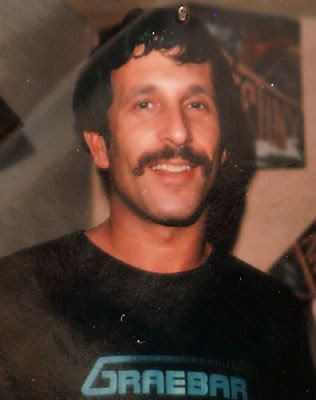
This is a conversation that I'd been sitting on for quite some time now, but thanks to the boys of A Digital Needle/Beam Me Up, I had the privilege to speak to Montreal's DJ Godfather, Robert Ouimet last November, before he played at a special edition of their monthly event, Beam Me Up here in Toronto. Before that, he played at Toronto Pride last summer, where he impressed not only myself, but by the looks of it, just about everyone else in Cawthra Square Park (AKA the 519 Green Space) that night..
It's a rarity these days, when many have either died, or have long left the music scene, to come across someone like Robert, a leading figure in the Montreal and Canadian disco community, who has not only stuck around (interesting fact: he won a JUNO award in 1994), but who remains as musically sharp, open and active as ever. That November night in Toronto, he proceeded to show the crowd - by and large, young enough to be his children, why they called him 'The Godfather.'
This evening he's back in Toronto for yet another round, so I figured this was a good time to finally post this up.. We talked about his days at the Limelight, Montreal's leading disco back in the day (which, interestingly enough, is now a strip club called Chez Paree); how disco people rediscovered him and how he too would end up rediscovering disco.
I read that you started at a place called 'Love'
Yep!
How old were you?
I was 24. It was the first year that I came to Montreal. I went to Montreal University in English Studies, and what happened is that I got fed up and at the same time I found a job, because I didn't have any money.
So it was out of necessity, then?
Yes. I was going at the club and the manager knew..
Knew you?
He didn't know me, he knew me because I was there and I was bugging him.
Ah, because you were persistent!
Yeah! And I wanted to try at least one night and then the owner liked me a lot so what happened is that he hired me.
Okay... And you said this was right at the end when, you know, when live bands were giving way to DJs.
Yeah, downstairs was live bands; R&B, soulful stuff and upstairs was the club... but it was a hole! But it was fun! It was kind of mixed up – black, gay, straight.
So, no pretension.
No, no, no... The owner was always there making sure everybody behaved.
I read somewhere that this was a place where a lot of hip soul bands would play too.
Yes! A lot of bands from the states, soul bands from the 60's early 70's.
Which ones do you remember?
When I came there, it was kind of the end of that stuff, so I'm not sure exactly which bands, but I know it had a good reputation.
So, how did you build from there, from Love?
The thing is, is that the Limelight was already open.
When did it open? 72, 73, something like that?
73... End of 73, around that... I'm not good with numbers and years, but what happened is that the DJ that they had was George Cucuzzella, who would later become the owner of Unidisc, and they wanted another DJ because George didn't like to work afterhours. They heard me and everybody was talking about me at that time, a lot of people – the underground people, because when I was playing I didn't play commercial stuff so what happened is that they came over, they heard me, I tried it and they liked it a lot.
So you just stayed...
I stayed there. I worked downstairs first because there was no upstairs, everything was downstairs at the time.
Okay, well tell me, because I was reading that it was like three levels or something?
That was a long time after.
Oh, okay. So it started small at that time?
Yes, second level only, that was a nice place... Really, really nice.
Yvon LaFrance, was it him who hired you?
There were two owners, another guy and Yvon. It was Yvon that heard me, that was more in charge of the DJs.
So tell me how it evolved, because I didn't know this, it started out with just the one level and then there was the second level, I heard called Le Jardin, for the gay crowd?
Okay, what happened is that they built up the third floor, the Limelight was the second floor and we went upstairs, so the music was going from upstairs to downstairs when they opened up the third floor. That's before Le Jardin.
Okay, before?
Yeah, a lot of gays used to go downstairs, but they wanted a place of their own, so there was a lot of gay people upstairs too, but they all had the same music, the problem was that I didn't see the crowd, it was hard to control and to work with. What happened is that they built it out and made Le Jardin with a DJ downstairs, and me, I kept the third floor, which had more people.
So, it wasn't really a gay venue, it was a mixed crowd?
It was always a mixed venue, but toward more of a gay crowd. Let's say the gay guys and their fag hags [both laugh] all the girls with them.
For you, I heard in that interview with CBC, the first dance music for you was really Motown?
That was my youth, my teens, you know.
So in 73, when you started, when you played at Love, that's what it started with?
There was a continuity with all of that, it was kind of a R&B, early, early Barry White, early Bohannon, mostly Funk and Soul. The early Limelight was that too, funk and soul on 45s, album cuts.
And you were mixing at this time too, right?
Yep, yep.
Because I remember hearing about some other places like, you know, I think I read about in the UK, it took a while for mixing to catch on.
I was blending, it was not really mixing, because that was hard in those days, especially those records.
So, was the Limelight was a lot more discriminating than Love? Because I read somewhere that it was a Studio 54 kind of place, where if you didn't look right, you could not get in.
Yes, it was very fashion oriented, very 'in' place, it was kind of a hidden secret – a word-of-mouth place.
Would you say that it was the most important disco in Montreal at the time?
Yes, it was the main club, Dance club. There was nothing besides the Limelight for five years after. It started later, the other clubs... There was a little club right beside the Limelight that tried to do something, a place called Lorelei, but it didn't work. It was nicer than Limelight.
Really?
Yes! But, it never worked.
Were they also very discriminating about who they let in also?
Yes, that too.. Crescent Street was the gay village at the time.
What was your relationship with the owner, Yvon LaFrance? Was there ever any tension there?
No, not in those days, that came later... It was quite good. He trusted me and I had confidence in him too, he let me do whatever I wanted.
He gave you freedom.
Yes, I was able to do anything I wanted. He gave me the opportunity, and I proved that I was a person that you can count on, because I was always there, I was never sick, I was never out of control. I might be drunk [laughs] but not out of control, no drugs.
And you were playing on the busy days, was it, the weekends?
Thursday, Friday, Saturday and Sunday...
And so they had other people fill in during the week?
In the beginning, it wasn't open during the week.
I was thinking, how you went to find records, as a DJ. You think of it today, it's easy going online and you can easily find out's new and what's playing where, I read that in those days, you'd go to New York regularly.
I used to go to New York, I read the magazines. I had Cashbox, I had Billboard, I knew ahead of time what was coming out, I knew what I wanted and I knew when, and there were some people at the time, who were travelling back and forth to Montreal and New York to buy records.
I heard that it was both ways, people from New York going to Montreal, as well, I'm getting ahead of myself here, because Montreal had a lot of imports.
Yeah! And I was friends with one of the guys, so he always gave me first choice, because he knew me, he knew I knew my music, and I was coming from the 60s, I knew all my shit and I was the first one in the truck, no store was getting there before me, and I had an unlimited budget so I was buying everything! [laughs] Sometimes I had a pile that high [hand in the air] of records, three hundred dollars a week of records. In those days, that was a lot!
Even today that's a lot! Around what time was this? What year? Before 12 inches still?
Yeah.
And before Record Pools and that kind of stuff?
It was a bit before the Record Pools. But the Record Pool, the first one from New York – For The Record was around the same time - '74.
That's when they started in Montreal too, okay. I mean, you started with soul music, but later on there was a lot of European stuff coming to Montreal first before it ever went to the US...
Yes!
And so even today, you look back at some of the top 10 lists from the time and Montreal's always looks different, compared to all the other ones.
I was playing for Montreal, not for a New York crowd, so I didn't mind what they were playing in New York. The culture [in Montreal] is a very mixed culture. I know French, you know, all kinds of different kind of music in Quebec, Latin stuff, stuff coming from Europe, it was easy for me to put together and insert all that with the disco that I was playing, it was working. I would play Tabou Combo, and people would go nuts over that!
Going a bit later in the 70s, going from being a DJ, I guess they start getting DJs in the studio, to be consultants, or to remix the records, how did that begin for you?
I got friends with a few people who were working at a record company, and they were bringing me promos and things like that and that's what happened, talking with them.. and I was very hard with them! [both laugh] I didn't play anything they wanted me to play! I played the things I wanted to play. I was really hard at it, they hated me! A lot of them!
Because they'd give you promos and you wouldn't play them? I mean, I know as a DJ, you don't want to be force-fed.
I was not their bitch! [laughs] I mean, I have a mind of my own, I know what I'm doing... When I see a crowd, I can read it. Without me even noticing it, I know. I feel it. So, I see a crowd, I know what to do with them. And if I don't, I'll stop the thing and play something else.
Okay, going from that how did you break new records to your crowd? I heard that when you liked a new record and you would introduce it by playing it next to one they already loved to make it acceptable. Because if a crowd hears something they don't know...
They will go away..
But you play it with something that is familiar...
And each time they got away, they'd leave the floor, I'd replay the same track! I'd come back to the old track, they were coming back on the floor, and I'd replay it again!
Ah, that's how you sent the message... Like, listen to it first!
It always worked! Everybody was freaking out 'cause I was doing that.
What was the first record that you – actually, let me go back a little, did it start with you doing edits for yourself?
No, I never did edits in the 70's, never.
I know it would have been really hard, because you had to tape it, and cut the tape...
I had guys who were doing that for me. Their name was PAJ.
Okay. And they were DJs too, right?
No.
No, okay.
They loved the music...
I should ask them, but do you remember how they started?
I don't remember... They started giving me edits, they said 'listen to it' and I liked what I was hearing, and a few times, I stopped playing the original completely, I played their mix. Like [Denise LaSalle's] "Freedom To Express Yourself.” My crowd knew only that mix, they don't know the original.
Okay, because today, everyone does re-edits. DJs will make re-edits for their own sets, you know, to make it easier to mix and that kind of thing, but way back then, it would have been so much harder.. What was the first record that someone actually hired you to say 'can you mix this record'? The first one you actually mixed, I guess...
The first one I mixed? That was Francine McGee. I'm not sure if it was Gino, or Francine... It was '77, anyway.
So, it was for RCA Records? Or the producer?
No, no, I think it was the producer. I did that for the producer, the guy who composed everything, I did that in his basement!
[laughs] So, obviously he knew you from the Limelight at this point.
Yeah, yeah...
So, that started the whole thing, you did things like Gino Soccio and all of it from there.
That's because of Quality Records, because of the promotion man who was friends with me, he got me involved with all of that, those people.
Yeah, because I saw your name as a 'Disco Consultant' on another Gino Soccio production, that was Karen Silver.
Yeah, from Toronto, also...
So, explain what that was, a 'Disco Consultant'?
A Disco Consultant is like telling 'yes' or 'no' to what they're doing.
Okay, cause I saw that old 60 minutes segment, and they had this producer, it was John Ferrara, who brought a bunch of DJs in the studio, and he would ask them 'do you like this?' 'do you like that?' Was it kind of like that?
Yeah! To do this and that and maybe check out the mix they had, the bass, or the sound, the drums... That's where I started. That's how I started working with Gino. He was bringing me his acetate and I tried a few things and I went to the studio to remix my first twelve-inch with him – “The Visitors.”
The Visitors – yes!
That was done in the studio, with the 16-track.
And you were there with him, or by yourself?
Yeah, with the engineer.
So Gino brought the acetate to you, to the club, to test it out?
Yeah, I had the acetate..
Before anyone else did?
A lot of it, yeah, but he was also testing it in the States too.
Right, I guess he had his record company there testing...
Because at the time, Gino got mixed up with RFC, which was a big thing for Warner Brothers/Atlantic at the time! They put a lot of money into it.
BTW, I Listened to the ATOMIX, the first one, and there is a Sylvester re-edit of of “(You Make Me Feel) Mighty Real”, what was that?
That's fucking good! Love it! It's not out yet.
It's unreleased, oh okay... Was it Tom Moulton, or was it someone else?
It's a guy from Germany... He sent it to me, he didn't want to send it to everybody. When I gave it away, I had to ask him... That was the last track I played last summer.
Oh, at Pride!
That's the last track I played and I got people coming up to see me, because of that... because they were freaking out!
That was amazing! Whoever he is, he's very good! Well, this leads into my next question, because the re-edit stuff, that's another world for me that I haven't even fully explored. My thing has been going to record stores and digging for whatever 12” singles or albums I find, or whatever looks interesting. I was really slow to latch on to all of that, but what's your take on disco re-edits today?
I love it!... The thing is, I was there at the beginning, and we're 40 years later, I don't want to play the same records.
Because you knew them the first time around, you played them for weeks on end...
I know them and got fed up with them, most of them... It's not because they're bad. After a certain time, you get fed up, because it's the same music you hear and play all the time, so you wanna move on into something else. There are some good re-edits coming out, some great remixes, also, that kept the feel of the original and that got me back into playing disco again, otherwise I wouldn't have played any.
So, hearing re-edits, the remixes that kept the feel of the original...
Yes! That's what got me back into playing disco, because I was ready to quit two years ago!
Oh!
Completely! I didn't wanna do it anymore.
What happened two years ago that made you want to quit?
I couldn't get work in Montreal because of my age, people thought I was kinda washed out, but without hearing what I was doing, even though I had radio shows... You know how people are with age and stuff like that, you're not supposed to be good for a long time. And I think I'm way better than I was in the disco days, for what I know and what I've experienced. I feel I mix a lot better than before.
That's another thing, so many people have left, either they've died, or they're not involved in music anymore, but you're still around, you're doing re-edits as well, you're doing your own shows, you're more tuned into a lot of this stuff than I am.
It's been a part of me, all the time, even in the 70s, I was very curious about music.
To maintain that for as long as you have is impressive!
It's still there! That's why I have four different shows and types of shows on web radio.
So for you, re-edits gave it new life... When did you feel people were re-visiting disco, because every ten years or so, someone says 'oh, disco's back!'
It's been happening for a while though, It's been happening with House, sampling disco. That, I was not too crazy about. That for me was kind of a hit-and-miss, but I think now, it's a step in the right direction. I think people want to go towards real music, but it's a movement that's a lot bigger in Europe than here and the States. I find that Europe has better musical dance culture than here.
You were mentioning it last night, things move a lot faster today, tracks they would come and go in a matter of weeks, but you said, a track like Karen Young – Hot Shot, you were so sick of it, you had to play it for months and months.
A lot of tracks we used to play for 9 months, to a year, because nobody was playing it. The only place you could hear it was at the club.
It hadn't crossed over to radio.
Radio didn't play that stuff. I think Radio killed it, killed a lot of disco hits, because of that. Because it was better to play at the club. People came for that.
To hear it in a club atmosphere... They always talk about in New York, Frankie Crocker at WBLS, playing a lot of disco on the radio, was there anything like that in Montreal?
Yeah, there was CKMF They were playing disco. More commercial stuff...
And of course, the radio station that played you live.
Yeah, every Saturday night.
LIVE From LIMELIGHT Oct 1978 On FM 96 - DJ Robert Ouimet (Part 1)
Uploaded by Tony De Luca
How long did that go on?
Two years.
Another thing we discussed last night, on the record. You weren't really one to tape yourself and listen back to your mixes.
No. For me, I never prepare a set. I know my music, but I never prepare a set ahead of time. It's in my head, and the crowd and the way I read the crowd. That's where it goes. I was never really interested in hearing what I was doing, because for me, it didn't make any sense, to hear what you were doing after it was done. “How come I did that!?”
You'd be criticizing too much?
Yeah! But it worked for the crowd at that time, and when you re-listen, you wonder, you're not sure. So for me, to be better in the way I worked, I would prefer to never record what I was doing.
Having started with R&B and Soul, how did you feel about Eurodisco, later on, as you started getting more of that, how did you feel about that?
I found soul in that stuff too. I mean, the first track I played like that, like Kraftwerk and the Donna Summer – I Feel Love, they were bringing something else. That was bringing another colour, that's why I liked it.
So there was no resistance from you, as far as that was concerned?
Not at all!
Because sometimes I hear about that, that some people who favoured the soul and R&B side of disco, couldn't really identify with that, with Eurodisco, or the more electronic side of it.
No, no, I was really open-minded.
Something I heard was that you were one of the first people to play Donna Summer's “I Feel Love” in Canada, when they were promoting the record. It was on the flipside at the time and the A-Side was a ballad.
Casablanca/Polygram at the time, gave me a gold record because of that!
Oh! For breaking that record!
Yeah!
So, how many gold records, or whatever certification, did you get, for breaking records?
Oh, I got one for Boney M..]
Which one?
"Daddy Cool"... I got one for Gino Soccio - “Dancer,” I got one for Musique – “Push, Push, In The Bush,” I got a big one for Saturday Night Fever, I got something on, I can't remember his name, the rock guy, we don't hear about him anymore...
What other DJs did you respect, because you were, I guess, the Godfather, as they called you in Montreal, but who else would you say - in Montreal or elsewhere?
Michel Simard, He was at Limelight after.
After you, right... You also mentioned New York, when you went to New York, you said your favourite place was Barefoot Boy (presided over by DJ Tony Smith).
It was Barefoot Boy, yeah.
When did you start going there?
Early 70s. Like 74, 75. Like I said, I'm very bad with numbers. I remember it was kind of a...
It was a gay club?
It was a gay club.
With a name like that, I suppose so... [laughs]
It was a gay club and it was fun to go to, the music was always great. It inspired me a lot!
It was the very soulful stuff at the time?
It was early disco and the good stuff, only the good stuff!
You already started at the Limelight at that point?
Yeah, I was learning to mix properly and that really helped me a lot! Hearing what they were doing, how they were doing it. You know, disco is not easy to mix. It's very up and down, it's really hard to do.
Would you describe disco as more feeling than technical, when you want to mix? You have to feel the music in a different way?
When you mix something like disco, it has to be very technical, because the beats are going up and down, so you use your fingers on the turntable or the pitch, know exactly when to go up or down. Nowadays, you don't do that, or mostly not.
Because 120 BPM is going to be just that.
That's it! But disco is not the same, it would be starting at 107, and sometimes finished at 117, that's a ten beat difference, that's a lot! And sometimes when you mix, the beat was fluctuating between 107, and 110, so you had to know when to go up and down on the pitch.
So, at what point was disco starting to get played out for you? Like you were starting to say, 'okay, this is enough', like you didn't like the new records coming out?
It started in '79..
Was there a single record that you can say people were really hyping up that you just couldn't get behind?
I don't really remember, but I mean, you spend 7 years of your life playing the same type of music, I mean, after a while, even though you like all that stuff, you need to branch out and do something else. At the same time that happened, new wave was beginning, so for me, new wave was kind of a breath of fresh air, compared to disco. It was different. Disco was getting very sophisticated at the time, and that was kind of raw, it was very interesting!
It was the feeling you had when disco kind of started, something new and exciting?
I think so. I had the same spark I had with disco at the beginning.
So, someone said that you were one of the first people to really bring new wave to the Montreal audience, that true?
Yeah! All the disco people hated me for that, really hated me! But I knew it was something that was coming.
What was the reaction? People would just walk off?
Okay, the first time I played “Rock Lobster” by the B-52s there were 1500 people in the place, everybody on the dancefloor. When I played “Rock Lobster,” nobody.
Nobody danced?
Nobody! So, I let the 45 go, and I restarted disco after. Everybody said, “you're nuts, you're crazy!” and two weeks after, half the crowd was on the floor, and a month after, it was packed!
So it took off! So, it started with that, “Rock Lobster.”
And at the same time that it happened, the crowd changed.
Was it still kind of a gay crowd or was it...?
Kind of a gay crowd still, but it changed, the regular disco, really really disco people kind of left and got replaced by another crowd.
So you left Limelight in 82 was it?
I left Limelight the first time, early '80.
What happened after that?
He [Limelight owner Yvon LaFrance] gave me my own club!
He gave you your own place!?
He gave it to me, the club downstairs... In three weeks, because there was not a lot of people, he closed it and got rid of me... That's all he wanted.
Oh, an excuse...
An excuse to get rid of me, because he couldn't do it.
Okay, going back to the Limelight, every level was a different concept, different sound by now?
Yeah.
So, he gave you the underground, for the new wave at one point. So, when he shut that down, somebody else picked you up? You found another job right away?
I found another job right away!
They knew you and everything.
And I worked every night, four nights a week, it was packed like crazy, a small, small club..
What was it called, do you remember?
Uh, Studio One.
Studio One, okay. There was also a Studio One in LA that I hear about too... So they gave you free reign?
It was great there, because I was able to play such a vast range of music.
So you mixed everything in there.
No, not mixed! Unmixed! I loved it because I was not able to mix.
You were not able to?
I didn't mix! In-and-out. Fade in-fade out! I think that mixing is overrated... I believe in music! Mixing is an extra.. But you don't need to mix together to play good music. David Mancuso proved it. He's still doing it!
I agree, and I've never heard him play, but selection always trumps mixing.
Yeah, very important, the selection and as long as you have it, good!
Because sometimes I'll hear a perfectly mixed set and it's all a bit monotonous.
It's boring!
Going back to your longevity, what would you attribute it to? Being around music for so long, what keeps it exciting for you?
I think that music keeps me young! Music excites me. There's not a lot of things in life that excite me, music does!
And I guess that curiosity that you're talking about.
It's still there. It never went away and I don't think it's gonna go away, that's what made me.
And you're still editing yourself now.
Yeah, I'm doing some new stuff also. I'm restarting everything again.
So the re-edits have really re-energized you creatively, not just in disco, but more broadly?
What really rejuvenated me was, it has to do with Lil' Dave [Montreal DJ Dave "Lil' Dave" Godin]. A lot! Because he came at a time when I was going down and he was up. And he pushed me and he made me realize that a lot of people knew about me, a lot of people that were worth knowing! He introduced me to all these people and that gave me a big fucking boost! Sorry about the 'fucking' part, but that's what it was! Because I thought I was alone, and that put me in contact with people that went through the same thing I went through, that they are going through at the same time as me, now too. And they heard about me and are aware of what I did, so that was great for me! Because I thought I was alone and completely forgotten.
Alone, how?
Alone, like... what I did, I did, and that only me and a few people remembered.
Like you were something of the past.
Yeah, and those guys were freaking out that I was there, and they treated me like I was an icon! I didn't expect that!
So, like you were saying, the ageism sometimes, that was part of that feeling alone?
I kind of doubted for a while, all of this, what I did and all that, but they made me realize that I did something great, something good, and they talked about it and they knew about what I was doing and what I did... That was great!
And that was just in the last couple of years, really?
Yeah.
I guess, before I end it, talking about this past Pride, here in Toronto. I was really impressed by what I heard from you and the crowd, you know. I was wondering how many people would be interested, like myself. I grew up thinking, I enjoy disco, but I wasn't sure how many other people around me would, you know. So to see all those people really into everything was great!
Yeah, I was very happy with that! I had a lot of fun that night! I had a nice compliment from the sound man, he said he never danced to disco, he said I made him dance all night!
And that's really the ultimate compliment, making somebody dance, that never danced! Well, I think on that note, we'll end it here for now.. Thank you very much for being open to this!
No problem!


To keep up with Robert Ouimet, his web radio shows and his latest edits, follow him on Soundcloud.
PREVIOUS RELATED ENTRIES:
disco delivery mix #1: disco pride (saturday june 29, 2013)
funkytown, montreal (wednesday october 21, 2009)
sunshine on my mind... (sunday january 7, 2007)
disco delivery #9: karen silver - hold on i'm comin' (1979, quality/arista) (friday march 3, 2006)
LINKS:
soundcloud: robert ouimet
discogs: robert ouimet
discomusic.com forums: montreal clubs
deep house page forums: canada's disco scene?
deep house page forums: a little canadian disco history
cashbox canada: godfather of canadian dj's robert ouimet (interview) (by michael e. williams) (february 7, 2013)
montreal gazette: disco flashback: funkytown resurrects memories of montreal in the 1970s (by andy riga) (february 7, 2011)
montreal gazette: legendary dj robert ouimet on disco's heyday, spins "pure disco" one-night-only at mtl club (by richard burnett) (october 6, 2012)
discomusic.com: clubs - limelight (1254 stanley street, montreal, canada)
limelight montreal
paj disco mix
discogs: paj
million dollar disco: paj disco mix
CATEGORIES: DISCO DELIVERY INTERVIEWS, CAN-CON DISCO