Showing posts with label Gay Disco. Show all posts

Saturday, May 08, 2021

Vintage Articles:
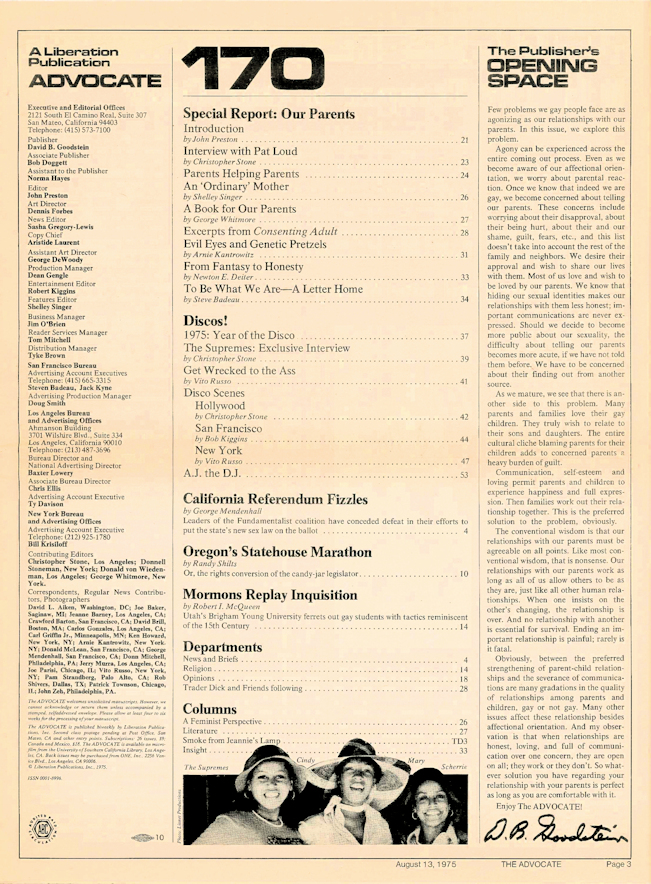
Disco Scenes (Hollywood, San Francisco, New York) - by Christopher Stone, Bob Kiggins & Vito Russo // The Advocate - August 13, 1975


Continuing with more instalments from the Discos! issue of The Advocate. For this issue, their regular city entertainment columns became a quick trip through parts of the gay disco scenes in Hollywood, San Francisco and New York.

Before I go on to the transcribed article, some things to mention:

Studio One is mentioned not just here but in the previous Vito Russo column as one of the best disco venues on the west coast (and it does sound like an impressive complex). Though well reviewed in this column, it appears history has been much less kind to it. Still early in its operation when this was printed, other than a mention about its stringent ID requirements, there are few hints in these pages of the controversy that would surround Studio One and its racist door policies. I’m certain subsequent issues of The Advocate cover the ensuing community backlash, which included multiple demonstrations outside the venue - for now, the Studio One article from the ONE Archives gives a good outline. I’m certain it was far from the only venue where exclusivity, something that was not only common among many disco venues, but also one might argue, necessary when it came to protecting queer spaces, also gave cover for some rather bold racism and classism - of which Studio One has become a prime example. As much as I love delving into the archives of gay publications, one thing that does stand out, whether it is The Advocate, or Christopher Street, or most other gay publications from the time, is that the point of view does tend to be overwhelmingly white and male. Although there seems to be greater attention around representation these days (due largely to sustained activist pressure, let's be honest), it remains an uphill struggle against the stubborn assumption, where ‘gay’ is often by default, white, affluent and male. It’s easy to get caught up in the selective fog of nostalgia, I’ve certainly been guilty of it myself, yet even more important to consider the limitations of the archive.

Some other interesting tidbits here for the nostalgic traveller - Christopher Stone mentions the young mobile disco entrepreneur, Jane Brinton towards the end of his Hollywood column. Brinton would go on to a much higher profile career in the music business in the 1980s and 90s, starting a management company called This Beats Workin’, managing DJ/producers Shep Pettibone and Junior Vasquez through the peak of their careers. Today, she is the co-founder and executive director of The Waterbearers, a charity working to expand clean water access in the global south.

While many of the venues mentioned are long gone and some have left a bigger imprint than others, it’s notable that at least a couple of the San Francisco venues mentioned in Bob Kiggins’ column have had astonishingly long lives. The Endup, founded in 1973, is the only one which remains open today. Opened in 1966, The Stud was around for 54 years, described as San Francisco’s oldest and most diverse queer bar. Having been the focus of a campaign to remain open amid a crushing rent increase in a rapidly gentrifying San Francisco in 2016, the Stud became ”the first co-op nightclub” in America. Despite this, in 2020 the double whammy of COVID and gentrification did it in (at least for now). Yet, The Stud still exists in a kind of digital exile, so a physical return in the post-pandemic future is not yet out of the question.

The City discotheque, while not as long-lasting, is also a notable venue. Patrick Cowley had worked there as a lighting technician before rising to prominence as a producer and all-around synth wizard. Apparently it was here where Cowley and Sylvester had met each other. Two men who figured prominently in both Sylvester and Cowley's careers - John Hedges and Marty Blecman, founders of Megatone Records, had both been DJ's at The City.

As a counterpoint to his lament in his earlier piece in this issue, Vito Russo, in his New York column seems to have found a disco scene to his liking, and it was on Fire Island.

A note about venue links: Whenever a specific disco venue is mentioned, I like to link to its discomusic.com discotheque profile. While discomusic.com still exists in a more skeletal version, the closure of discomusic.com as an active community was a real loss for many of us disco fans. While some of the site’s features, like the forum and the disco record database have been largely supplanted by the growth of Facebook and Discogs, respectively; it remained an incredible repository of information and and its forum a much more open and less intrusive (given how Facebook monetizes all of our data) space to interact. That being said, I’m certain it was all very time consuming and expensive to maintain, however one part of the site which hasn’t been duplicated anywhere else was its archive of user-submitted DJ and venue profiles. Often bolstered by user comments and photographs, these entries were often incredible repositories of disco history. While many of the submitted listings have been preserved by the Internet Archive, some have not. Even some of the ones that have are not quite fully intact. Still, for context, I try to link to these archived profiles whenever possible.

I should also say how much I love all the disco-themed ads in this issue, especially the ones attached to these columns (and there are other full-page ads in between these also). I’ll have to parcel these out into a separate post sometime.

____________________________________________


Disco Scenes - Hollywood
by Christopher Stone

Do you wanna dance? As gay discos go-go, the two really big shows in Hollywood town are still Studio One and Cabaret.

My favourite is Studio One (652 N. LaPeer, West Hollywood). Their advertising, which touts the club as “the place to come and the disco to be at in Southern California,” does not exaggerate.

Good to excellent entertainment is always featured at The Backlot, the complex’s dining-showroom. While the cuisine poses no threat to Le Restaurant or Scandia, it’s as good as you’ll find in any gay eatery in Hollywood.

Studio One also features four bars, a jewelry concession and a game room, complete with watering hole, television and pinball.

The discotheque itself is without equal in California. The largest dance floor around, embellished with lights and lasers, makes for a totally satisfying disco experience. There is always room to dance and breathe, even when there is a big crowd, which is every night after 11.

But what I really like best about the place is the friendly, “family” atmosphere created by owner-manager Scott Forbes, his partners and staff. They are genuinely nice, sociable and fun people. Possibly because of the genial tone set by the staff, the clientele seems to be friendlier than at the other clubs.

Studio One has reigned as Hollywood’s premier disco for well over a year, and I have no doubts about its retaining that top position long after the others have locked their doors. (By the way, be sure to always bring proper identification to Studio One, or any disco. Oscar nominee Valerie Perrine was turned away at the door the other night for lack of an ID.)

Cabaret (333 La Cienega, West Hollywood) opened last spring and was an immediate hit. Like Studio One, Cabaret boasts multiple bars and rooms. They also have Howard Metz, Los Angeles’ most celebrated disco jock, spinning their records.

But the dance floor is postage stamp size compared to the other club. It’s great if you want your tootsies tortured or if you get off on stepping all over others. If you have claustrophobia, forget it, dear.

Cabaret attracts a hard-edged, raunchy crowd, and the camaraderie is so apparent at Studio One is completely lacking there. To be fair, manager Jeff Croon and his assistant Tim Manning have been very accommodating to me, but some of their staff members are totally devoid of charm and common courtesy.

Perhaps it’s the rough, decadent feeling at Cabaret that is so attractive to its regular patrons.

For the most part, Cabaret hasn’t been able to compete with the “name” entertainment at Studio One. An exception was Charles Pierce who graced the showroom for three weeks. If management is wise, they will get Pierce’s autograph on a long-term contract, pronto!

Our Side (836 N. Highland, Hollywood), formerly the Paradise Ballroom and before that Dude City, is a pleasant place to dance, dance, dance to disco jock Tony Miller’s hot platters. The nitery’s recent facelift seems to be attracting good nightly crowds.

And right across the street is The Other Side, Hollywood’s chicken de-light disco. ‘Nough said.

Once “the” disco in town, After Dark (8471 Beverly Blvd., West Hollywood), re-opened last spring following last summer’s mysterious fire. But the disco hasn’t recaptured anything approximating its former glory. More and more straight people attend the club; the magic is gone.

If you’re a say-at-home and would rather have the disco come to you, by all means call Jane Brinton’s Aristocrat Mobile Discotheques (213-851-7831). Brinton and her staff will bring over $20,000 worth of disco hardware, music, lights, bubbles and what-have-you to your home, office, school organization, wherever.

Last month, Jane and her mobile units were in the middle of Franklin Canyon playing for Karen Black’s wedding. Movie generators were used as her power source. That’s mobile.

There are other mobile discos in town, but none that equal the elaborate, sophisticated equipment Aristocrat has to offer.

Jane’s price tag for hauling her hardware runs up to $300 per evening, but the fee varies with the length and location of the gig. The cost includes over 2,000 albums and a jock to play them.

In addition to her mobile service, Brinton can custom design and build a disco of your very own for between $6,000-60,000.

“It all depends on what you want,” says Jane. ■

____________________________________________


Disco Scenes - San Francisco
by Bob Kiggins

Whatever your musical taste, San Francisco has a dance bar to feed it - for a few evenings’ worth at least. The present difficulty with “going out” is that with so few really hot dance scenes to choose from, boredom can set in quickly. And a disco full of bored people is not long a disco.

Cabaret/After Dark, our lone dance-show-restaurant-bar, has gone through some changes of late. Opened over two years ago as the first of its kind in the city, Cabaret introduced quality name entertainment to an increasingly ambisexual clientele. Riding the crest of a not-yet-defined sociological wave, the major focus here, as anywhere else mentioned was not dance or stage shows but sex.

And not just gay male genital sex, either. Increasing numbers of women, gay and straight, swinging couples, curious tourists and just plain folks out for a good time turned the gay bar/dance hall combo in to a jumble of sensuality.

The disco that best accommodates that phenomenon will win out over a management lacking the foresight, creativity and financial resources necessary to bring it off. While San Francisco is well-endowed with all three, the recent shuttering of Cabaret shows how tenuous the relation can be.

There may be hope. Supposedly closed for “extensive remodelling,” the fact that Cabaret will be revived (under new ownership) as The City, 936 Montgomery St., which promises to be an entertainment cruise complex the liked of which this “Baghdad-by-the-Bay” hasn’t seen since the Cliff House and Sutro Baths went up in flames. At press time, it’s all systems go for a mind bending concoction that could prove the ultimate paean to the art of disco craftsmanship and imagination. When The City is unveiled over Labor Day Weekend, San Francisco will take its place in the great race to out-disco the next city - or the next block, since rumours persist that we will witness the birth of a sister showplace Cabaret Two.

For the time being, however, don’t come to San Francisco expecting any super-discos. Disco fever is, of course, rampant here, but with the unexpected shut-down of the Cabaret, it has shifted to the less overwhelming neighborhood dance bars. Herewith, then, a listing of fun places to cure even the itchiest of feet.

The Endup, at 401 6th St. (corner of Harrison), sports a decor straight out of the teen stereo department of Montgomery Ward (flashing colored lights behind translucent wall panels, a plastic raised dance floor, black lights, even a go-go boy in a cage), but it’s as “today” in disco terms as Gloria Gaynor. The music is loud, “get-down,” driving and expertly paces; the dancers eager, extroverted, and energetic; the crowd amiable, good-looking, and in the 25 and up range. A spacious bar and attentive bartenders (there are, unfortunately, no floor waiters) add to the Endup’s overall appeal. Expect to sweat and be crowded on weekends, when you’ll pay $1 admission (it’s good for a drink). Cruisy, too.

Not too far away, at 1535 Folsom St., is the Stud, a perennial favourite hang-out of the long-haired, flannel-shirted, “earthy” set. A congenial atmosphere and (for the most part) less than frenetic vibes makes the Stud one of the more comfortable places around. Dancing is free-for-all in a pocket-sized area, the music (taped) varied (i.e., Stones to Spinners), and it’s rarely too crowded. Organic decor. Live music Thursday nights.

And while you’re in the area, you can do it up neo-country style at the Rainbow Cattle Company, Valencia at Duboce. After the dinner rush, this bar/restaurant opens the back room to the shit-kickin’ dance dreams of a friendly crowd, determinedly un-glittered and decidedly laid-back. Country & Western, down-home boogie, and a newly refined audio system raise the roof and spirits of the Cattle Co. clientele - the least disco maniacal in the city.

For friskier dance floor acrobatics, check out the Mind Shaft, 2140 Market St. Wend your way through the pool table area near the door (where you’ll pay $1 for a drink ticket) to the elevated dance area (it’s even latticed - the ideal patio boxing ring), set amidst a colourful, attractive Deco-ish environment. It gets steamy on weekends (traveling waiters are very accommodating), but you’ll be so immersed in the heady soul music and elbow-to-elbow craziness nothing will matter.

Without Cabaret, the glitter set seems to have found sanctuary in Buzzby’s, 1436 Polk St., a flashy, sassy, cheerfully stylish disco in the heart of one of San Francisco’s flashier gay ghettos. The Buzzby clan is primarily well-dressed and well-heeled, but all images soon dissolve under the spell of the crafty d.j., who invariably gets everyone on the floor in chaotic, spirited dancing. Again $1 at the door, and efficient floor waiters/waitresses. (Note: Buzzby’s has of late been enforcing their capacity limit; arrive 11PM-ish to avoid a wait in line.)

You might also find any of the following to your liking: Bo-Jan-gles, 709 Larkin (very Soul-Train, crowded and mixed); the Nickelodeon, 141 Mason St. (Where boys will be girls, decor very Hollywood); Olympus, Columbus at Lombard ($2 weekends, palatial, bouncy, largely straight); or the ’N Touch, Polk near Pine St. (Pushy crowd, mostly cruising).

[Ed. Note: Donald McLean is on vacation. His column will resume upon his return.] ■

____________________________________________


Disco Scenes - New York
by Vito Russo

Everyone seems to be discussing the big disco boom in New York these days. The Village Voice has just done a cover story on the subject, indicating that discos are at least as popular as that paper’s two recent cover stories which concerned gay people. In New York, you can’t find a disco without gay people, and vice versa, so I guess it’s all the same story.

The first bit of news for those of you who haven’t heard is that The Flamingo has closed for the summer and the former Flamingo crowd adjourned to Cherry Grove’s Ice Palace on Fire Island. More about that Ice Palace in a minute. In the city, it’s 12 West, the new in-place for the disco freaks, beautiful people and hangers-on from Bayside, Queens and Brooklyn, looking for David Bowie in the crowd. 12 West is located on West St. Between 12th & Jane and is just a stone’s throw from the latest gay outdoor sex scene, where you can get your rocks off while someone picks your pocket. (This is especially easy if you also have your clothes off. Stay away from it.)

There’s real action at 12 West, where you can dance until 6AM without stopping and without coming down once. Its quadrophonic sound system is sensational, and free juices and fruit are available all evening. Also, a generous supply of ice water for those who dehydrate quickly. It is a membership club, as are all major discos in New York. You may either join for something like $40 a year (they never stay around that long), or you can come as the guest of a member for about $5. This is your best bet. If you don’t know anyone who is a member, wait outside. Someone will take you in eventually, It’s done all the time.

Le Jardin is a more commercial, more above-ground version of 12 West that has been around for a few years now. It started out as a lavish gay bar on the order of Studio One in L.A. and is now a heavy glitter trip. Whenever a place gets “discovered” and becomes popular with all the groupie teenagers from New Jersey, the original crowd moves on to greener (more “in”) pastures. This is what has happened to Le Jardin. Everyone has gone over to 12 West. Le Jardin is worth seeing, however and boasts the entire basement and the entire rooftop of the Diplomat Hotel on W. 43rd St. The basement level is, as the name implies, a garden for dancing. The dance floor is enormous and surrounded with lots of fake greenery and green and white lounges and couches at which you may be served large drinks from small glasses. The rooftop is really something to see. It overlooks most of Manhattan consists of several rooms in blue and white and silver. There is a stark-white baby grand piano and a silver and white bar which is surrounded by silver ferns. There is also an outdoor terrace which is furnished with waterbeds, from which you can watch any number of color television sets. It’s a nice place to visit and will give you a sense of freaky New York nightlife, especially if you’ve never been here before. It costs $7 to get in, and they have a membership policy also.

For a special weekend, and it must be a special weekend due to its location, visit the Ice Palace on Fire Island. Daytripping (spending a day and leaving on the last boat) is discouraged, so make arrangements to stay awhile. You won’t regret it, because there’s a lot more to see on Fire Island than just the disco, and your trip won’t be wasted. The Ice Palace has been around for a long time. It’s probably the longest running disco on the East Coast. Even when it was just a dance bar, it was a place where people discovered records and made them hits before they ever got air play. On Fire Island, there’s always one song which seems to typify that certain summer, if you will. Last year it was “I’ll Always Love My Mama,” with “Love’s Theme” as a close second.

This year the Ice Palace has been the subject of a $60,000 redecoration, and sports mirrored walls and even shows with top stars before the late-night dancing begins. Della Reese, Morgana King and Carmen MacRae are among the latest in early evening entertainment, followed by dancing until 4AM, all one block away from one of the most beautiful beaches in the world. Fire Island is another world, and the rules are all flexible. If you stay at the Beach Hotel, be prepared to listen to disco music all night, as your room will more likely than not be directly opposite the dance floor, separated only by a swimming pool. The dress is very casual, sometimes nothing at all, due to the fact that this completely gay community is isolated after the last boat leaves; no one may arrive or leave until morning except by speedboat or helicopter. The Ice Palace gets its share of straight people, but it is more of an integrated society than a “look at them dance” routine, and at about three in the morning, people are literally dancing on the walls. (They have these little walls which separate the rooms and people dance on them, ok?)

I assume that anyone who is interested in disco dancing in the first place accepts the rules that apply. These are not, usually, cruise bars. They are places where people go with a group of friends to dance the night away. On Fire Island, this rule bends a little because everyone is there for a good time; the lack of restrictions, law and order, and stress bring about a sort of early-Rome feeling which continues until the sun is well up over the gorgeous horizon. There is seldom, if ever, any trouble. There are two policemen on Fire Island and they dance very well. Their job consists of mostly tossing unruly straight teenagers off the dock when they manage to find their way out to the Grove. Also, drugs are ignored within reasonable limits.

Discos in New York are enjoying a period of fashion. This may last a year or a day. One never knows here. Everyone is looking for a way to dance their troubles away. Places like the Limelight and Hollywood, old-fashioned, plain gay dance bars are still packed to the rafters every night, so the discos aren’t taking any business away from them. ■

____________________________________________


PREVIOUS RELATED ENTRIES:
vintage articles: cheap thrills, entertainment and escapism - by christopher stone // the advocate - august 13, 1975 (wednesday may 5, 2021)
vintage articles: wanna dance? get wrecked to the ass! - by vito russo // the advocate - august 13, 1975 (wednesday april 28, 2021)
vintage articles: exclusive supremes interview - by christopher stone // the advocate - august 13, 1975 (sunday march 21, 2021)

LINKS:
the waterbearers: jane brinton
one archives: studio one
los angeles conservancy: the factory (studio one)
wehoville - jim crow visits west hollywood: studio one and gay liberation (by don kilhefner) (august 5, 2016)
los angeles times - opinion: should we preserve ugly but important buildings - like the former studio one in west hollywood? (by ann friedman) (july 27, 2016)
los angeles blade: west hollywood divided over fate of the factory (by christopher kane) (july 3, 2018)
los angeles times - scott forbes, 57, ran dance palace (obituary) (by jon thurber) (february 7, 2002)
the endup san francisco
the stud san francisco
discomusic.com - clubs & discotheques: the city (san francisco) (web archive)
discomusic.com - clubs & discotheques: the endup (6th and harrison, san francisco) (web archive)
discomusic.com - clubs & discotheques: the stud (folsom street, san francisco) (web archive)
gaytravel.com - fire destroys gay landmark on fire island (march 27, 2015)
rooftops of nyc: rock ’n roll on the rooftop (le jardin, diplomat hotel, w. 43rd street near sixth avenue) (december 1, 2011)
new york times: an aging midtown hotel that will not go gently (by david w. dunlap) (november 7, 1993)
google newspapers: the village voice - inside the disco boom (by richard szathmary & lucian k. truscott iv) (july 21, 1975)


CATEGORIES: VINTAGE ARTICLES

Wednesday, May 05, 2021

Vintage Articles:
Cheap Thrills, Entertainment and Escapism -
by Christopher Stone // The Advocate -
August 13, 1975

Continuing with some more from the August 1975 Discos! issue of The Advocate. Admittedly, I’m posting this a little out of sequence. This was Christopher Stone’s introduction to their Disco coverage, just a couple of pages before their exclusive interview with The Supremes.

Interesting to note in this little time-capsule, the contextualization of Disco not as a novel juggernaut, but as a revival, or continuation of an earlier trend, one picked up by the gay underground as far back as 1971. Something “wild, free and outrageous,” originating in “[d]efunct factories, markets and restaurants” highlighting again, clear parallels to the origins of rave culture, for example.

Also notable in this time period - disco being cast, not as something restrictive or limiting (as some later press in the decade would) but as a force opening up musical opportunities. Success in disco is cast here as an antidote to “tight and restrictive” radio playlists, creating new stars and breathing new life into older acts.

More to come very soon.

____________________________________________


Cheap Thrills, Entertainment and Escapism
by Christopher Stone


“Shame, shame, shame-shame on you, if you can’t dance too.”

From Hollywood’s Studio One to Le Jardin in Gotham, everybody’s doing it: the hustle, the bump, the time warp and the continental (not to be confused with the Fred & Ginger version).

For the entertainment industry, 1975 is the Year of the Discotheque. No doubt about it, the masses have turned on to what’s been getting us off for the last four years.

In the country discos were almost completely gay. During the last year, hetero clubs have been opening faster than Gloria Gaynor can say “goodbye.” Independent surveys indicate that at least 70% of the discos are still gay. Many straight people confess that they have more fun at the gay clubs.

The current disco revival began in 1971, spearheaded by the gay underground. Defunct factories, markets and restaurants were transformed into dance meccas where gay people boogyed their way to happiness. The atmosphere was wild, free and outrageous. Attire ranged from black tie to tie-dye. Discothequers lost themselves in a frantic world of non-stop music and madness. Nobody cared who did what to whom just as long as you didn’t stand still.

About two years ago discos surfaced, and now there are an estimated 500 in New York, 100 in Southern California and an additional 700 sprinkled between the coasts. The numbers seem to change daily.

The discotheque, which literally means disc library, originated in France during the ‘50s. The fad swept across Europe, becoming especially popular in London, and eventually reached our shores in the early ‘60s.

Back then, the clubs were primarily straight. The American Graffiti generation twisted, rugged, monkeyed, jerked and swam the night away to the Supremes, Martha and the Vandellas, Chubby Checker, Little Richard - even Bobby Rydell. Ann-Margret look-alikes set the pace from cages, which were sometimes suspended from the ceiling.

But with the advent of acid rock, the disco turntables stopped turning. Now they are spinning as never before.

The recession seems to be primarily responsible for the resurgence. At a time when money is as tight as one’s pants, discos offer cheap thrills, entertainment and escapism. (On the West Coast, admittance is usually free during the week, with cover charges ranging from $1-$3 on weekends; Eastern discos charge more.)

Discos make dollars and sense for club owners who can no longer afford the hefty fees commanded by the better “live” groups and attractions. And while rock groups were sometimes temperamental and undependable, hit records never have a bad night. Disco owners offer their patrons superstars at their recording studio best, seven nights a week.

Moreover, record companies are ecstatic over the disco boon. Platter pushers previously had to rely solely on radio airplay to make a hit record. Most radio playlists are tight and restrictive, so many discs were pressed and then never heard. Discos have changed all that.

“Rock the Boat,” “I’ve Got the Music In Me,” “Never Can Say Goodbye,” “Love’s Theme,” “Get Dancin’,” “The Hustle” and “Shame, Shame, Shame ” are just a few of the smashes that owe their success to disco airplay.

Stars such as Gloria Gaynor, Disco Tex and the Sex-O-Lettes, Carol Douglas and Van McCoy were born in discos. Others such as Labelle, the Supremes and Shirley & Co. were re-born there. Now record companies have disco reps who monitor the clubs, listen to the jocks and supply them with new products. (Up until this year, most disco jocks had to supply their own records.) Major labels even supply the clubs with “special mixes” of certain songs, designed for optimum reproduction when played over a disco’s elaborate sound system.

Where all of this will end, no one seems to know.

No one wants it to end.

It looks like discos may just be here to stay. ■
____________________________________________


PREVIOUS RELATED ENTRIES:
vintage articles: wanna dance? get wrecked to the ass! - by vito russo // the advocate - august 13, 1975 (wednesday april 28, 2021)
vintage articles: exclusive supremes interview - by christopher stone // the advocate - august 13, 1975 (sunday march 21, 2021)
in defense of disco by richard dyer (tuesday march 13, 2008)

LINKS:
wikipedia: nightclub - post wwii: emergence of the disc jockey and the discothèque
wikipedia: twelve-inch single
library of dance: the bump
christopher stone - author

CATEGORIES: VINTAGE ARTICLES

Wednesday, April 28, 2021

Vintage Articles:
Wanna Dance? Get Wrecked To The Ass! -
by Vito Russo // The Advocate -
August 13, 1975


Continuing with another installment from the Discos! issue of The Advocate with this article from the late writer and activist Vito Russo. Best known perhaps for his landmark work, The Celluloid Closet documenting gay representation in cinema and for being a founding member of both GLAAD and ACT UP, Russo left an indelible mark on the world and particularly in gay activism before his passing of AIDS-related complications in 1990. Russo would contribute to the “Disco Scenes” section later in this issue (which will be up soon), but his article here is an interesting window and counterpoint to the inescapable rise of disco—music, culture, and spaces—particularly in the gay community/communities.

Though he says this isn’t a judgement of the music or the experience, it does read as something of a lament. As Russo suggests, the growth of large, impersonal discos seemed to be replacing the more intimate, casual social atmosphere of the neighbourhood bar—where one could still dance, yet, as Russo maintains, have a better chance of actually striking up a conversation or even a friendship. Even I, as a disco enthusiast all these years later, can relate to much of what he’s saying. Heightened sound and elaborate lighting systems are not necessarily conducive to an atmosphere of elevated sociality. While there’s something to be said about losing yourself in the massive sensory experience of a large crowd in a large space, reflecting back to pre-pandemic days when going out was a relatively regular occurrence, even I tended to prefer smaller, casual venues for dancing (and playing records). Smaller dance bars also tend to fit within the culture here in Toronto, even today (though I wonder if Russo ever went to The Loft?).


There’s also a certain parallel here to contemporary debates around dating apps and the impact they have on queer communities in urban centres. The argument, particularly for queer men, that apps like Grindr, Scruff—which for all their convenience, are replacing and endangering the hard-fought physical spaces of the bars, clubs and bathhouses—has a certain resonance, especially if you are living in a city large enough to have its own “gay village.” Though, as Russo intimates here with discos, this is not a trend confined solely to queer people or spaces, the impact feels more immediate and disproportionate. Hard-won and already fewer in number, these spaces are not just businesses but bedrocks of community-building. Though this debate will undoubtedly continue, as with any wave of change, there are gains and losses; Russo here captures a moment when discos were signalling a notable shift in gay social life.

Vito Russo left a much bigger legacy than I could ever do justice to here. Books and documentaries aside, the Making Gay History podcast has an excellent condensed summary of his life and work that is well worth a listen.

____________________________________________


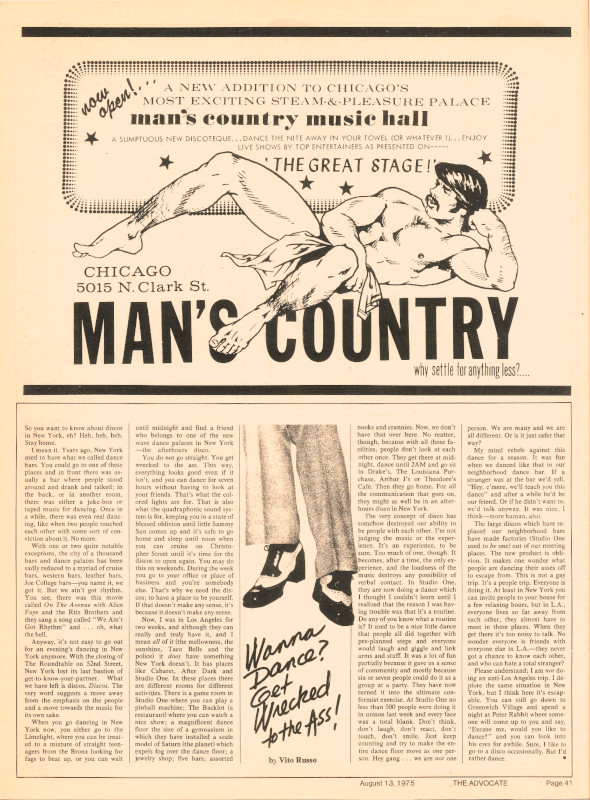
Wanna Dance? Get Wrecked to the Ass!
by Vito Russo


So you want to know about discos in New York, eh? Heh, heh, heh. Stay home. I mean it. Years ago, New York used to have what we called dance bars. You could go to one of these places and in front there was usually a bar where people stood around and drank and talked; in the back, or in another room, there was either a juke-box or taped music for dancing. Once in a while, there was even real dancing, like when two people touched each other with some sort of conviction about it. No more.

With one or two quite notable exceptions, the city of a thousand bars and dance palaces has been reduced to a myriad of cruise bars, western bars, leather bars, Joe College bars—you name it, we got it. But we ain’t got rhythm. You see, there was this movie called On The Avenue with Alice Faye and the Ritz Brothers and they sang a song called “We Ain’t Got Rhythm” and … oh what the hell.

Anyway, it’s not easy to go out for an evening’s dancing in New York anymore. With the closing of The Roundtable on 52nd Street, New York lost its last bastion of get-to-know-your-partner. What we have left is discos. Discos. The very word suggests a move away from the emphasis on the people and a move towards the music for its own sake.

When you go dancing in New York now, you either go to the Limelight, where you can be treated to a mixture of straight teenagers from the Bronx looking for fags to beat up, or you can wait until midnight and find a friend who belongs to one of the new wave dance palaces in New York—the afterhours disco.

You do not go straight. You get wrecked to the ass. This way, everything looks good even if it isn’t, and you can dance for seven hours without having to look at your friends. That’s what the colored lights are for. That is also what the quadrophonic sound system is for, keeping you in a state of blessed oblivion until little Sammy Sun comes up and it’s safe to go home and sleep until noon when you can cruise on Christopher Street until it’s time for the discos to open again. You may do this on weekends. During the week you go to your office or place of business and you’re somebody else. That’s why we need the discos; to have a place to be yourself. If that doesn’t make any sense.

Now, I was in Los Angeles for two weeks, and although they can really and truly have it, and I mean all of it (the mellowness, the sunshine, Taco Bells and the police) it does have something New York doesn’t. It has places like Cabaret, After Dark and Studio One where you can watch a nice show; a magnificent dance floor the size of a gymnasium in which they have installed a scale model of Saturn (the planet) which expels fog over the dance floor; a jewelry shop; five bars; assorted nooks and crannies. Now, we don’t have that over here. No matter, though, because with all those facilities, people don’t look at each other once. They get there at midnight, dance until 2AM and go sit in Drake’s, The Louisiana Purchase, Arthur J’s or Theodore’s Cafe. Then they go home. For all the communication that goes on, they might as well be in an after-hours disco in New York.

The very concept of disco has somehow destroyed our ability to be people with each other. I’m not judging the music or the experience, It’s an experience, to be sure. Too much of one, though. It becomes, after a time, the only experience, and the loudness of the music destroys any possibility of verbal contact. In Studio One, they are now doing a dance which I thought I couldn’t learn until I realized that the reason I have having trouble was that it’s a routine. Do any of you know what a routine is? It used to be a nice little dance that people all did together with pre-planned steps and everyone would laugh and giggle and link arms and stuff. It was a lot of fun partially because it gave us a sense of community and mostly because six or seven people could do it as a group at a party. They have now turned it into the ultimate conformist exercise. At Studio One no less than 500 people were doing it in unison last week and every face was a total blank. Don’t think, don’t laugh, don’t react, don’t touch, don’t smile. Just keep counting and try to make the entire dance floor move as one person. Hey gang … we are not one person. We are many and we are all different. Or is it just safer that way?

My mind rebels against this dance for a reason. It was fun when we danced like that in our neighborhood dance bar. If a stranger was at the bar we’d yell, “Hey, c’mere, we’ll teach you this dance” and after a while he’d be our friend. Or if he didn’t want to, we’d talk anyway. It was nice, I think—more human, also.

The large discos which have replaced our neighbourhood bars have made factories (Studio One used to be one) out of our meeting places. The new product is oblivion. It makes one wonder what people are dancing their asses off to escape from. This is not a gay trip. It’s a people trip. Everyone is doing it. At least in New York you can invite people to your house for a few relaxing hours, but in L.A., everyone lives so far away from each other, they almost have to meet in these places. When they get there it’s too noisy to talk. No wonder everyone is friends with everyone else in L.A.—they never got a chance to know each other, and who can hate a total stranger?

Please understand: I am not doing an anti-Los Angeles trip. I explore the same situation in New York, but I think here it’s escapable. You can still go down to Greenwich Village and spend a night at Peter Rabbit where someone will come up to you and say, “Excuse me, would you like to dance?” and you can look into his eyes for awhile. Sure, I like to go to a disco occasionally. But I’d rather dance ■
____________________________________________


PREVIOUS RELATED ENTRIES:
vintage articles: exclusive supremes interview - by christopher stone // the advocate - august 13, 1975 (sunday, march 21, 2021)
in defense of disco by richard dyer (tuesday, march 13, 2008)

LINKS:
wikipedia - vito russo
making gay history - the podcast: episode 10 - vito russo
goodreads - the celluloid closet: homosexuality in the movies by vito russo
the act up historical archive: why we fight by vito russo
uw press - celluloid activist: the life and times of vito russo by michael schiavi
vito: a new documentary by jeffrey schwarz

forgotten new york: 10th street (april 19, 2020)
forgotten new york: holland hotel (january 25, 2019)
one archives: studio one
discomusic.com - clubs & discotheques: roundtable (151 e. 50th street between lexington and 3rd avenue, new york) (web archive)
discomusic.com - clubs & discotheques: limelight (91 7th avenue s., greenwich village, new york) (web archive)
discomusic.com - clubs & discotheques: cabaret (beverly boulevard, west hollywood) (web archive)
discomusic.com - clubs & discotheques: after dark (beverly boulevard & la cienega, los angeles) (web archive)


CATEGORIES: VINTAGE ARTICLES, IN MEMORIAM

Sunday, March 21, 2021

Vintage Articles:
Exclusive Supremes Interview -
by Christopher Stone // The Advocate -
August 13, 1975


It has been over a month since the sudden passing of original Supreme Mary Wilson at age of 76, just weeks before her 77th birthday. Unfortunately we’re at that time when many of the musicians I’ve either written about or have been part of the music on this blog are passing away, that’s besides the pandemic we are in right now, when so many are dealing with death and loss.

Mary’s passing prompted me to go into my archives where I found some old issues of The Advocate that I had scanned several years ago. Still the American LGBT publication of record, their August 1975 Discos! issue is where I found this particular article - an exclusive interview with The Supremes by frequent Advocate entertainment contributor and editor Christopher Stone, who is still active today as an author in gay fiction and non-fiction.

I’ve covered The Supremes here on the blog several times in the past, so it’s no surprise that I have a soft spot for the last two Supremes lineups. While those groupings had less pop success than previous incarnations, they had some of their greatest showings in the discos, which certainly further solidified their loyal gay following, a fact that’s well-highlighted in this particular article. Their current single at the time “He’s My Man” was perfectly primed for disco action and marked something of a comeback for the group after a near 2 year gap between releases.


The interview generously touches on the strong gay following they have, namely the fondness drag performers had for them. While here Mary laments that they had yet to go to a gay venue to see any of the drag tributes to them, interestingly a few years ago, a defunct local publication here in Toronto where I live had a regular Then & Now column written by DJ and writer Denise Benson, documenting memories of bygone local clubs and discos. Her columns have since been compiled into a book, but I recall one particular column on a club called David’s which featured a memory of this particular lineup of Supremes making a surprise appearance there to judge a drag competition, probably not long after this interview had been conducted.

By this time the group consisted of Mary Wilson as the sole remaining original member, plus the return of Cindy Birdsong and the new addition of Scherrie Payne as their primary lead vocalist. Though Payne doesn’t have a great deal of quotes in this interview, Mary and Cindy’s comments here more than hint at their internal struggles with Motown and the uphill battle before them trying to re-establish The Supremes as a musical presence.

Though The Supremes would only last a couple more years as an active entity, Mary’s battle for recognition was really only just beginning. It would be the better part of a decade before her first book, Dreamgirl - My Life As A Supreme would come out and help turn the tide against the official line at the time which seemed to marginalize The Supremes as little more than Diana Ross’ launching pad, with Wilson and the late Florence Ballard as mere musical footnotes.

Together with the social discussions that have been rippling through society lately, the #metoo movement among them, has me thinking about what it means to be a woman, a black woman, in an industry that has often denied one's agency on both grounds. While I am neither, so many of the artists that I love are. That being said, even I have to admit that I have at times been guilty of that casual sexism that often exists in musical coverage, where often so much emphasis and credibility is placed on the (usually male) producer as the creative driver that the agency and artistry of the woman (usually the vocalist) goes underrepresented and unacknowledged even on work that bears their name.

Certainly when we talk about agency, Mary’s legacy is a testament to it. While much has been written about Diana Ross’ legendary ambition and tenacity, she certainly wasn’t the only Supreme with grit and determination. As someone who sustained a long performing career herself, Mary Wilson had to fight an uphill battle for agency nearly every step of the way. After spending years on the wrong side of Motown politics, battling the label throughout much of the 1970s and 80s (well documented in her second book and subsequent updates), she had emerged in the last decades of her life not only a seasoned performer, but an astute operator in the politics of the music industry and a tireless ambassador for the Motown legacy. To the point where her efforts helped change laws in Washington, she also ended up cultivating a working relationship with Motown's parent company, Universal Music, having been a part of practically every Supremes release and re-issue in the past 20 some years. It was perhaps a much more generative relationship than the one she had with the old Motown label when this article was written.

To paraphrase what the lady herself said in a 2017 interview; unlike some of her contemporaries, she had a chance to fight back and show the world what she was made of.

Rest in Peace and Power Ms. Mary Wilson.

____________________________________________


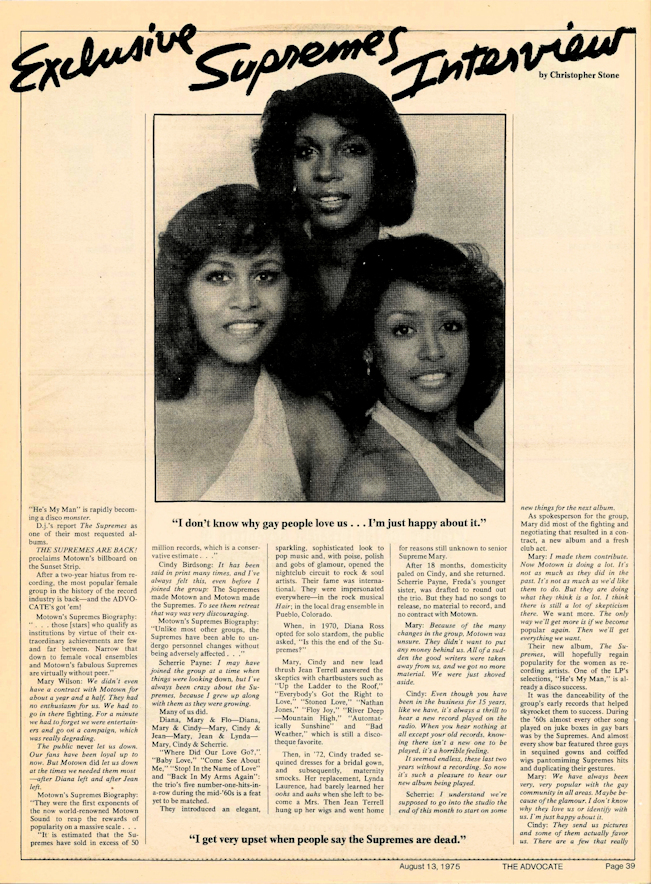
Exclusive Supremes Interview
By Christopher Stone

“He’s My Man” is rapidly becoming a disco monster.

D.J.’s report The Supremes as one of their most requested albums.

THE SUPREMES ARE BACK! proclaims Motown’s billboard on the Sunset Strip.

After a two-year hiatus from recording, the most popular female group in the history of the record industry is back - and the ADVOCATE’s got ‘em!


Motown’s Supremes Biography: “…those [stars] who qualify as institutions by virtue of their extraordinary achievements are few and far between. Narrow that down to female ensembles and Motown’s fabulous Supremes are virtually without peer.”

Mary Wilson: We didn’t even have a contract with Motown for about a year and a half. They had no enthusiasm for us. We had to go in there fighting. For a minute we had to forget we were entertainers and go on a campaign, which was really degrading.

The public never let us down. Our fans have been loyal up to now. But Motown did let us down at the times we needed them most - after Diana left and after Jean left.


Motown’s Supremes Biography: “They were the first exponents of the now world-renowned Motown Sound to reap the rewards of popularity on a massive scale… “It is estimated that the Supremes have sold in excess of 50 million records, which is a conservative estimate…”


Cindy Birdsong: It has been said in print many times, even before I joined the group: The Supremes made Motown and Motown made the Supremes. To see them retreat that way was very discouraging.

Motown’s Supremes Biography: “Unlike most other groups, the Supremes have been able to undergo personnel changes without being adversely affected…”

Scherrie Payne: I may have joined the group at a time when things were looking down but I’ve always been crazy about the Supremes, because I grew up along with them as they were growing.

Many of us did.

Diana, Mary & Flo - Diana, Mary & Cindy - Mary, Cindy & Jean - Mary, Jean & Lynda - Mary, Cindy & Scherrie.

“Where Did Our Love Go?,” “Baby Love,” “Come See About Me,” Stop! In the Name of Love” and “Back In My Arms Again”: the trio’s five number-one-hits-in-a-row during the mid-’60s is a feat yet to be matched.

They introduced an elegant, sparkling, sophisticated look to pop music and, with poise, polish and gobs of glamour, opened the nightclub circuit to rock & soul artists. Their fame was international. They were impersonated everywhere-in the rock musical Hair; in the local drag ensemble in Pueblo, Colorado.


When, in 1970, Diana Ross opted for solo stardom, the public asked, “Is this the end of the Supremes?”


Mary, Cindy and new lead thrush Jean Terrell answered the skeptics with chartbusters such as “Up The Ladder to the Roof,” “Everybody’s Got the Right to Love,” “Stoned Love,” “Nathan Jones,” “Floy Joy,” “River Deep-Mountain High,” “Automatically Sunshine,” and “Bad Weather,” which is still a discotheque favourite.

Then, in ’72, Cindy traded sequinned dresses for a bridal gown and subsequently, maternity smocks. Her replacement, Lynda Laurence, had barely learned her oohs and aahs when she left to become a Mrs. Then Jean Terrell hung up her wigs and went home for reasons still unknown to Supreme Mary.

After 18 months, domesticity paled on Cindy and she returned. Scherrie, Freda’s younger sister, was drafted to round out the trio. But they had no songs to release, no material to record, and no contract with Motown.

Mary: Because of the many changes in the group, Motown was unsure. They didn’t want to put any money behind us, All of a sudden the good writers were taken away from us, and we got no more material. We were just shoved aside.

Cindy: Even though you have been in the business for 15 years, like we have, it’s always a thrill to hear a new record played on the radio. When you hear nothing at all except your old records, knowing there isn’t a new one to be played, it’s a horrible feeling.

It seemed endless, these last two years without a recording. So now it’s such a pleasure to hear our new album being played.


Scherrie: I understand we’re supposed to go into the studio the end of this month to start on some new things for the next album.

As spokesperson for the group, Mary did most of the fighting and negotiating that resulted in a contract, a new album and a fresh club act.

Mary: I made them contribute. Now Motown is doing a lot, It’s not as much as they did in the past. It’s not as much as we’d like them to do. But they are doing what they think is a lot. I think there is still a lot of skepticism there. We want more. The only way we’ll get more is if we become popular again. Then we’ll get everything we want.

Their new album, The Supremes, will hopefully regain popularity for the women as recording artists. One of the LP’s selections,”He’s My Man,” is already a disco success.

It was the danceability of the group’s early records that helped skyrocket them to success. During the ‘60s most every other song played on juke boxes in gay bars was by the Supremes. And almost every show bar featured three guys in sequinned gowns and coiffed wigs pantomiming Supremes hits and duplicating their gestures.

Mary: We have always been very, very popular with the gay community in all areas. I don’t know why they love us or identify with us. I’m just happy about it.

Cindy: They send us pictures and some of them actually favor us. There are a few that really favour Diana. You know - the same eyes.

Mary: Why we have never gotten around to a gay bar to see one of these groups, I don’t know.

Cindy: They sometimes come backstage wearing jeweled gowns. From a distance you might actually think they were the Supremes. You know the wigs we used to wear? Their wigs would be almost identical. Their gowns would be something similar to something we had worn in the past.

Little was heard from the Supremes last year, but an ex-group member was making news. Florence Ballard, who was heard on over 20 of the trio’s hit records, was discovered living on welfare with her mother in a ghetto neighborhood.

Motown’s Supremes Biography: “In ’67 Cindy Birdsong stepped in to replace Florence Ballard, who had grown weary of the hectic pace of show business, preferring marriage and family.”

Rumors have persisted that Flo did not prefer to leave, but was forced into retirement.

Cindy frankly discussed the woman she had replaced: Florence was my favorite before I joined the group, because she was so outgoing and she welcomed strangers openly. I never thought I would be taking her place. When I met the Supremes, I was a member of Patti Labelle & the Bluebelles. Girl groups didn’t get along too well. Ignoring that, I became friends with the Supremes. I like their group - their style. Of course, I always loved our group. I thought we were better than them.

I knew the Supremes were having a lot of problems. The way Florence left was … rather … bluntly. It seemed that they just scooped her out of there so fast. She was on stage one night and I was on stage the next. She didn’t have any idea that she wasn’t going to be on that stage the night I replaced her.

I guess a lot of people point the finger at me. I came in there so fast. I was on stage within a day and a half after I joined the group. Of course, I was so wrapped up in what was happening to me that I didn’t really consider Florence. But I felt funny about it because I found out a little of what was really going on just before I went on stage.


And how do they feel about that other ex-Supreme - the one they performed several paces behind when they were re-dubbed Diana Ross & The Supremes?

Cindy: All those rumours about fights are completely untrue. I think our relationship with her is better then when she was singing with us - when we were singing with her.

Mary: We’re probably better friends now than we’ve ever been. That’s not saying that we see each other every day. But I think we’ve both grown up a lot. I see her… maybe once every time I’m home.

Cindy: Our paths cross so infrequently because she is busy with a movie career.

Mary: I thought she did a fantastic job in Lady Sings The Blues.

Cindy: She should have gotten the Oscar, I thought.

The Supremes are not preoccupied with the past. They’d much rather talk about the 50 million records they hope to sell rather than the 50 million-plus already sold. They have emerged from a crucial, grueling two years confident, rested and real.

Cindy: Everything has gotten very casual and relaxed. You see how we come dressed for an interview (she tugs on her T-shirt). When I first joined the group we would have walked in here decked out like we were going to church on Sunday - almost with gloves and hats on. Our lashes would not be missing.

Mary: With the responsibility of getting things back in order, we have not had as much of the fun or excitement as before.

Cindy: Scherrie asked, “Where are all the guys you told me I was going to meet?”

Mary: And all the glamorous parties …

Cindy: Scherrie’s the only single one now.

Mary: Don’t worry, Scherrie. It’ll all come in time.

Hit records, television, Vegas. “It’ll all come in time” seems to sum up the feelings of these optimistic voices.

Mary: For the mass public, we have not been around. For us, we’ve never stopped. Sometimes I get very upset when people say “Well, the Supremes are dead.” DEAD HOW? We work just as much as we’ve ever worked. In fact, we’re trying to cut down some of our work because we each have families and other things we want to do.

We’ve been popular among our fans. It’s the mass public, the people all over the world that you have to reach through television and records, that we have not been popular with. But that’s because we have not been involved in those mediums for two years. We’ve got to saturate those two markets again.

They say the other groups, the Three Degrees, Labelle, are beating us. I think they still have a long way to go before they can catch up with us.

As far as I’m concerned, the Supremes have never died, honey … I want everyone to know that
■
____________________________________________


PREVIOUS RELATED ENTRIES:
disco delivery #51: the supremes - high energy (1976, motown) (saturday january 26, 2008)
the supremes - mary, scherrie & susaye (reprise) (thursday march 8, 2007)
disco delivery #1: the supremes - mary, scherrie & susaye (1976, motown) (tuesday january 10, 2006)

LINKS:
the guardian - mary wilson: the supremes' tenacious star who refused to accept defeat (by alexis petridis) (tuesday february 9, 2021)
new york times - mary wilson, co-founder of the supremes, dies at 76 (by derrick bryson taylor) (february 9, 2021)
rolling stone - lamont dozier remembers mary wilson: ‘she was the glue that kept the supremes together’ (by elias leight) (february 9, 2021)
rolling stone: mary wilson's tireless music business advocacy (by ethan millman) (february 12, 2021)
soulmusic.com - motown spotlight february 2021 - mary wilson (by sharon davis)
eur web - mary wilson: reflections of a supreme journey! (by scherrie payne) (february 14, 2021)
the irish post - tribute to a musical legend: remembering mary wilson of the supremes (by michael j. mcdonagh) (march 3, 2021)

wikipedia: the supremes (1975 album)
discogs: the supremes - s/t lp
the funk & soul revue - rare cut: the supremes - he's my man (by george haffenden) (october 28, 2017)
christopher stone - author


CATEGORIES: VINTAGE ARTICLES, INTERVIEWS, IN MEMORIAM

Tuesday, March 17, 2015

Vintage Articles:
'The first step in getting ahead is getting started.’ An interview with Bob Crewe. -
by Donald von Wiedenman //
The Advocate - April 7, 1976


Something to add on to the previous Disco Delivery post on the Bob Crewe Generation's Street Talk album - I found this interview back when I was researching through back issues of The Advocate for nothing in particular aside from anything that seemed interesting and relevant to my interests (and there was plenty). I had quoted a section of this interview in the previous post, but I figured I might as well post the entire thing here for posterity. The article, written by The Advocate's features editor at the time, Donald von Wiedenman - an interesting figure himself, descendant of Bavarian nobility footnoted in rock history for his brief marriage to the late Mama Cass Elliott - is perhaps one of the most vivid descriptions of Bob Crewe that I've read.

Although he's widely acknowledged as a gay songwriter now in his death and in light of his portrayal in the Jersey Boys musical and film, it's interesting to note that even while speaking to the leading gay magazine about a record that more than hinted at homoeroticism, he's nonetheless gently evasive about his own sexuality in print. Even when the topic of the gay community comes up, he never manages to implicate himself as part of that community, even while talking about it. Although one can fill in the blanks and realize that someone who speaks about it as knowledgably as he does has to have more than an outside passing familarity with it all.

Although he reportedly wasn't entirely happy with his Liberace-lite portrayal in Jersey Boys, having only seen the film thus far, what it does seem to do well, just as this article does, is portray the infectious charisma that Crewe seemed to have when in his element as a writer and producer. Taking inspiration from everything around him and in turn inspiring those around him; notwithstanding any camp liberties in the storytelling, his inspiring personality is one thing in evidence in the film, just as it is here, and just as it is when hearing old friends and colleagues speak about him.

Apart from producing the award-winning "Leader Of The Pack" cast album in 1980s, the volume of his musical credits seem to drop off after the disco era into the 80s. He appears, as many do, to have turned a new chapter and dedicated much of the last part of his life to his visual art and philanthropic efforts. Prior to his passing this past September 2014, Crewe's health had apparently been diminishing rapidly following a 2010 accident which left him in hospice care and suffering from dementia. The statement left by his surviving brother spelled it out quite grimly. Looking at this interview from 2008, which must have been one of his last, he nonetheless seemed determined to remain as active as possible as a creative person, well into his later years. If anything, this article captures him at a high point, as the quintessential dream-maker, to paraphrase the article, with a million things happening around him and all the connections to back it up...

____________________________________________


‘The first step in getting ahead is getting started.’ An interview with Bob Crewe.
By Donald von Wiedenman


         It is early in the morning (for me anyhow), and I am slouched on Bob Crewe’s leather-covered bed at his home high in the Hollywood hills. The house is a shambles. A bevy of workers are gutting, sawing, ripping, hammering and generally making pests of themselves as they tear out the inside of Bob’s house, making it ready for the new era to come. Down where we are, on the lower level that harbors his bedroom and makeshift office, we sit among the debris of a life lived in madness. Golden records here. Golden records there. Autographed photographs, record jacket designs, mislaid mottos and a bookcase that contains, among other goodies, Cities of Destiny and The Suicide Academy.

Bob Crewe is the man of the moment. One can’t dance at a disco these days without dancing to records that Bob wrote and produced. No overnight success, his career goes back to “Tallahassee Lassie” and “Daddy Cool.” Today, he is one of the most powerful and successful record producers in the wonderful world of rock-and-roll, and his recent hits include “My Eyes Adored You,” “Swearin’ To God,” “Disco-Tex & The Sex-O-Lettes Review,” “Lady Marmalade,” “Get Dancin’” and “I Wanna Dance Wit’ Choo.” He had created stars, made millions of dollars and exerted an influence that has definitely had an effect on all of us.

From upstairs-- almost drowning out the noise of the carpenters -- Bob’s latest 45, “Street Talk,” is blasting away on speakers that are bigger than a bathtub. The music is lush, sweeping and sensual. It is Wagnerian rock, an all-encompassing, third-world sensation of unearthly delights. It’s the kind of music that makes you want to lie down, take off your clothes and fuck your way to The Big Dance Floor in the Sky. It is, to put it quite simply, very horny music.

Crewe is talking about 10 things at once. His chatter is the patter of jumbled jargon, obscure references and the first names of the biggest names in the business. To listen to him is to be confused and elated at the same time. I have the feeling that everything he says is a special confidence intended only for me. So I listen and I watch, keeping careful track of all that surrounds me. Observations are what it’s all about and if it works for him, it’s bound to work for me.

Crewe tells me that he is deep in the midst of expanding the theme of “Street Talk” into what he terms the world’s first trisexual rock ballet. “I don’t know whether to spell it with an ‘i’ or a ‘y’ “ he muses. “I suppose it should be trysexual, as in try anything.” He laughs, pleased at the sound of yet another undiscovered secret. He knows that everything he says--everything he thinks--is only the fragment of an idea that can be developed later. The world is an adventure to him: Everything leads to something else.


         Bob goes back a long way, and for a man somewhere near the age of 40, he is remarkably young. Tall, goodlooking, he has a boyishly lived-in face that is handsome in the classic sense. In many ways, he is as immediate as his music, yet he has a kind of timeless quality, as if he’d be just as much at home dancing the Hustle as he would the Madison. Today he is a vision in blue. Faded jeans, a blue pullover, blue suede sneakers, and shades of the ‘50s white socks. His body seems to light up, as if his energy can actually be seen by the naked eye. Even when he is calm, he never sits still.

He is telling me more about his trysexual rock ballet. As he talks, he pulls out a copy of After Dark, flips through the pages until he comes to a drawing of a lustily innocent boy with his underpants coyly pulled down over one hip. It is unmistakenly the work of Los Angeles artist Toby Bluth, a lusty young man in his own right.


         “This,” says Crewe, “is how I see the hero of ‘Street Talk’.” He smiles. “I call him Cherry Boy. The ballet--or rock opera, film, stage musical, whatever--begins with Cherry Boy going into a disco. He is young, naive, never made it one way or the other. He’s hot. He’s street talk. Everyone notices him, wants him, desires him. Of course, he gets picked up, by a guy and a chick named Rod and Selma. Rod is for Rodeo Drive in Beverly Hills. Selma is Selma Avenue in Hollywood. The music we hear is called ‘Menage a Trois,’ a very sensual understatement, not sordid at all. These two people keep him.

“The mood shifts with ‘Back Alley Boogie,’ a really funky sound.” Crewe pauses, thinking of the next logical step. “At the end of the piece, we see Cherry Boy with a chick on his arm going into a disco and picking up another boy, the new street talk. It’s a very circular piece. The hunted becomes the hunter. It’s a microcosm of our own lives.”

Of course, this all hits home. From the hunted young man to the hunting older man, the story is universal; a come-to-grips-with-reality morality play that never knows a final curtain.

Crewe decided to call Toby Bluth and discuss all this with him to see if Bluth will do the illustration for the album jacket. I am amazed at the speed with which Crewe works. Right in front of my eyes an unfocused concept has taken on a definite form. I feel as if I am in the middle of rock & roll history.

As Crewe talks avidly on the phone, I notice a sign on the wall that reads, “The first step in getting ahead is getting started.” My heart stands still. It is the very core of reality for those of us who dozed through the last decade in a haze of smoke and a pile of pills.

Crewe is off the phone. He starts “Street Talk” from the beginning again, takes the phone off the hook and tells me that he first came to Hollywood in 1960. At that time he wanted to get into acting. He already had a long string of hits behind him, and he wanted to try something new. But the meatmarket approach to acting in Hollywood was too much for him. Although he was attracted to the glamor of it all, he was too afraid of failing to really pursue it very far. So he went back; back to producing records, back to New York, back to the safety of doing what he knew best.

“Those were incredible days for me,” he confesses. “I had so much fun doing what I wanted to do that I didn’t know it was work. Do you know what I mean?” He doesn’t wait for an answer. “I always thought work was something dreary, something that was alien to one’s being. It took me a long time to realize that I was actually working when I was having such a great time. I guess that is what it’s all about--getting paid a lot of money for what you like to do best. I used to think that I wasn’t suffering enough.” He pauses, throws a jaded shrug at the work ethic, and adds somewhat obscurely, “I was more daring then. I guess it was the time. I often think that a lot of that was just so much shit. Or was it? I mean, I got dressed-up in an ape costume, for example, and went to Philadelphia to plug Frankie Valli’s ‘I Go Ape.’ Can you imagine? And another time, I took a bunch of my friends back to Newark, where I grew up, to see my humble beginnings.” (I can only think of Diana Ross in Rock Dreams, her eyes scanning the darkness of the past.) “And do you know what?” Crewe asks. “Everything was gone. Nothing was like it had been before. I felt saddened because no one would ever see it again.”

We talk about the popularity of his music--and disco music in general--in the gay clubs. The hot records break first in gay circles, leading the way for the non-gay world to follow. Crewe knows his business very, very well. He answers without hesitation.

“I think gay clubs are the most honest forum for determining the success of disco music. First of all, the patrons are very affluent--more affluent and more independent than the men and women who go to other bars. Most of the gay men that I know are very proud. They work for a living (unless they’re kept), and they have a lot of money to spend. And they spend it on themselves--whether it’s buying drinks or paying a cover charge.

“Another big factor about gay bars is that everyone there is into dancing, much more than at a straight bar. As a rule, you can’t bullshit gay men and women. They’re looking for music that will make them move, and if the music doesn’t get them onto the dance floor, it’s no good. The club closes down. It’s very much cause and effect.”


         The door opens. Lou Ann (sic), his right hand woman, comes in with assorted messages that need to be dealt with. Someone upstairs starts “Street Talk” all over again. In the middle of discussing a check for the architect, which needs to be sent right away, Crewe smiles at me and tells me that when he was eight, he was one of Lippel’s Cutie-Cutes.

Cutie-Cutes? Oh yes, he tells me, it was a school for dancing for bright young things like himself. Even today, I realize, after time and the tides have taken their toll, Crewe is still one of the Cutie-Cutes, just a kid out on the boards trying to make his dreams come true. Get down, get back and get dancing--life can be just as fun as you make it.

The next day I bop down to Cherokee Studios where Crewe is laying down the tracks for his Street Talk album. I walk into the pounding, grinding, tantalizing sound of “Menage a Trois,” a perfect melody, I think, for the collection of lovelies around me. First there is Cindy Bullens, who is co-arranging this opus with Crewe. She is slight, boyish, determined, loose and immensely likeable. Then there is AJ, the Great DJ, his hair the color of a dye job gone wrong, his face looking suitably dragged out after being up all night, one supposes, playing the music that brings happy feet onto the disco floor.

Toby Bluth comes in, portfolio under his arm; a tall, thin, jaded young man named Jock (or possibly Jacques) in tow. They smile at the multitude. The multitude smiles back. The studio receptionist, who looks as if she won the Philadelphia David Bowie look-alike contest, swoops in, listens to a few heady bars and floats out. All around me--converging on the plate of shrimp with the lusty gusto of those who live under only the darkest of rocks--there are assorted technicians, artists, musicians and hangers-on.

Crewe, noting in the confusion that Bluth needs to be tended to, heads in his direction, asking AJ on the way if he’s seen Cherry Boy. “Seen him?” AJ grins back. “Darlin’, I’ve had him.”

Somehow in this dialog, complete with jaded smiles and a thinning air of decadence, flashes me back to London in the Sixties. Again, I am reminded of how much things stay the same, of how the same lessons I learned years ago are the lessons people are still learning today. I have the feeling, as one often does in the windowless world of recording studios, that I am in a time warp. Yes, that’s it. It’s straight from the “Ed Sullivan Show,” but the emphasis is not on straight.

In the midst of all this craziness, Crewe, with a cigarette constantly in his hand, is in control of everything. Working the complex controls of a million buttons and levers on the magic dashboard of the rock & roll spaceship, he is definitely the mastermind behind the mastermind. He punches up the piano, punches out the violins, turns this knob to get that effect and no one knows that all that hard work is really a piece of cake to the man who can’t understand why everything is so much fun.


         In front of me, there is either a woman or a man undulating to the music, a thin, androgynous shape that is at once yesterday’s unisex and tomorrow’s way of life. Crewe comes over to me. The music in the control booth is so loud that it is impossible to concentrate on anything else, the very purpose of it all, I suppose. He starts to sing, and, cliche or no cliche, the room stands still. He sings the words that only he knows, the words that hatch as he thinks, the words that follow will form the shape and content of the world’s first trysexual rock ballet.


         I am thinking that all of this sounds a little far-fetched, that it smacks of being just a little too unreal to be believed. But then I look around the studio at smiling faces and good-time graces, and I know that only a dream-maker can make a dream come true. Bob Crewe and street talk--they are the very heartbeat of the music in our souls.

All things considered, that’s not bad coming from a Cutie-Cute who never grew up ■

____________________________________________


PREVIOUS RELATED ENTRIES:
disco delivery #66: the bob crewe generation - street talk (1976, elektra) (sunday march 15, 2015)
disco delivery mix #4: disco pride '14 - street talk (saturday june 28, 2014)

LINKS:
discogs: bob crewe
frontiers media: bob crewe, gay music legend, dead at 82 (by karen ocamb) (september 11, 2014)
the advocate: #tbt: the gay jersey boy (by christopher harrity) (september 11, 2014)
jersey girls sing: bob crewe - the master and the music
the new york times: bob crewe, songwriter for frankie valli and four seasons, dies at 83 (by william yardley) (september 12, 2014)
the guardian - music: bob crewe obituary (by richard williams) (september 17, 2014)
bob crewe.com - at this time
ann ruckert: an update on the health of bob crewe (november 19, 2011)
about artist and writer donald von wiedenman
jersey girls sing: bob crewe - the master and the music


CATEGORIES: VINTAGE ARTICLES, INTERVIEWS, IN MEMORIAM

Search this blog