
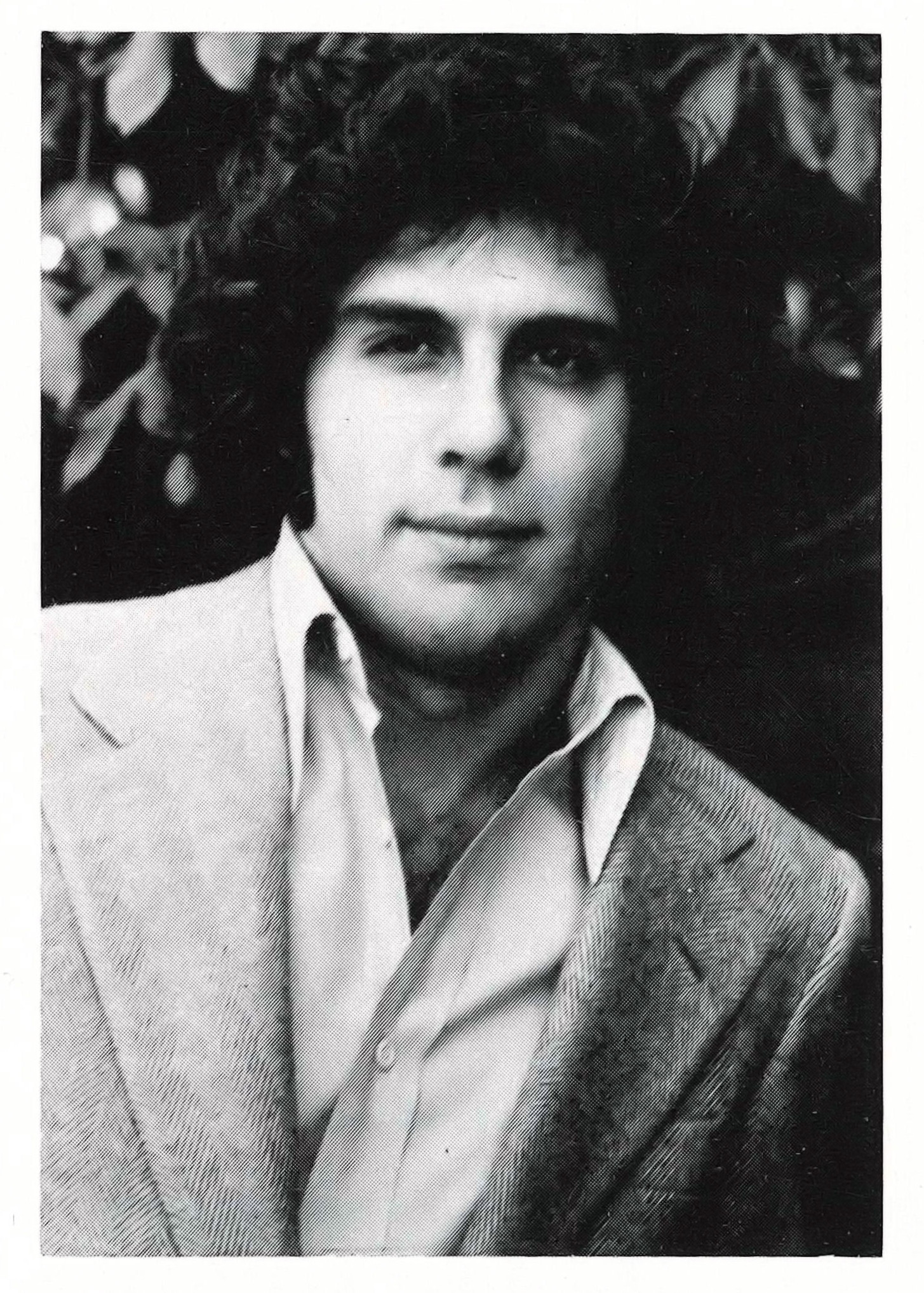
Last week, Ray Caviano passed away at the age of 75. As is bound to happen with the passage of time, this is happening with unfortunate frequency with disco veterans lately. There are certain people I regret not being more proactive in talking to, and he's one of them.
While looking through my archives, I found this interview with Ray from the March 1980 issue of Christopher Street Magazine. At the top of the issue, they called him "the wizard of the disco industry," and he was undoubtedly at a high point in his career by this time having just established his RFC Records label with Warner Brothers. It's an interesting discussion about how he got where he was, and where disco might be going at the time. Speaking of Christopher Street, I should also mention at a time when few major corporations would advertise with gay magazines, one of their biggest advertisers in the late 1970s was T.K. Records. As T.K.'s man in New York for much of that time, I'd imagine Caviano would have had a lot to do with that.
Whether you know who he was or not as one of the most influential promoters in US disco business, he was directly or indirectly responsible for popularizing countless signature disco hits. On TK Records he would promote hit singles by K.C. & The Sunshine Band, George McCrae, Peter Brown and The Ritchie Family. He was also instrumental in picking up more Euro-disco sounds for the label, like Voyage, Amant and Boris Midney. Later, he would promote singles as varied as Yoko Ono's "Walking On Thin Ice," to "Cherchez la Femme" by Dr. Buzzard's Original Savannah Band, Vicki Sue Robinson's "Turn The Beat Around," to ruffling feathers at Warner Brothers' rock department by successfully promoting Rod Stewart's "Da Ya Think I'm Sexy" as a disco single, to name a few highlights. While his imprint is all over disco; as this interview details, his history goes back well before - having worked for Jann Wenner at Rolling Stone magazine and also having promoted Wendy Carlos' landmark Switched-on Bach album in the late 60s.
As a young, handsome and ambitious gay man in 1970s New York City, he was uniquely positioned to promote disco in the places where it really mattered. A high school drop-out, he nevertheless rose through through the ranks of the music business both as an independent promoter and at labels like London Records, then T.K. Records. He was not even 30 when Mo Ostin, chairman of Warner Bros. snapped him up. There he would start Warner's dance department and as part of the deal, would be given his own label RFC Records, where he would sign Change and Gino Soccio. At the time, he was the youngest label president in Warner Brothers' history.
Unfortunately, things would go down-hill in rather dramatic fashion by the mid 80s. He was even the subject of a 1986 Village Voice cover story detailing his downfall. The story called Caviano the "kingpin of disco" who had gone from making a reported 6-million a year to forging cheques and stealing to support a supposed $500-a week drug habit, which would eventually land him in jail.
During much of this time, his twin brother Bob Caviano was also a major player in the music business as a booking agent and a manager for Grace Jones and The Village People. Bob Caviano would found LifeBeat before succumbing to AIDS complications in 1992. Ray Caviano had also faded from view during that period; so much so, many assumed he had also passed around that time. In 2013, he would be interviewed for a Waxpoetics piece on Gino Soccio by Jered Stuffco (AKA Jex Opolis) who tracked him down working as an addictions counsellor.
In recent years, Caviano had been suffering from kidney problems, and yet he had continued to promote music right up until his passing. He had been a prolific poster on Facebook, particularly on his History of Dance Music Page.
I'll post links to some good interviews with Caviano at the bottom of the post, which detail more of his history. But for now, enjoy this piece from the archives, documenting one of the most influential disco promoters, riding high at the top of his game, as one of the most powerful gay men in the business.
______________________________________________________________________________
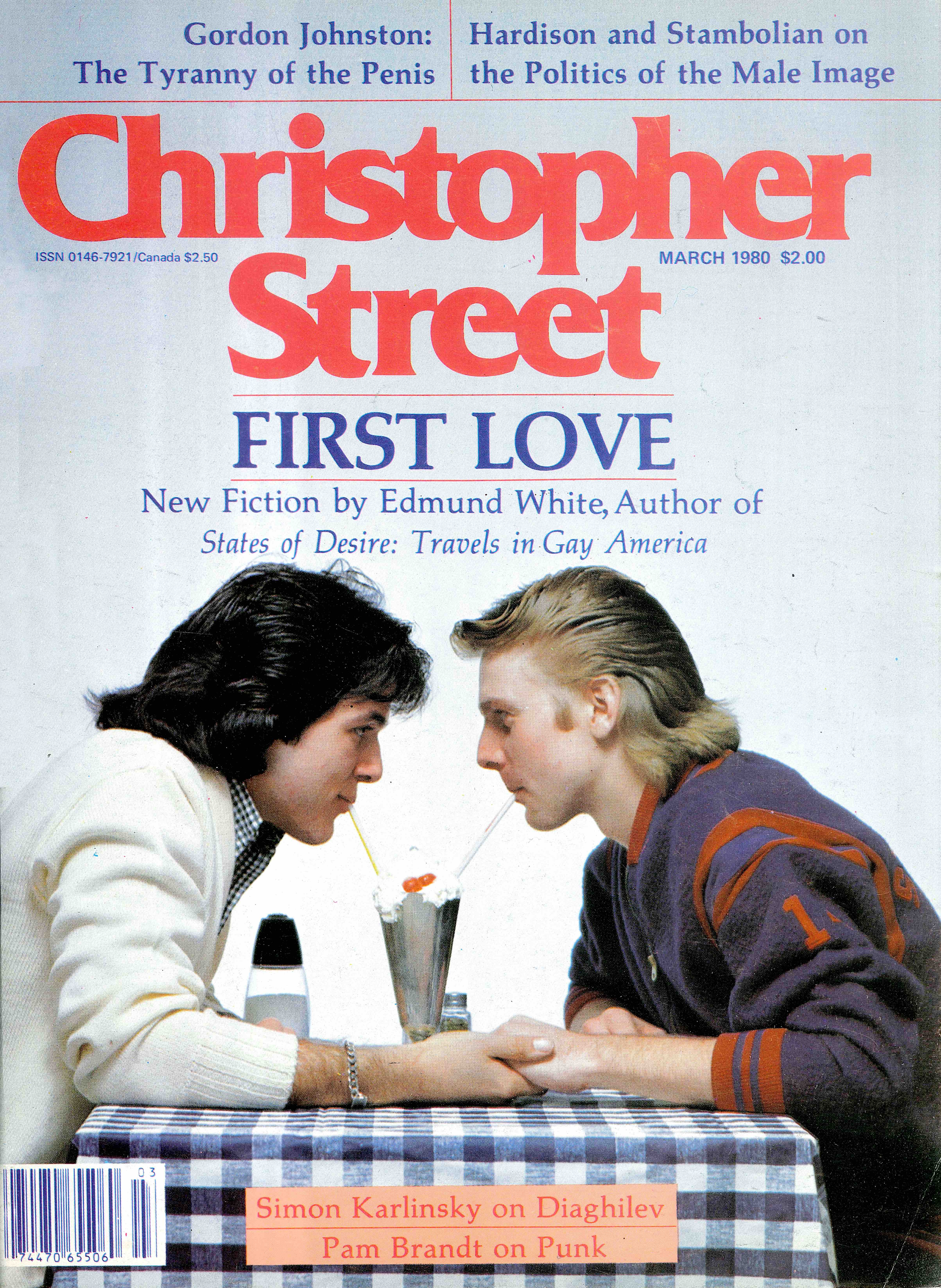
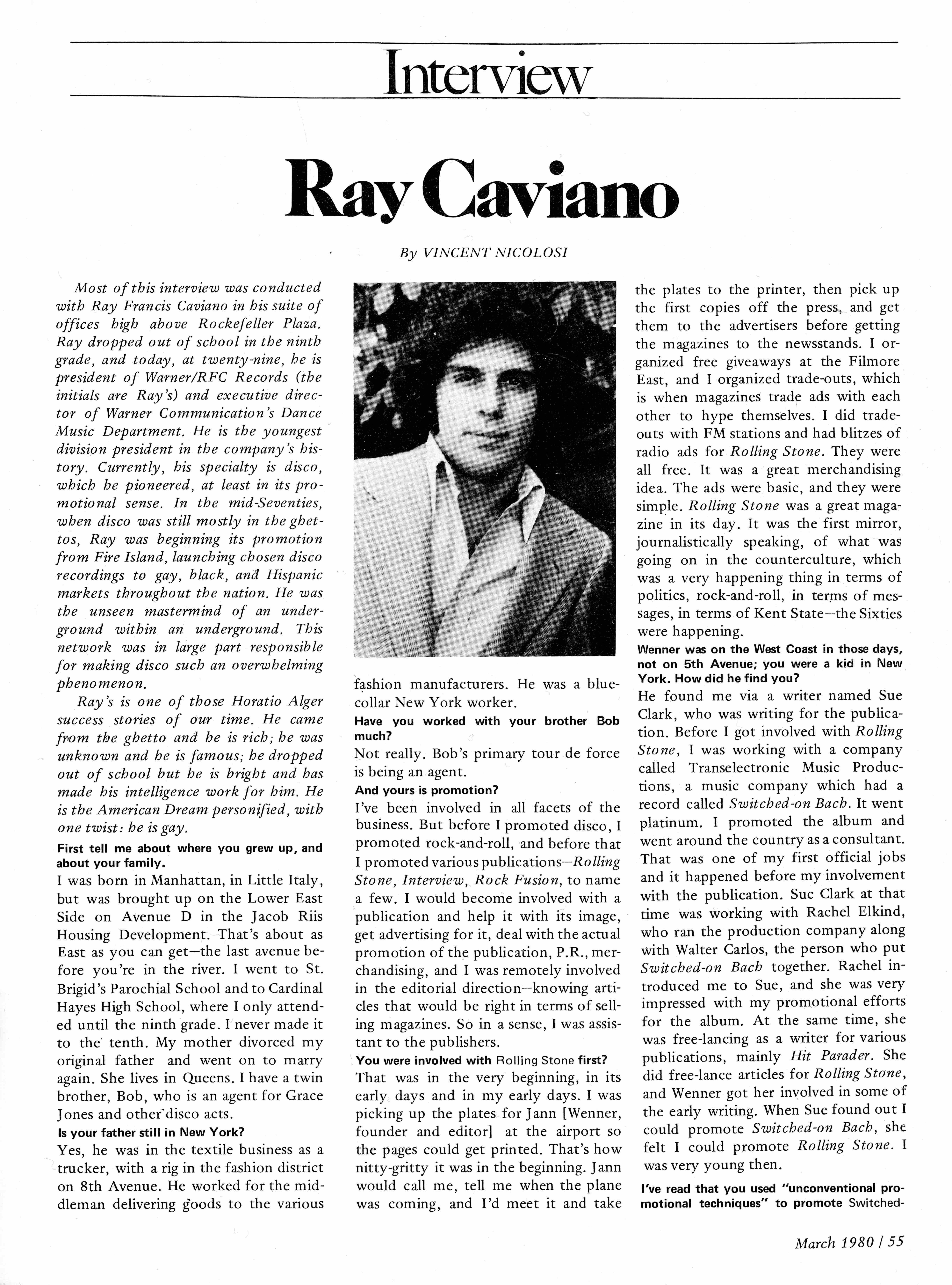
Interview: Ray Caviano
by Vincent Nicolosi
Most of this interview was conducted with Ray Francis Caviano in his suite of offices high above Rockefeller Plaza. Ray dropped out of school in the ninth grade, and today, at twenty-nine, he is the president of Warner/RFC Records (the initials are Ray’s) and executive director of Warner Communications’ Dance Music Department. He is the youngest division president in the company’s history. Currently, his specialty is disco, which he pioneered, at least in its promotional sense. In the mid-Seventies, when disco was still mostly in the ghettos, Ray was beginning its promotion from Fire Island, launching chosen disco recordings to gay, black and Hispanic markets throughout the nation. He was the unseen mastermind of an underground within an underground. This network was in large part responsible for making disco such an overwhelming phenomenon. Ray’s is one of those Horatio Alger success stories of our time. He came from the ghetto and he is rich; he was unknown and he is famous; he dropped out of school but he is bright and has made his intelligence work for him. He is the American Dream personified, with one twist: he is gay.
First tell me about where you grew up, and about your family.
I was born in Manhattan, in Little Italy, but was brought up on the Lower East Side on Avenue D in the Jacob Riis Housing Development. That’s about as East as you can get—the last avenue before you’re in the river. I went to St. Brigid’s Parochial School and to Cardinal Hayes High School, where I only attended until the ninth grade. I never made it to the tenth. My mother divorced my original father and went on to marry again. I have a twin brother, Bob, who is an agent for Grace Jones and other disco acts.
Is your father still in New York?
Yes, he was in the textile business as a trucker, with a rig in the fashion district on 8th Avenue. He worked for the middleman delivering goods to the various fashion manufacturers. He was a blue-collar New York worker.
Have you worked with your brother Bob much?
Not really. Bob’s primary tour de force is being an agent.
And yours is promotion?
I’ve been involved in all facets of the business. But before I promoted disco, I promoted rock-and-roll, and before that I promoted various publications—Rolling Stone, Interview, Rock Fusion, to name a few. I would become involved with a publication and help it deal with its image, get advertising for it, deal with the actual promotion of the publication, P.R., merchandising, and I was remotely involved in the editorial direction—knowing articles that would be right in terms of selling magazines. So in a sense, I was assistant to the publishers.
You were involved with Rolling Stone first?
That was in the very beginning, in its early days and in my early days. I was picking up the plates for Jann [Wenner, founder and editor] at the airport so the pages would get printed. That’s how nitty-gritty it was in the beginning. Jann would call me, tell me when the plane was coming, and I’d meet it and take the plates to the printer, then pick up the first copies off the press, and get them to the advertisers before getting the magazines to the newsstands. I organized free giveaways at the Filmore East, and I organized trade-outs, which is when magazines trade ads with each other so hype themselves. I did trade-outs with FM stations and had blitzes of radio ads for Rolling Stone. They were all free. It was a great merchandising idea. The ads were basic, and they were simple. Rolling Stone was a great magazine in its day. It was the first mirror, journalistically speaking, of what was going on in the counterculture, which was a very happening thing in terms of politics, rock-and-roll, in terms of messages, in terms of Kent State—the Sixties were happening.
Wenner was on the West Coast in those days, not on 5th Avenue; you were a kid in. New York. How did he find you?
He found me via a writer named Sue Clark, who was writing for the publication. Before I got involved with Rolling Stone, I was working with a company called Transelectronic Music Productions, a music company which had a record called Switched-on Bach. It went platinum. I promoted the album and went around the country as a consultant. That was one of my first official jobs and it happened before my involvement with the publication. Sue Clark at that time was working with Rachel Elkind, who ran the production company along with Walter Carlos, the person who put Switched-on Bach together. Rachel introduced me to Sue, and she was very impressed with my promotional efforts for the album. At the same time, she was free-lancing as a writer for various publications, mainly Hit Parader. She did free-lance articles for Rolling Stone, and Wenner got her involved in some of the early writing. When Sue found out I could promote Switched-on Bach, she felt I could promote Rolling Stone. I was very young then.
I’ve read that you used “unconventional promotional techniques” to promote Switched-on Bach. What is meant by “unconventional”?
It was unconventional in that Switched-on Bach is a classical album which I promoted to FM rock stations, and it worked. Therefore, that record became more than just a classical record. The album today, as I understand, is platinum. How many classical albums do you know that have gone platinum?
You also did promotion in Thompson [my note: Tomkins?] Square Park?
I got involved in free concerts in the park and helped organize concerts for Blues Project and Country Joe and the Fish. These were Sixties rock bands that came out of the consciousness of what was happening on the Lower East Side, the East Village, and the Fillmore East. I was going to the parks department, working with management, just putting everything together. Both of those groups went on to become big progressive rock bands of the Sixties. They were a cult consciousness, Timothy Leary, East Village kind of thing.
You were deeply involved in the Sixties for being so young.
Well, obviously if I didn’t finish high school then I had to get involved on a nitty-gritty level. I was reading Billboard every issue in the eighth grade.
Did you make it to Woodstock?
Yes, I went to Woodstock, to Strawberry Fields in Canada, and to Powder Ridge in Connecticut, which never happened as a festival, but Melanie performed for free. I went through that whole thorough introspective look at the counterculture, subjectively and objectively. In my head I was looking at the whole thing, saying, “What’s going on? What are these people doing? What are they saying? Where are they heading? They’re going to get older and where are they going to be?”
Are you much different from who you were in the Sixties?
Well, back then I had long hair and wore horned-rimmed glasses. Now my hair is shorter and I wear contact lenses.
But even though you’ve been deeply involved in what’s happening now, would you still consider yourself a product of the previous decade, a survivor, so to speak? Or are you in fact a man of the Seventies who sojourned in the Sixties?
What I am is a person of the Fifties television boom. I was brought up by television in the Fifties. It was future shock at its best, taking advantage of living in New York, survival in that sense. It was not having things and having to fight for them. Before I did these other things I worked in a grocery store, I delivered things for a cleaner, delivered newspapers, and worked in a newsstand, and worked in a lawyer’s office. I’ve always been into a work ethic, even at an early age. This ethic was coupled with the energy and the desire to go a step further with what was happening around me; being aware, and using that awareness in a media sense, in a McLuhan sense. Being aware of future shock, aware that things are changing and that we can be a product of those times. It all fits into America right now, which is jigsaw at the moment, because of our capitalistic society, and the things we’re locked into. So I’m out of the Fifties from television, into the Sixties and here I am alive and well in the Seventies. It’s a whole other trip, simply because I lived in three distinct decades, all having distinct implications, and all bringing different social changes.
On the topic of decades, let’s turn to disco. Where do you see it in the Eighties?
Well, I see disco in the Eighties just being involved as it’s been in the Seventies, as rock has been involved in the Seventies. Rock is bigger than ever in a sense, in a remote sense, but still it’s there and very much relevant and I think disco is doing that. I just think we need to get into the music a little bit more and understand how it’s changing, and how it’s evolving, and how people are looking for different things. At the same time, a lot of it is contingent upon what is happening in our time and what statements are being made through music, as disco moves to address itself more to the spirit and still to the dance floor. Essentially, it is dance music. So it was always have tempo and rhythm, but I think it can also appeal in a more sophisticated, full-sounding, lyrically better-structured way, giving us more interesting kinds of records, records which take time out to tell a story, or reveal more emotion and apply their lyrics to things which speak more to overall life, but are made in the context of celebration. That’s what disco—dance music—is. It’s party. It’s good times. It’s escaping. You can sell these messages in the context that’s a blending of a lot of things going on in disco: the homogenization of music, like the rock artists who are using disco. There is a fusion in a sense, one has to look at the ingredients from other areas, and how it can be interwoven. “Hot Stuff,” the new single by Donna Summer, has a guitar break like one from any rock album you’ve ever heard.
Do you think rock is burning out? Do you think one, either rock or disco, will absorb, nullify, or diminish the other?
No, rock is not burning out, not that I see. I see a stabilization between the musical forces now developing, that fusion element.
Do you think words or lyrics will become more important in disco?
They’re already taking on a new importance. Gino Soccio is one example. He wrote his album, Outline, produced, and arranged it. One of his strengths is in his lyrics.
When your label was first formed, you mentioned that development of the artist would be an important part of Warner/RFC. What does artist development entail?
That entails different things. First, it’s simply spending money, developing the artist’s public image. Other than people here at Warner/RFC, we have publicists from outside who arrange interviews with the press and radio, and produce printed advertisements and so forth, to tell the public just who an artist like Gino Soccio is. Beyond the public awareness thing, artist development comes to a personal thing as well—me sitting down, say, with Gino and creating the vibe and an aura that I’ve got with him. It’s a confidence thing. He’s got such a good feeling about Warner/RFC and that gives him a certain security, whereby it enhances his artistic sense, where by he produces. It’s the domino theory of success. I show him that he is a star, that he is hot, that he can produce, that he is being taken care of. He just has to write hit songs. There’s a science in what Gino does, and there’s a science in what I do, and of course there’s an art as well. I pick up where he leaves off, and he leaves off by giving me hit product and I give him hit results. It’s that kind of optimum, as basic and as academic as it sounds.
There’s a lot published about you lately and much mention made off you being gay. Is it an important thing in your life?
It’s not any more important than anything else. The most important thing to me is disco. Period. Paragraph. I’m not using my job in any way to promote gay consciousness. That would be another distinct responsibility. I don’t have time for it. I’m into promoting artists and making hit records. I can talk about the gay market and the fact that gays buy disco records, and again I can look at it from a business point of view. I’m not going to use my position at Warner Brothers to wave a flag and promote gay political power. It’s apples and oranges. If I were to leave Warner Brothers and go out and promote gay consciousness, then that’s a full-time job, and I’d want to achieve very high goals in that arena. I’m promoting records and that’s another whole area. You don’t want to go around the music industry saying this is a gay disco record You want to say this is a hit record. I don’t want to put the onus on one ethical [sic] minority, saying these are the people behind me. I think this would be a very stupid approach. Business is my first priority. My gay life is more of a… of a…
Private life?
No, I don’t know if it’s private as much—I’m not hiding the fact that I’m gay. I’m just not exploiting the fact that I’m gay.
Has being gay had any kind of influence on your success in the disco world?
It’s been an asset in that I’ve been aware of a market that is very sensitive and into disco music People at the record companies know what gay people do in terms of breaking records, not just people at Warner Brothers. Black people play a very influential role, and Spanish people. When you take a place like New York City and add up the gays blacks and Hispanics, you haven’t got a minority any more, you’ve got a majority. If you find a black gay person, you find someone who is even more sensitized. You follow what I mean? The Paradise Garage typifies that. It’s one of the best discos in America, in my opinion. It’s a coming together of all sensibilities and sensitivities, from black and white and gay and straight. It’s a melting pot of music. You can go to some of those other clubs and they’re stereotyped in their sound, based upon who they’re playing to. At the Paradise Garage, programming is the most important thing. It’s what you play that’s important, not just how you play it.
What is it and, in the beginning, what was it that gay culture found so pleasing, so attractive?
It was an environment where birds of a feather could flock together. It provided an environment where people could socially come together and be together. You also must look at it financially. Gays have large discretionary incomes—no families—and leisure time. They can stay out late and they don’t have to worry about getting the kids to school in the morning or whatever. It’s that kind of reality. It’s a more conducive environment for the gay life style. Also, they didn’t stop at disco. Ballet. Publishing. I’m not going to reveal who they are, but I know umpteen people in the music business as agents, managers, promotional people, et cetera. It’s common knowledge that ninety-five per cent of the people who run the national disco promotion departments of the record companies are gay. That’s the reality of it. You have to understand, I’m not trying to convince people to be gay. People who are heterosexual and are happy, that’s great. I think it’s great when people are gay and happy, too. I’m not into this philosophy of selling gay as bring where it’s at. When I tell you that gay clubs are influential with disco music, then if I were straight, I’d be telling you the same thing. Again, I want you to interpret this information in the guise of objectivity. That’s important. It so happens to be coincidental that I’m gay, and that the hottest clubs are gay, as are the trend-setting clubs which break records. I’m interested in clubs that break records. It’s great to have other clubs that play my hits, but I’m going to go first to the guy who will put my record on first and take a shot, because it’s very competitive. Those slubs are the gay clubs and the black clubs. The clubs in suburbia play the hits after they’re established in New York for a long time. As I say, it’s coincidental that I’m gay and that the gay disco power exists the way it does.
In America, there are many different cultures involved in disco, and there have been for some time. You mention the gays, blacks and Hispanics. Do you think disco has helped put aside any ethnic barriers?
It has its obvious ethnic appeal, but I think one has to look at the growth in the importance of black music in our society, and the value of the black artist in our society. It’s something that I appreciate, and I think has merits on its level, just as rock-and-roll has its merits. One can’t put a limitation on the potential of what black people have to offer—or Hispanic, for that matter—in terms of their influence on American contemporary music. I’m not worried about the fact that middle America influences what mass appeal wants. What might concern me more is the scale the other way around.
But why is it that something so ethnic has caught on in such a national way, crossing cultural boundaries?
I think people are tired of pretension in music. And the ethnic appeal in disco bas a very … I don’t know how to describe it … It adds a very earthy kind of perspective to the music. It just breaks away the boundaries and gets to the core that much more quickly. There’s something more soul-raising about soul music or disco music in terms of statement, and the influence of it. One has to look at the blues, at people like Sarah Vaughan, Dinah Washington and Billie Holliday and what they did and had to offer that was so noticed. It was artistic and had things going for it in terms of the statements the artists were making, but it lacked the mass appeal. I think now we’ve loosened up the reigns in the sense of allowing the black artist or the black disco style artist to explore the other possibilities musically. I think we’ve really played out this rock-and-roll thing to the hilt. We’ve hit every riff and we’ve heard every statement, for a minute. I think disco offers an opportunity for people to hear new feelings about themselves and about their lives, in a way that rock doesn’t offer. There’s a disco record now called “Born to be Alive.” Now, that’s a very simple statement, but if people can have the attitude that they’re happy to be alive, and that they can enjoy their jobs and life style, and have a positive outlook on life, then what other statement needs to be said in an older way? The Billie Hollidays of the world had great statements to make, but America wasn’t essentially ready to hear. I think also that being in a disco is like being in a church. It’s like a tribal ceremony. You have the ultimate kinship going on out on the dance floor that seems to be very appealing because you have the human element in disco where you’re dancing on the dance floor and connecting in a sense with your partner. In a sense when the whole floor is on, when they’re up, you can feel that, and in a sense the DJ is putting that all together and you’re connecting with him. There’s such an interaction. Do you see what I mean?
I see the kinship, but I see more of a self-indulgence as well
Well, I don’t know … I mean, this is America. Let’s be realistic. We have these options to be self-indulgent; we have a right to be. It’s the society we live in. In Russia, they’re talking about selling Elton John’s records because he went down as such a hit. I mean, this is America. It didn’t stop people from doing the ultimate rock experience in the Sixties by going to listen to the Grateful Dead and sitting in the sixth row and taking LSD and thinking Jerry Garcia was doing such a special thing with his guitar or certain other rock groups which I can identify with very heavily—Jimi Hendrix or Janis Joplin. I mean, people took these people very seriously. There was such an aura built up around those artists. And Mick Jagger—isn’t he self-indulgent? If we’re going to talk morals, then…
I’m talking about a generational thing—the criticism of prevalent narcissism in the decade as a whole, and disco being the ultimate expression of that.
I think people have stimulated their minds and they know what they want now. I think they want to escape the routine, now that they have their responsibilities down. They merely want to enjoy the off-moments. If they can’t enjoy the off-moments, then why should they enjoy the moments when they’re giving and working, being so-called “responsible citizens”? I would think that most of the people who go to discos are responsible citizens. I think the disco community is a responsible contributory one as a whole—if we’re going to speak in a general sense.
I understand that disco is now a prevalent part of European culture also. It would seem that disco might be the perfect opportunity for non-English speaking artists to have, for the first time, a national hit in America. There were never really any such artists who made it in rock, or folk before that. Do you think we’ll see a trend of European groups making it in America?
Yes, for example, Voyage is from Europe, and so is Don Ray, but they sing in English. They want to hear English on the other side. You know, disco is a great international music thing. What appeals in Paris, appeals in San Francisco, appeals in Rio. And they want English, for the most part. The Italians and the Parisians have been way ahead of us in terms of dance. They may not be as intense as we are now. Americans have a way of picking something up and engulfing it, making it much more intense, more than anyone else can. It’s because of the extremes in our society. But Europeans have been into disco for quite some time.
So, what’s next in your career? Ever thing you’ll produce or direct any movies?
I don’t know. I’m still very young. Once this machine starts running as I’ve orchestrated it, I think I’ll be able to see exactly what the next step is. I’m one of those individuals who likes to find new challenges so that I’m not hung up with the success of a stereotype of one thing. Once I have a groove going, it’s better that I say, “Well, it’s time, on to the next thing.” ■
_________________________________________
Vincent Nicolosi is a free-lance writer who divides his time between Vermont and New York City.
______________________________________________________________________________
PREVIOUS RELATED ENTRIES:
gino soccio speaks (wednesday may 29, 2013)
vince aletti's disco files (wednesday february 4, 2019)
LINKS:
facebook: john luongo - ray caviano RIP (september 29, 2026)
red bull music academy: the rise and fall of ray caviano and rfc records (by jered stuffco) (december 3, 2014)
good timin records: gino soccio was the one-man band behind countless disco gems—until he vanished (by jered stuffco) (may 31, 2013)
village voice archives: lost in music: an oral history of disco (by vince aletti) (july 20, 2020 - originally published summer 1995)
the heartbeat of the dancefloor - episode 008: ray caviano interviewed by marsha stern
yes she did - episode 13: RFC on YSD
facebook: the history of dance music hosted by ray caviano rfc
CATEGORIES: VINTAGE ARTICLES

